
Why do we study a Muon Collider if we have the FCC?

15 DECEMBER, 2023 | By Roberto Losito
The 2020 update of the European Strategy for Particle physics clearly identified as highest priority, after the full exploitation of the HL-LHC, the construction of a Higgs factory in order to study in detail the Higgs boson(s). At the same time, it recommended to pursue, at a lower priority, R&D to address the many challenges to be faced to build and operate a Muon Collider at an energy of 10 TeV or above.
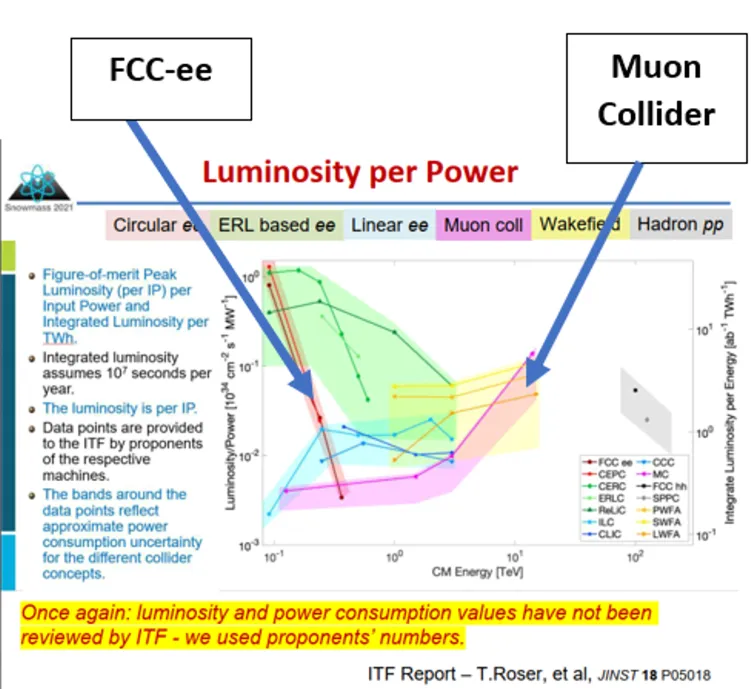
Muons are leptons, elementary particles such as the electron. When they collide, all their energy is available for the collision, contrary to hadrons, where the energy of the particle is divided into its components (quarks). It can therefore be more efficient. A diagram that shows Luminosity vs Energy used to produce it would see the muon collider rapidly gaining the lead above an energy of about 3 TeV in the center of mass:
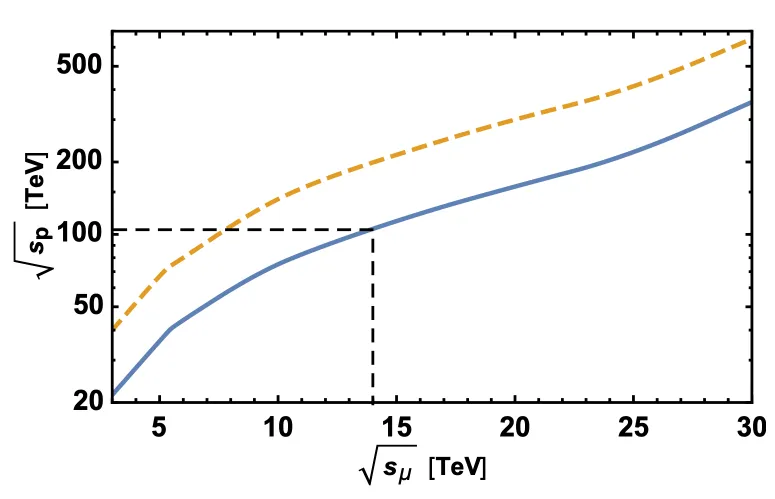
Also, since the energy of the particles (muons) is all available for the collision, the physics produced by a 10 TeV Muon Collider is in several cases equivalent to the one that can be studied in 100 TeV hadron collider:
In exchange of these advantages, there are a number of difficulties in building a muon collider complex that need an intense R&D programme to assess the real feasibility of such a machine.
In brief:
- Muon have a very short half-life (2 µsec) in the laboratory frame and therefore any acceleration scheme need to be very fast and efficient not to lose too many particles on the way
- the efficiency of the production process of muons (shooting protons on a target) is very low. One need therefore multi-MW (>2) beams to produce enough muons to have a reasonable luminosity.
- Because of the production process, the muon beam coming from the decay of secondary pions has a very large emittance. The 6D beam emittance needs to be reduced by at least 5 orders of magnitude before acceleration and collision.
- The mechanism explored to reduce the emittance is ionisation cooling. The muon beam passes through several cells made of an absorber (ideally liquid Hydrogen) to reduce transverse and longitudinal momentum and reaccelerated to give back longitudinal momentum. All is done in intense solenoidal magnetic field to contain the transverse excursion of particles. This generates field emission and breakdown in RF cavities.
- The beam has ten to be accelerated fastly up to 1.5 or 5 TeV (depending on the chosen machine). This is done through a series of Energy Recovery Linacs (ERLs) and Rapid Cycling Synchrotrons. While a green field study is being pursued on this layout with no initial constraints on the length of these machines, we are going to investigate whether some of them could be hosted in the SPS and LHC tunnels, saving therefore a significant amount of work, cost, CO2.
- Power requirements are for the moment huge (fast acceleration = lot of energy in a short period of time…) and we are working on trade-offs that will allow to reduce the power requirements
- Once accelerated, beams will be injected in the collider and stay there as long as possible. After a few turns muons will start decaying generating neutrinos and electrons/positrons. The latter will generate a large background in the experiments and dose to the machine components, the former (neutrinos) will travel through the earth and though weakly interacting with it, their number will be so high that a non negligable level of radiation might arise on surface, at distance from the accelerator site. This is called “Neutrino Radiation”.
CERN is hosting and leading the International Muon Collider Collaboration, with more than 50 Institutes participating, to address all those challenges. The work is based on the advances already done by the Muon Accelerator Program (MAP) that was active in the US until 2016. The MAP programme proposed for instance a viable scheme for ionisation cooling and provided some test of RF cavities in high magnetic field, showing that there are solutions to some of the main problems. The IMCC will start from those results and extend to other parts of the complex, taking also into account technological development that happened since 2016.
For instance, thanks to the push given by the fusion community, High Temperature Superconductors are today available in sufficiently large scale to be used for such a facility. HTS (for instance REBCO) not only consume less energy (for a magnet at 2 K and at 20 K there might be a factor 10 of difference in power consumption) but allow to more easily achieve large magnetic fields (designing a 60T magnet is no more considered unfeasible).
The IMCC collaboration is seeking funds to construct a demonstrator facility to generate a muon beam and cool it in 6D. The MICE experiment in the UK demonstrated the principle, but only in 4D. The cost of such Demonstrator facility is of the order between 100 MCHF and 200 MCHF (depending on the scope), and several sites are possible (CERN, ESS, Fermilab…).
The difficulties of fast acceleration and Neutrino radiation reflect in heavy constraints on the design of Detectors and of Machine/Detector Interface. BE-EA will certainly have its role once a technical design will be started.