
Sur le chemin d’un nouveau système de lecture de position pour les collimateurs – NA-CONS

21 DECEMBER,2021 | By Antonio Alonso, Ramon Folch, Yannis and the NA-CONS team
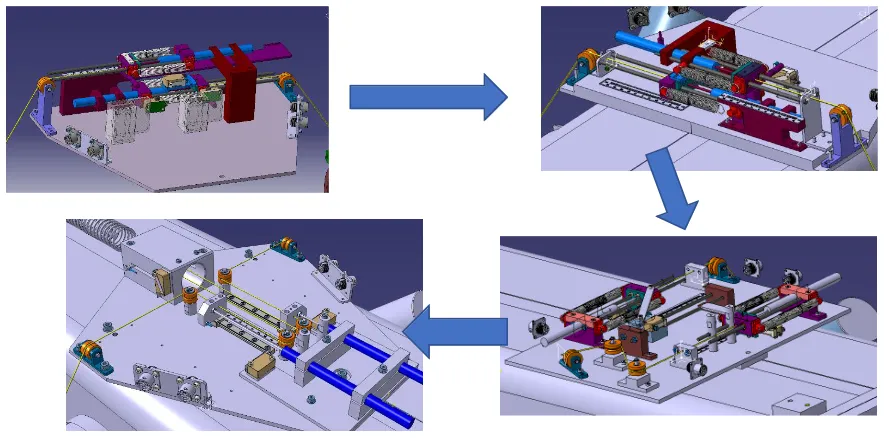
Le collimateur deux blocs possède un système mécanique pour déterminer la position des mâchoires situées à l’intérieur. Grâce à une bande métallique et des potentiomètres, il est possible de connaître la position exacte de chaque mâchoire. Malheureusement ce système est très ancien et pose des problèmes de fiabilité pour l’opération. La maintenance est de plus en plus difficile et le montage est complexe et délicat (environ 4h). Le but de ce projet est donc de revoir ce système pour le rendre plus facile à monter tout en assurant une bonne maintenabilité et un niveau de qualité similaire. Sylvain et Yannis ont réfléchi une année entière pour améliorer le système.
La solution retenue est un système possédant la même cinématique que l’actuel mais avec un câble inox plutôt qu’une bande. Lors du montage du prototype début novembre, un groupe de travail a été formé. Ce groupe multidisciplinaire a réussi en un temps record à identifier tous les points faibles de la solution et a proposé des améliorations en une version fonctionnelle. La plupart des membres du groupe de travail connaissaient peu le fonctionnement de ce collimateur. Et c’est grâce à ce regard naïf et nouveau que nous avons pu trouver des solutions pertinentes et challenger l’existant. En l’espace de seulement 3 semaines, nous sommes passé d’un prototype en imprimante 3D à un prototype réel qui est en cours d’optimisation.
D’ici janvier, la solution choisie sera mise sur banc de test pour vérifier la fiabilité. Et si tous les voyants sont au vert, elle sera prête à être implantée sur tous les collimateurs disponibles courant printemps 2022. Concernant le résultat, à première vue c’est réussi puisque les monteurs ont pu assembler le prototype beaucoup plus rapidement que la solution à bande et sont ravis de la simplicité du montage ! Il faut retenir de ce projet l’excellente alchimie que nous avons eue ces dernières semaines au sein de ce groupe de travail. Le fait de réfléchir tous pour le même but, sur la même longueur d’onde et le même enthousiasme a accéléré le projet d’une manière considérable.
Unravelling the secrets of the XCRHV Micro-Collimator
In the context of the North Area Consolidation, several old equipment in the beamlines will be fixed and renovated, including the famous XCRHV micro-collimator. The XCRHV micro-collimator is used in the secondary beams of the SPS experimental areas. Used in "micro beam" mode, his function is to attenuate a beam of protons to allow only a small number to pass. This is made by the use two sets of 2 collimator jaws, that allows to narrow the beam gap horizontally and vertically to less than 1 mm. This equipment is unique at CERN, and there are only two units, one installed in the beamline and one remain as a spare, and here lies all the problem, the one on the beamline works properly, but not the spare, this spare was found in a pretty bad shape, covered by years of disregard and oblivion, it seems that in all these years it was used as an “organ donor” for the main XCRHV on the beamline.
Regarding the spare was a dantesque spectacle, thus it was my mission to make the spare great again. At the starting point, no data of the collimator was available, it was not known when it was manufactured, by whom, if the spare was working, what was the failure, no technical specification, no drawings, no manual, no hope. So, it was necessary to do some kind of “Archeological Engineering” to deal with all this missing documentation. I separated this task in two different parts, the onsite and offsite research, for defeating your enemy you first must understand him, so I started to gather all the available information about the collimator in all the possible sources.
As the famous archaeologist Dr. Jones once said “Seventy percent of all archaeology is done in the library” therefore the first step was to ask all the people that may know anything about the XCRHV in the last 40 years, I spoke with more than 20 people trying to get the smallest scrap of data existing, I even spoke with HR and the Pension Fund to try to contact the original members of the project in the 80’s, but unfortunately it was too late. Another source of information were the computer databases, I dig deep into EDMS, dfs and CDD and I was able to find some long-time lost photos and documents that can give us clues about the detailed functionality and history of the device, even better, I was able to find around 100 old drawings of the equipment that some forgotten hero scanned long time ago. But at CERN there is also physical databases, memories of ancient times, where you can find very interesting information; looking for answers I visited the CERN main archive, located in the deeps of the R1 basement, where all the CERN physical documents since the very beginning are stored. Unfortunately for me, all the physical folders of the XCRHV were lost at some point in the past like dust in the wind, I couldn’t find either the original drawings or microfilms, but all this detective research was a partial success, and I was able to get some small but priceless information. Meanwhile the onsite research was taking place, there, with the priceless help of Bruno and Mohammed, we started to clean, identify, and make the autopsy of the old spare XCRHV, to know the cause of failure and by reverse engineering understand how exactly it works.
And so, the adventure continues, we have some theories of the cause of failure that we will test, and we have also found several references of the old moving equipment (motors, joints, bearings…) that will be changed into new ones, also all the electrical system will be renovated. With all of this we will make the Micro-collimator stronger than ever and ready for a new and bright future in the North Area.