
How a facility sets us ‘on fire’

3 DECEMBER, 2023 | By Markus Brugger, Nikolaos Charitonidis, Aboubakr Ebn Rahmoun, Alice Goillot, P. Simon, Vasiliki Stergio
As mentioned in previous Advent stories, HiRadMat was originally conceived in 2009 as a test bench for the Large Hadron Collider (LHC) collimators at a time when ad hoc installations were the baseline for such tests. Management approval and the securing of EU funding in 2010 got the ball rolling for the irradiation facility, and the construction was successfully completed in 2011, now a bit more than 12 years ago. At that time this implied removing the former T1 target of the West Area and the T9 target of West Area Neutrino Facility, still stored further downstream in the area and using specific tools and methodologies developed then and still used today at CERN.
Over the years, HiRadMat has become not only essential for many tests at CERN, but also a key European facility for material testing. It is designed to provide high-intensity, high-momentum pulsed beams to an irradiation area where accelerator components, high-power targets and various other material samples can be tested. Pushing these intensities has brought us to the limits of certain beamline components, leading to a respective upgrade study and programme.
Let’s thus focus today first on a brief general description of this unique facility, as well as then on a particular experiment carried out earlier this year!
HiRadMat, aiming for a large variety of material tests, instrumentation developments, and qualification of targets and beam intercepting devices used at CERN and beyond, from the conception of the facility, strong emphasis was put on offering exceptionally flexible beamline optics. The beam is extracted from the Super Proton Synchrotron (SPS) using the same extraction channel as LHC beam 1, then sent down the TT60 transfer line, from which the HiRadMat primary beamline (TT66) branches off after about 200 metres, offering spot sizes of 0.2–4 mm to the various experiments in a flexible way.
Similarly, and to serve an increasingly large user community, from the beginning, HiRadMat has been part of Transnational Access programmes EuCARD, EuCARD-2, ARIES and more recently EURO-LABS, making the facility accessible to users from all over the world. Today, the facility provides up to 2 x 10¹⁶ protons per year. For the past twelve years, HiRadMat experiments have been pushing the frontiers of beam-to-material knowledge, with around 50 experiments successfully completed.
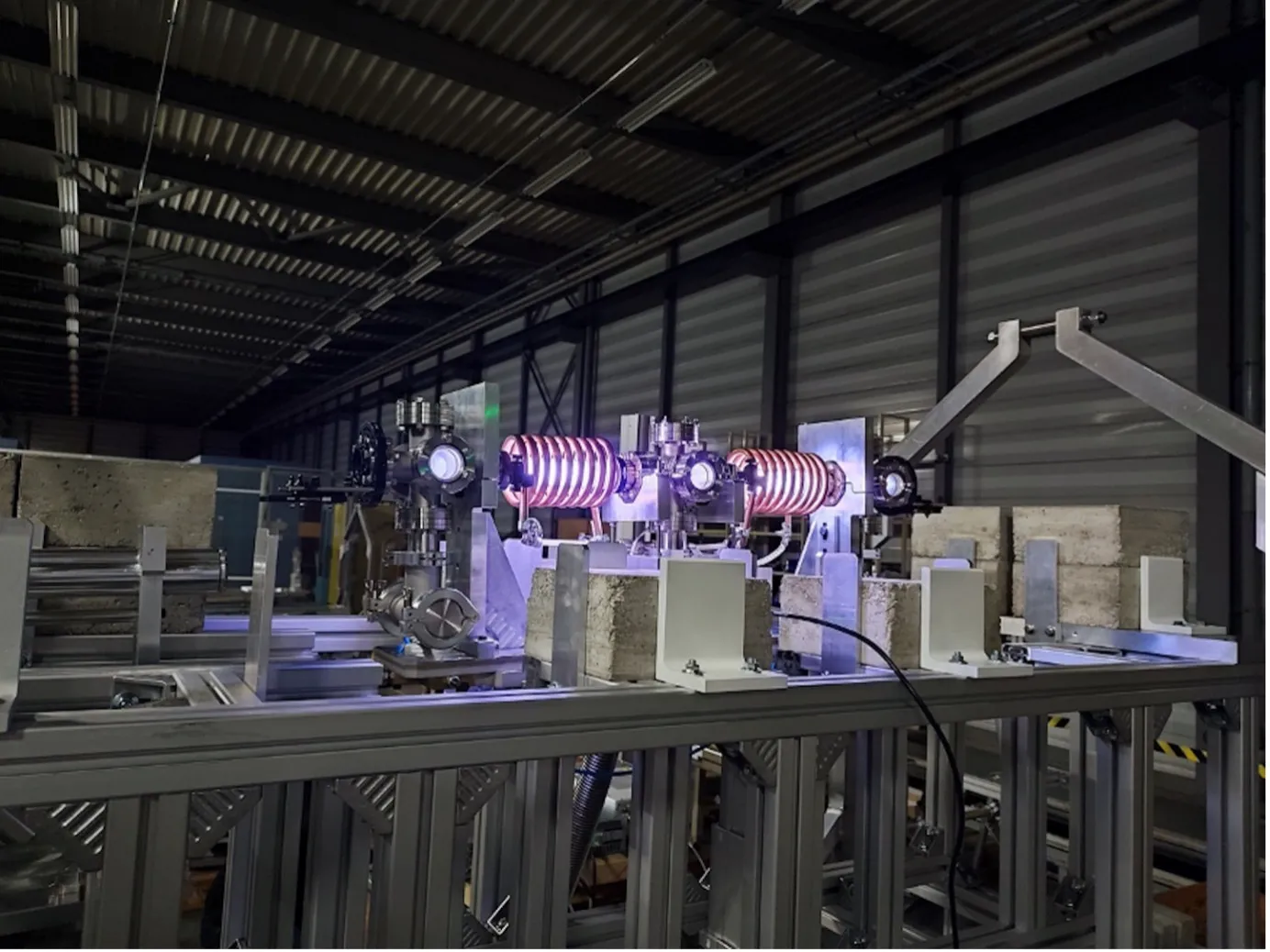
These HiRadMat experiments are evaluated according to scientific criteria by a board of external experts. A particular one was a newly proposed experiment nicknamed “Fireball”, which was carried out earlier this year aiming for new insights into extreme astrophysical phenomena such as gamma-ray bursts. It was designed to study the micro-instabilities of a high-intensity electron-positron beam interacting with low-density plasma. The electron-positron beam is produced when a 440 GeV/c proton beam from the SPS impinges on a special target. The resulting beam then propagates through the plasma and creates a highly unstable system: fluctuations of the magnetic field in the plasma cause charge separation in the beam, and this separation consequently causes further magnetic fluctuations in the plasma. This gives rise to non-linear phenomena and plasma emissions that have never been studied in this way before.
These measurements provide new insights into extreme astrophysical phenomena, in particular blazar jets and gamma-ray bursts (GRBs). GRBs are among the most energetic phenomena in the Universe and, even though they have been observed in distant galaxies, the enormous amount of energy they release can disrupt radio communications on Earth – some theories even suggest that they affected the evolution of life on Earth. However, the fundamental physical processes involved in GRBs are still not understood. HiRadMat has thus enabled the community to perform a first accelerator-driven experiment of this kind, helping to lift the veil on the microphysics processes that are not observable with satellites or ground-based telescopes and are impossible to simulate numerically.
The Fireball setup here at CERN included various instruments designed to study the formation of plasma instabilities and magnetic fields, in particular a custom-made magnetic spectrometer with a dipole magnet. Several of you were involved in the preparative work, but also to power this magnetic spectrometer in a flexible and cost-effective way, ABT, EPC and the HiRadMat team reconfigured the quadrupoles of the beamline, and successfully readjusted the optics.
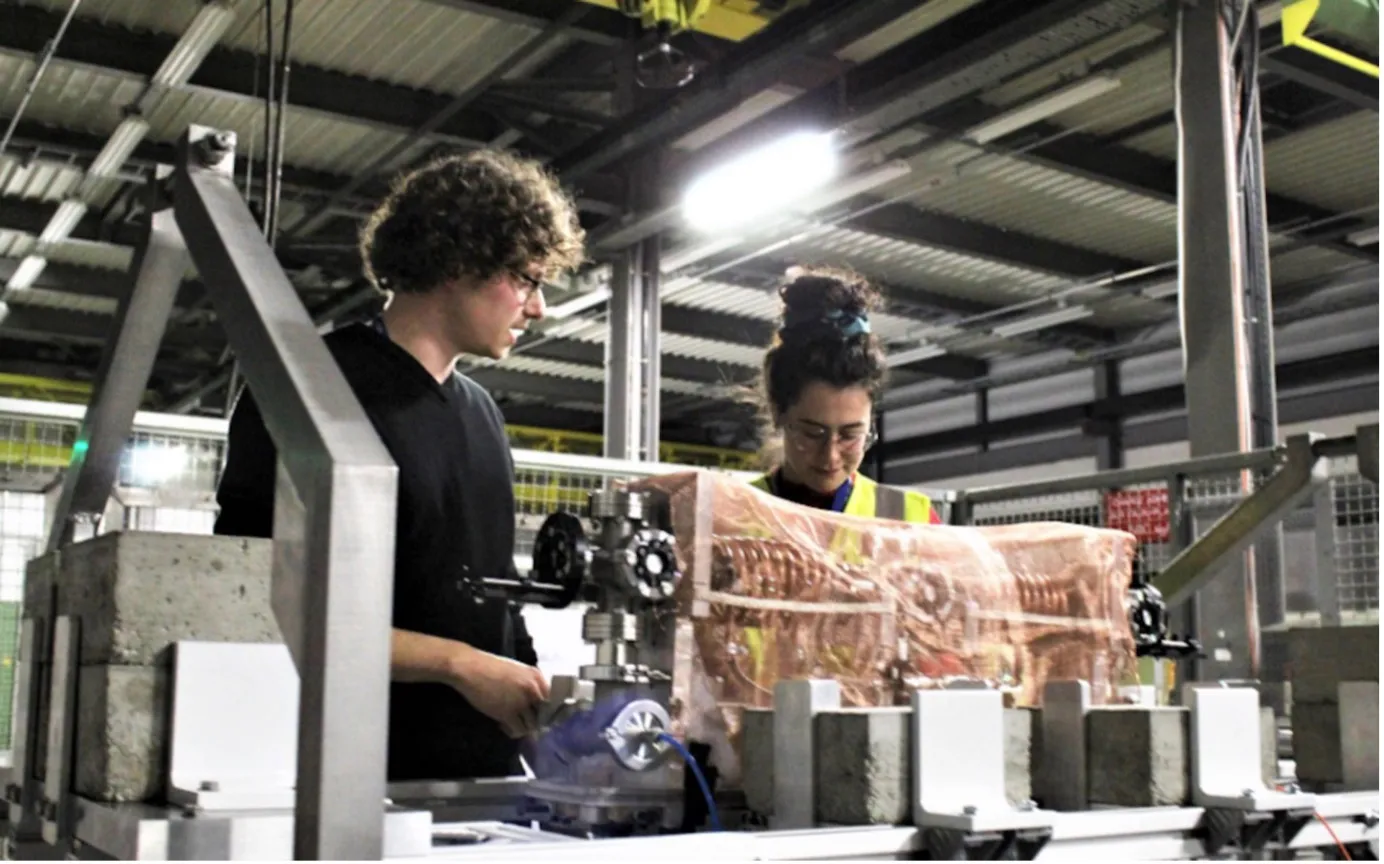
It is this collaboration within CERN, the commitment of the HiRadMat team and the partnership with the collaborations, which is key to implementing all the necessary modifications in terms of beam and infrastructure and leading to a successful measurement. The Fireball collaboration has recently finished their analysis of this years’ run and submitted a respective article to Nature Physics. Their team, technical coordinator and spokesperson have explicitly expressed their gratitude to all involved CERN teams, highlighting in particular the collaborative effort in running this unique facility, illustrated here below with a few pictures.