
Collimators and the RL40 workshop

13 DECEMBER,2020 | By Markus Brugger
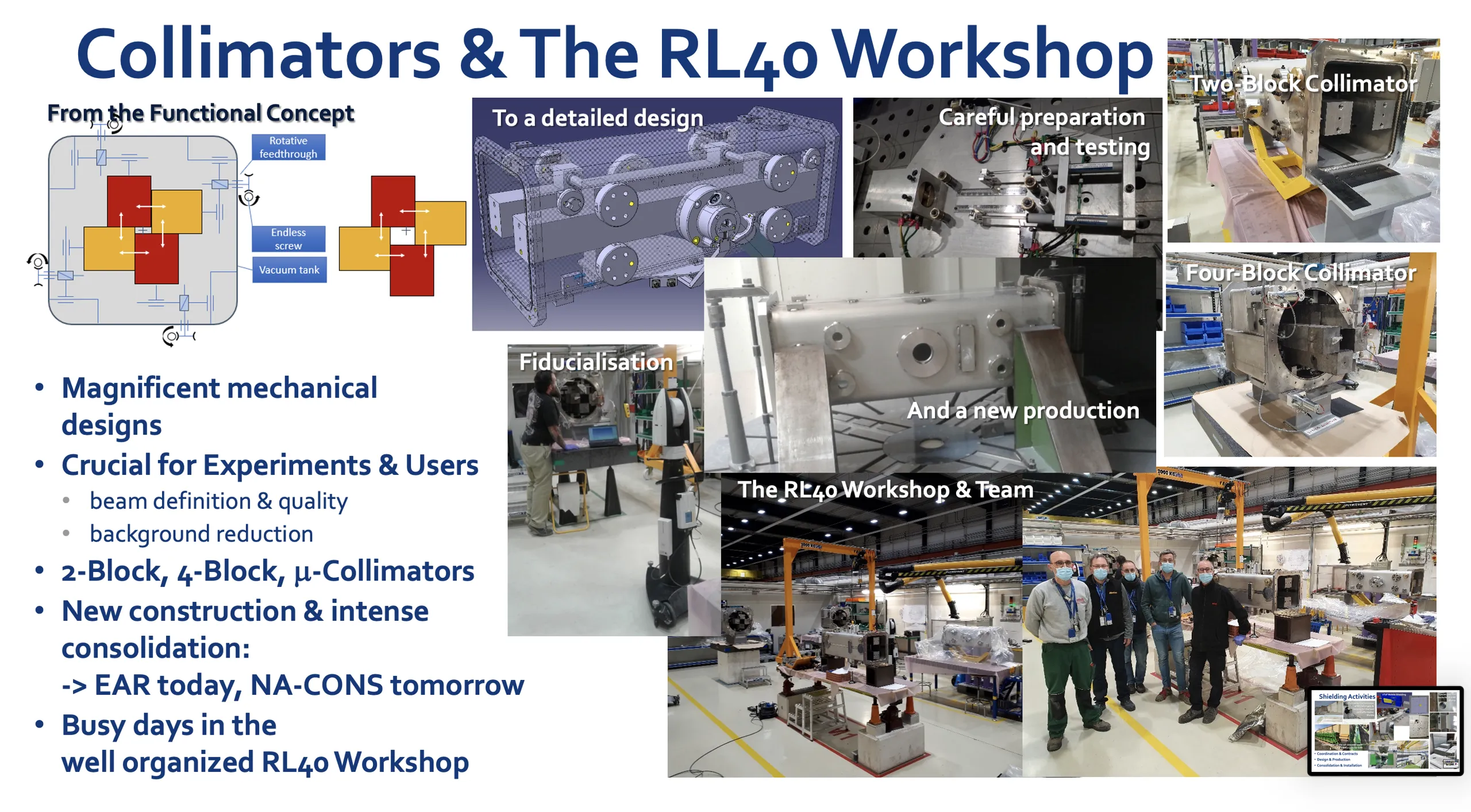
Yesterday having looked at the surrounding shielding structures, today let us continue walking along the East and North Area beamlines where you come across several different beam elements: magnets, beam instrumentation, beam pipes, mechanical supports and regularly also collimators. The latter, not visible from the outside, crucial for beam operation and the eventual physics reach, they are complex objects relying on a robust design, thus I propose having a more detailed look at them together. Collimation is essential in our beamlines for providing high-quality beams and maximum flexibility for their physics exploitation. These collimators are blocks of material with a passage for the beam, adjustable in one or two planes, or not at all. The beam passage in the adjustable collimators is in general rectangular, while the passage in fixed-hole collimators may be of any shape, often round or elliptical. In secondary beamlines, collimators are normally made of heavy materials, iron or heavier, with high stopping power. They are typically about 1 meter long as the nuclear interaction length for iron corresponds to ~18 cm, for copper to ~15 cm and for tungsten to ~10 cm. The collimator thus shapes and reduces the incident particle flux by a factor ranging from 150 for iron to more than 2000 for tungsten. However, at PS/SPS energies, several new charged and neutral particles are produced in an interaction and though many interaction products will be of low momentum, they may cause backgrounds in the experiment if they are not dealt with properly. In the context of the East Area Renovation (EAR) project many of the two-block (XCS) and four-block collimators (XCH) had to be carefully consolidated and some even newly produced. XCSHs (XCSVs) are one-meter-long collimators in the horizontal (vertical) plane. The two iron jaws have a range of ±55 mm and a minimum gap of 1.2 mm, operated in vacuum. XCHVs are four-jaw collimators, also one meter long, also operating under vacuum. The four blocks can define a rectangular gap of a minimum size of 1.2 mm in each plane and have a maximum range as their two-block brothers. The mechanical construction is based on a complex spring-loaded and very robust mechanics. During LS2 for the EAR project two 2-jaw and five 4-jaw collimators were renovated, and again since a long time we also produced a new 2-jaw collimator, involving many support and service teams and strongly relying on both of our mechanical workshops. As the refurbished collimators were radioactively activated, we had to reconfigure our RL40 workshop to allow for an effective handling of the collimators, management of the parts, preparation of the components and final assembly and testing. It is a great pleasure seeing these collimators now shining in a new light and becoming ready for their operation in 2021. For the East Area beams, they will allow significantly extending the future beam options and quality and provide operational flexibility for our users. Congratulations to all teams involved!