
Looking deeper into the muons with MUonE

21 DECEMBER, 2023 | By Dipanwita Banerjee and Sylvain Girod
Elementary particles are characterized by a set of fundamental properties like mass, electrical charge, spin etc., There is another property that helps learn about these elementary particles deeply and that is called the magnetic moment. At the most basic level the magnetic moment defines how a particle responds to a magnetic field. The parameter that defines this property is called the g-factor which relates the magnetic dipole moment of a charged particle to its intrinsic spin. Paul Dirac computed this to be exactly equal to 2. However, more precise measurements through the years have shown that this value is slightly greater than 2. This “anomalous” part comes from the interaction of the elementary particles with the virtual particles during their fleeting existence.
For the electrons this value has been measured to the subparts per billion level and its agreement with theory has been an important triumph of the standard model. For the muons it’s a little different story. The muons are basically heavier electrons, and the higher mass of the muons mean that heavier virtual particles need to be considered when calculating the anomalous part. This also means that it is more sensitive to a broader range of virtual particles and “new physics”. Any deviation of the muon g-factor from theory will therefore be an indication of new physics and can open our doors to a new world. Currently there is a 4.2σ tension between the theoretical prediction and experimental measurement. The theoretical predictions are currently limited by the knowledge of strong interaction effects.
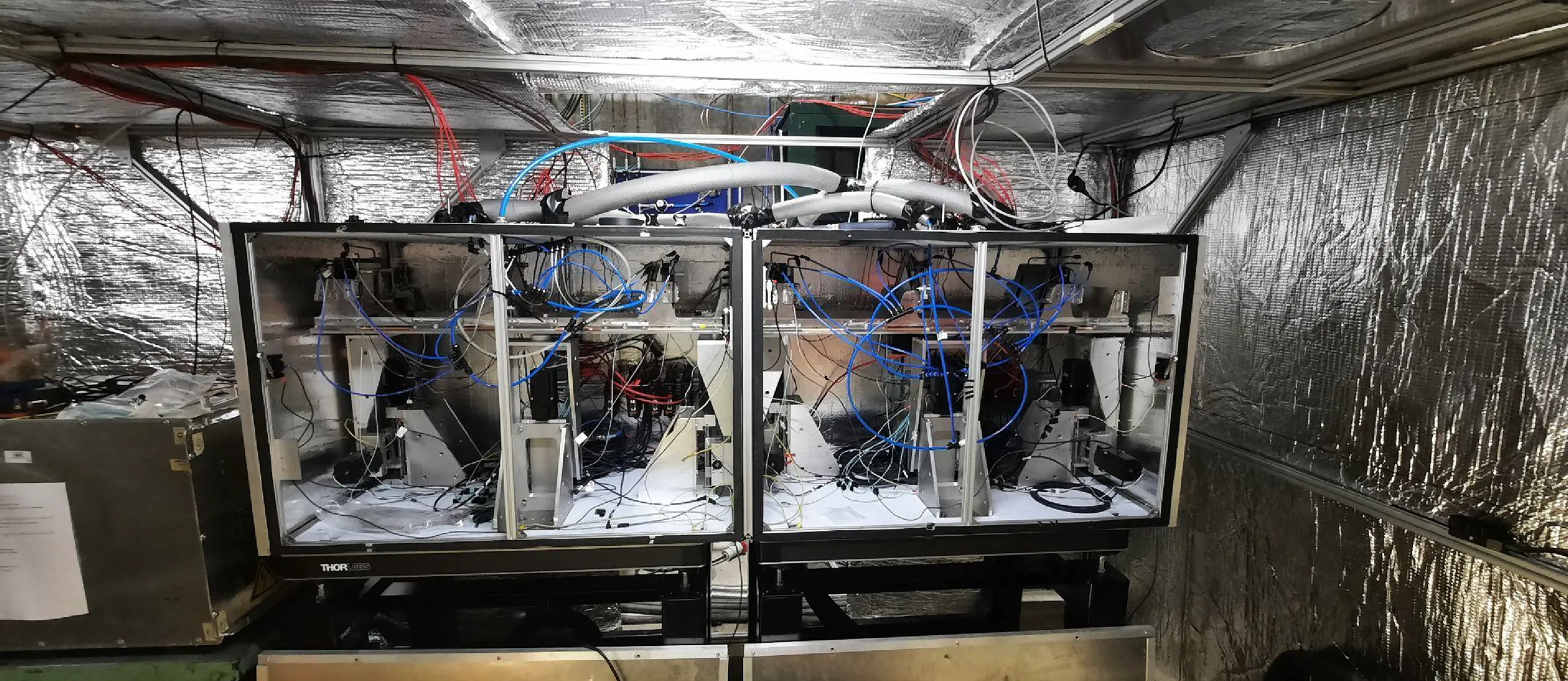
This is where MUonE comes in aiming to measure the hadronic contribution from muon on electron elastic scattering. It will shoot the high intensity muon beam of M2 on 3 cm Carbon targets and measure the scattered muon and electrons with tracking detectors. This is far from an easy measurement. The final measurement requires 40 stations of target + 3 tracker modules as shown below which will equal to 40 m longitudinal space + space for an electromagnetic calorimeter to tag the electrons coming to about 45 m total. As the measurement is extremely sensitive the alignment of the whole setup requires micrometer precision, so movement of the support structure from small temperature changes need to be minimized. To prevent this MUonE aims to use a “tent” which will be actively cooled to maintain a temperature of 18°C.
As you all know AMBER occupies the 55 m EHN2 hall so where will this 45 m setup go? Well, upstream of AMBER where we normally install the CEDARs a 13 m space is readily available. As CEDARs will not be used during the MUonE run we can install them there without needing to move AMBER. We will still be missing about 35 m space though. For this all the magnets downstream of the CEDARs will be removed. The plan is to place all these magnets on rails for easy changeover. This may require some small modifications to the walls as well.
So, many exciting studies and changes may follow. For the cooling of the tent, we can use the CEDAR ventilation that is currently installed but this will also require modification to cover the 45 m length up to the end of the beamline. Many groups will be involved to make this experiment a success including BE-EA, EN-HE, EN-CV, SY-BI etc., etc., This is again an excellent example of collaboration at CERN which makes so many interesting physics measurements possible.
MUonE had test beams in 2022 and 2023 with two stations in the CEDAR location. They also used the CEDAR ventilation with slight modification. The next test beam time is planned for 2025 following which the proposal for MUonE will be prepared and submitted for a potential run after LS3.