
Software Migration Project

7 DECEMBER,2020 | By Markus Brugger
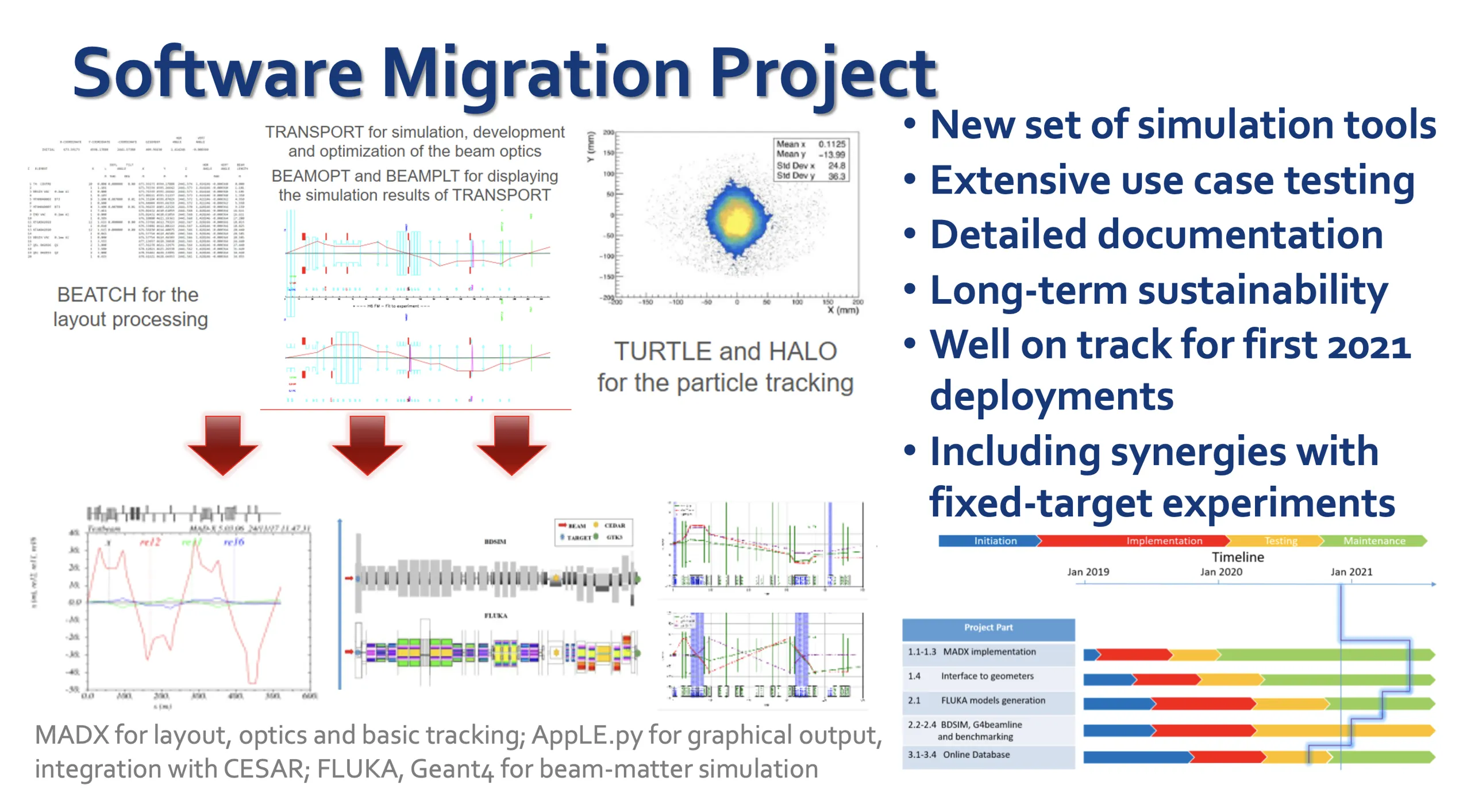
The operation of our beamlines, related layout, and optimization work and in particular the physics design studies of new experiments or related upgrades, are at the heart of our responsibilities of the East and North Area. In total we refer to more than 8 km of beamlines, 10 major experiments or facilities, as well as many more user and test areas. The software so far used for the layout of the beam lines (BEATCH), beam optics (TRANSPORT), particle tracking (TURTLE) and muon halo calculation (HALO) has been developed in Fortran in the 1970’s and 1980’s. Like our experimental areas, it also requires consolidation, especially to ensure long-term maintainability and continuity. For this purpose, a few years ago we have launched the <EA Software Migration Project> transferring the beam line description to a set of newer commonly used software tools at CERN, such as MADX, FLUKA, G4Beamline, BDSIM and others. This also implies a respective integration within the framework of CERNs’ layout database and the interfaces to the software codes used by other groups.
Furthermore, the future interface is designed to allow for an easier comparison between the measured beam parameters and the ones calculated with beam optics software, as well as an easier coupling with simulations packages used by the fixed target experiments. Focusing initially on a few beamlines only and a respective preparation of 2021 commissioning, during 2020, this project has led to several successful benchmark studies (with previous measurement data) and is now ready to get sequentially deployed in 2021 and the following years (extending eventually to all beamlines/experiments under our responsibility). Strongly interlinked between the various sections, it has already allowed us testing future functionalities and ensure an appropriate integration within our new configuration management efforts. Congratulations to all people and teams involved and looking forward to the new era of software tools to be used, and providing a solid basis for fixed target physics for the next 40 years or so