
Quality Assurance Process of a New Connector for ATLAS ITk Strips

23 DECEMBER, 2023 | By J Pariente
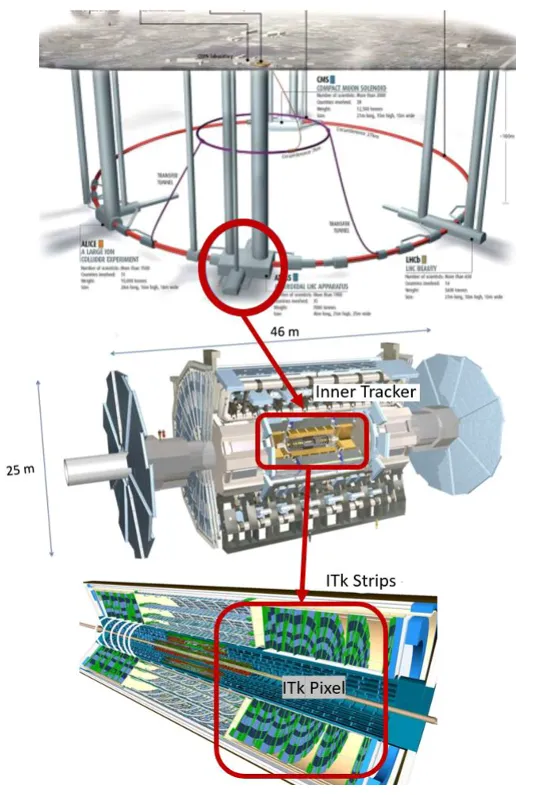
The ATLAS Inner Tracker (ITk) is a critical component of the ATLAS experiment at the Large Hadron Collider (LHC). It serves as the innermost tracking system, designed to capture precise information about charged particles produced in high-energy collisions.
The ITk is undergoing an upgrade for the Phase-II LHC, featuring an all-silicon design. This upgrade is essential to meet the challenges posed by the increased luminosity, higher data rates, and enhanced radiation levels expected during the High Luminosity LHC (HL-LHC) phase. The ATLAS ITk is made by two sub-systems: ITk-Pixels and ITk-Strips. ITk Strips is a cylinder covering the higher radius, surrounding the Pixel sub-system.
The ITk-Strip detector comprises six disks, and each disk is equipped with 32 wedge-shaped carbon fiber supports known as petals. Within each petal, there are 18 sensors, evenly distributed on both sides, totaling 165 m² of silicon micro-strip sensors for the entire detector. A custom connector was specifically tailored for the distinctive needs of ATLAS ITk Strips. The Cabling Team is currently prototyping an assembly that connects a multi-wire cable with 40 signal wires and 8 power wires to the connector.
The insertion of contacts into the connector's insulator is a crucial step in ensuring secure connections. It's essential that the retaining tabs on the contacts securely hold them in place within the connector, preventing any unintentional disconnection. These tabs engage with retention rings inside the connector insulator, and a specialized tool is employed for the extraction of contacts when necessary. However, during the prototype assembly, an observation was made that some power contacts could be easily removed by hand from the power insulator. After verifying the integrity of the pins' tabs, attention was turned to the retention rings inside the connector insulator. To investigate this further, a tomography was conducted for a detailed analysis.
The tomography results revealed inconsistencies in the size and dimensions of the retention rings. A comprehensive report was shared with the manufacturer, leading to the dispatch of new power insulators. Rigorous quality checks were conducted on a new insulator, including:
- Contact self-retaining capacity test
- Tomography
- Leakage current test
While the new insulator exhibited satisfactory self-retaining capacity for most cavities, some still posed challenges during contact extraction, even with the appropriate tool. Additionally, tomography identified two significant voids near specific cavities.
Consequently, an insulation test at 500V was performed to assess any potential leakage currents arising from the identified voids. Given uncertainties about the origin of imperfections, a new quality procedure is proposed for the insulators. This includes initial tomography upon receipt, a contact self-retaining capacity test, and a follow-up tomography for potential connector imperfections.
In conclusion, the Cabling Team is dedicated to ensuring the quality of the assembly for ATLAS ITk Strips through rigorous quality processes, ensuring precision, reliability, and contributing to advancements in particle physics.