
The Water Cherenkov Test Experiment

8 DECEMBER, 2023 | By Dipanwita Banerjee, Philippe Boisseaux-Burgeois, Aboubakr Ebn Rahmoun ad Roman Folch
Neutrinos are the most abundant, tiny, neutral, and elementary particles in the universe with mass so small that no one has been able to measure it yet. Theorists first predicted the neutrino’s existence in 1930 and it took almost 26 years to discover it. These elusive particles can travel through matter with almost no interaction. Trillions of neutrinos from the sun jets through us every second and we can’t feel them.
So far, three types (flavours) of neutrinos have been discovered and named after the particles they interact with: electron neutrino (νe), muon neutrino (νµ) and tau neutrino (ντ). If the neutrino was not already intriguing enough, they also change these flavours, as they travel. This phenomenon is called neutrino oscillation. Scientists around the world are now trying to determine the neutrino’s mass, how it interacts with matter and understand the unknown physics of the universe.
As the neutrinos are very weakly interacting with matter, a large detector is needed that maximises the probability of the neutrino interaction. Water-based detectors provide a very large target mass at a reasonable cost and therefore are used to realise multi-kiloton scale experiments like the Super-Kamiokande experiment, the planned Hyper-Kamiokande experiment and the proposed THEIA detector and ESSnuSB detectors, as well as the yesterday mentioned DUNE project.
Neutrinos are detected in these detectors when they interact, converting into the equivalent charged lepton (muon or electron for νμ or νe respectively), or when they elastically scatter off electrons (when the recoil electron can be detected). These leptons are then detected via the Cherenkov radiation as they travel through the water.
A realization of this physics programme requires:
- new detector technologies;
- calibrating detector responses to the percent-level precision;
- modelling physics processes within the detector.
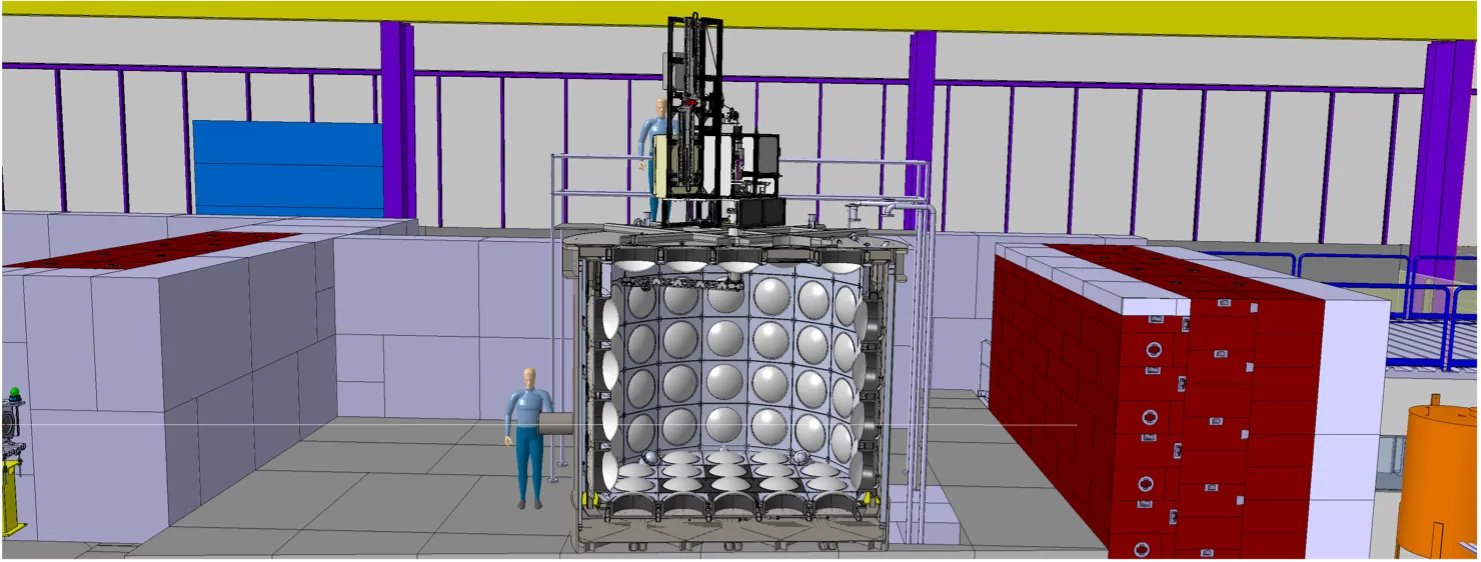
This is where the Water Cherenkov Test Experiment (WCTE) comes in. It consists of a 40-ton, 4 m diameter and 4 m high water Cherenkov tank to be operated in the East T9 beamline and will help to understand the performance of different new detector technologies. In the T09 beamline with known particle fluxes. The WCTE will be able to study the performance of a < 1 kiloton scale neutrino experiment and measure important physics processes for the modelling of the Water Cherenkov detector response. The tank will be filled with demineralised water to test detector response with low momentum hadrons, muons, and electrons (0.1 – 1 GeV/c). In addition, Gd2(SO4)3 will be loaded in the water for enhanced neutron detection.
The realisation of this experiment is not straight-forward for its scale and duration of operation and requires a fruitful collaboration of many groups. Among the few exciting challenges, we have to help the collaboration in:
- providing the low momentum beam in T09 with complete vacuum in the beamline -> BE-EA
- installing the 4 m high 4 m diameter tank in the T09 beamline -> EN-HE, BE-EA
- connecting the demineralised water connection, the water purification and Gd- loading system to the tank as well as draining the tank EN-CV -> BE-EA
- assembly area in the East Hall and support for scaffolding, access to the top of the tank BE-EA
WCTE already had its first very successful test beam times where they tested parts of their setup (not including the tank) in 2022 and 2023 in T09. The finalisation of the design and production of the tank is currently ongoing with the delivery foreseen in July 2024 for 15-weeks beam time after.