
A few experiments

11 DECEMBER,2020 | By Markus Brugger
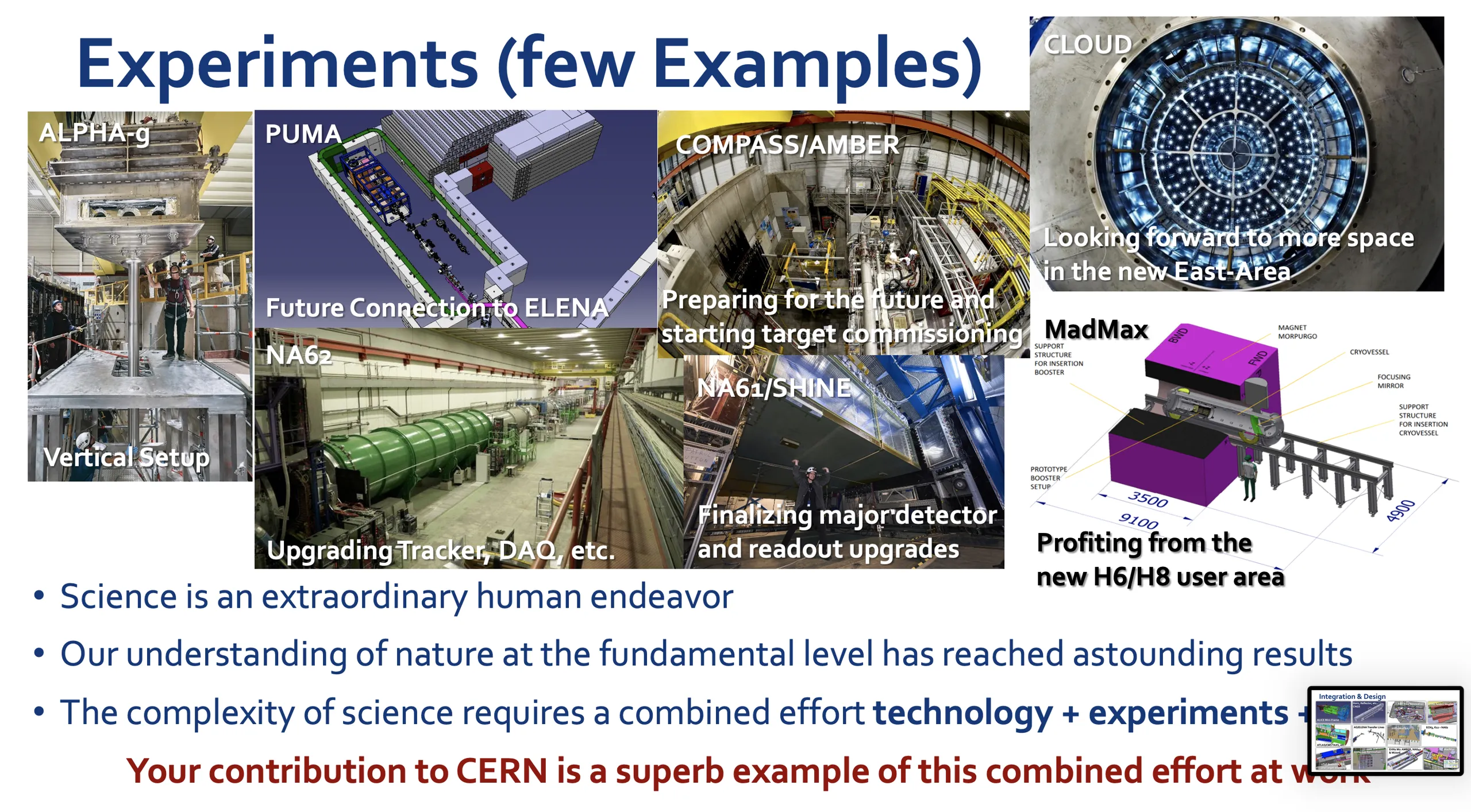
Despite 2020 being a shut-down year, since several months now many experiments not only finalize their upgrade activities, but also start getting ready for 2021 operation. For the latter, recently we have set the target dates for when beams are coming back into the various experimental areas, as well as when physics measurements are restarted. As you have read in previous Advent entries, exciting times for all our areas given the major modifications implemented in many of them. In total there are more than 15!!! (installed or soon operational) concerned experiments, and clearly, I will not be able going through all of them (perhaps an occasion for a dedicated 2021 mini-series during our coffee meetings). Nevertheless, let us aim for a mini preview for those affected most by LS2 activities. AD/ELENA hosts AegIS, ALPHA, ASACUSA, BASE & GBAR, (ATRAP now discontinued and PUMA coming in during the coming years) probing the properties of anti-matter and seeking deviations from theoretical model predictions. Picking ALHPA-g and GBAR, both looking into the gravitational behaviour of antimatter as an example, this has never been directly probed before first measurements started just before LS2. Indirect measurements have set limits on the deviation from standard gravity at the level of 10–6 but detecting even a slight difference between the behaviour of antimatter and matter with respect to gravity would mean that Einstein’s equivalence principle is not perfect and could have major implications for a quantum theory of gravity. Furthermore, launching the implementation of PUMA and having BASE-STEP in the design phase, we will soon also be able to transport the collected anti-matter for measurements outside the AD/ELENA complex, providing new opportunities and indicating the start of a new era of anti-matter physics at CERN. The East-Area now in its blooming reconstruction phase, hosts CLOUD as exciting experiment using a special cloud chamber, initially to study the possible link between galactic cosmic rays and cloud formation, and over the last years becoming a reference facility for a much vaster field of atmospheric studies. Related results have contributed much to our fundamental knowledge of aerosols and clouds, their effect on climate, our understanding of pristine pre-industrial conditions and how related formation/transition/growth processes can be modelled with high precision. Finally, our North Area with NA61/SHINE, NA62, COMPASS/AMBER, NA64 (e and μ), NA63, NA65, MuonE, the Neutrino Platform, MadMax and several future projects or ideas such as BDF/SHIP, KLEVER, ENUBET or “SHADOWs”. Probing the precision frontier of particle physics, these experiments investigate portals towards physics beyond the standard model (BSM) and dark matter (DM), pushing intensity and detection limits to reach the highest possible precision (e.g., aiming at 10-12 in the case of NA62). NA64 now comes in two flavours, trying to find signatures of dark matter with electrons in EHN1 and in the future also with muons in EHN2. For the latter hall, the established experiment being COMPASS, a new collaboration has been formed called AMBER, aiming at a long-term QCD programme to reveal the secrets of the innermost constituents of matter, their forces, and models, possibly hinting again for BSM physics. Their first setup will provide new results of the proton radius, though appearing at first sight simple, both the measurement and possible consequences to our models are far from trivial. To name a last example, NA61/SHINE addressing multiple particle physics areas thanks to a multi-purpose, multi-particle spectrometer for measurements of products of hadrons and ions over a large energy range. Their approved physics programme covers topics in strong interaction physics, neutrino beam studies and Cosmic ray interactions. 2021 did not feature unfortunately ions for the North-Area, their detector and in particular readout system got upgraded over the past years and will literally <shine> in the years to come. Writing these lines makes me proud of our group where all of you strongly contribute to these experiments, their physics design, and experimental areas, enabling present and future fixed-target physics. Many thanks to all of you!