
Objectives towards LS3 for the Cabling team

22 DECEMBER, 2022 | By Maria and Gianluca Canale
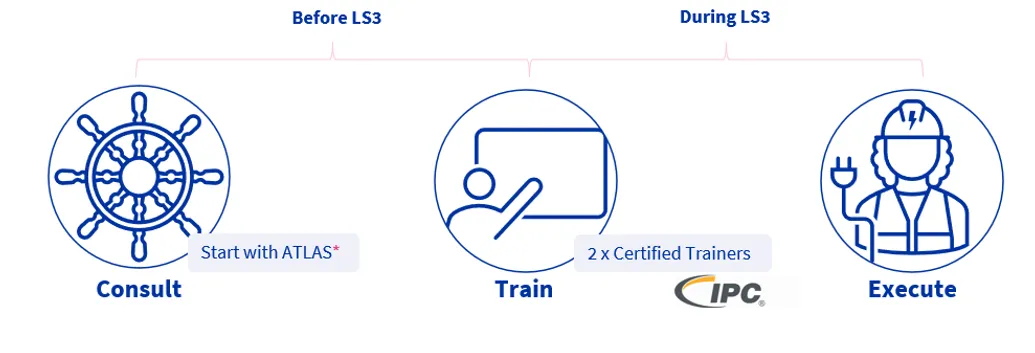
After an intense and successful LS2 and important lessons learnt from each individual worksite, the BE-EA Cabling Team has set new objectives for LS3. ATLAS & CMS Phase III will see a cabling-related upgrade of one order of magnitude higher than what was done during LS2.
Additional challenges have to be met after the release of the new SSI-FS-2-1 (Fire Behavior for cables in High-Risk areas according to CPR is Cca-s2,d1,a2) which replaces the IS23. Furthermore, the LHC High Luminosity era will lead to higher Total Ionizing Dose (TID) absorbed by chunks of cables in “hot” areas. These two requirements lead to the increase of cable diameter and, thus, conflict with the limited space and complex routing within a sub-detector or in the LHC tunnel, not to mention the fact that this theoretical new cable generation would probably be incompatible with the standard CERN connectors.
Moreover, looking ahead to the year 2026, we are wondering:
- Will there be competent personnel to connectorize the installed cables?
- Will the right tooling be used throughout the process?
- Will the connectorization be carried out in accordance with the manufacturer’s instructions and quality requirements according to IPC-A-620?
We knew that these challenges need to be communicated as soon as possible. 2022 was a year of raising awareness for the criticality of early cabling system definition for LS3 – starting with a BE Seminar in early January. Our first specific target was ATLAS – having already created close links following our significant contribution in the New Small Wheel during LS2. ATLAS Technical Coordination responded positively and seized the opportunity for this collaboration without a second thought.
- The structure?
- A workgroup (REACT, Requirements of Experimental Areas for Cabling Team) with one representative from ATLAS and one representative from the BE-EA Cabling Team;
- The activity?
- Establish a regular communication channel between the Cabling Team and all the individual sub-detectors to gather information on the definition of their cabling requirements.
- The goal?
- Provide support to the collaboration (whether based at CERN or an in-kind contribution) from A to Z – from the material definition to the procurement (drafting of Technical Specifications, support in the process of Market Survey) down to the installation phase (selection and qualification of tooling and training of personnel – since Gianluca and I are now Certified IPC Trainers). Finally, act as liaison between the collaboration and various cabling-related services at CERN (e.g. CARE/HSE for cable qualification tests – e.g. after an irradiation or thermal ageing campaign, CERN Store for reservation CERN-standard products…)
Until today, we have established contact with all sub-detectors – the current input shows that only for ATLAS, a total of 15,000 cables and 140 km will be installed. Our sub-detector contacts appreciate our initiative and our feedback and as a result we are now systematically invited to cabling-related Final Design Reviews, as well as to the Specification Committees for Market Surveys.