
What is PPS2 about, and how are we involved?

16 DECEMBER, 2023 | By Markus Brugger
When hadrons collide at the LHC into one another, in most cases, projectile protons break up in the collision and a large yield of energetic particles are produced and form as such the basis of all corresponding physics studies. Occasionally, however, protons interact through different mechanisms, whereby they remain intact, though have slightly changed their trajectory or momentum.
However, protons that survive the collision, having lost a small fraction of their momentum, leave the interaction point still packed within the proton bunch, but gradually drift away as they travel further along the beamline, and are as such the subject of investigation of CERNs forward proton detectors (FPD).
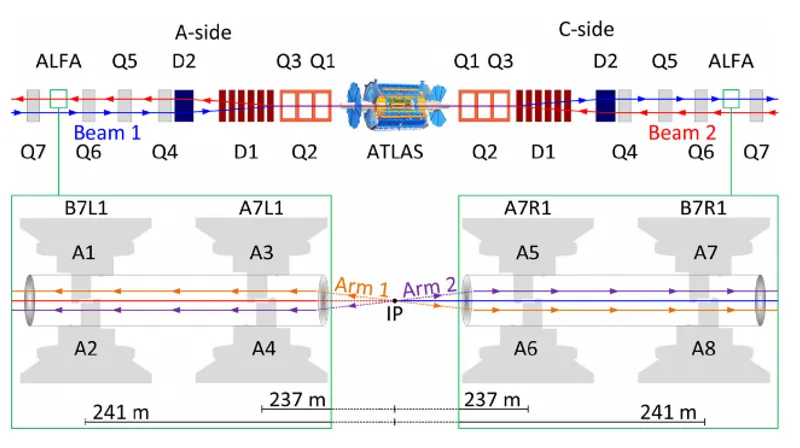
To study their respective underlying processes, already in the first two LHC runs, both interaction points IP1 and IP5 have been equipped with FPDs, first pioneered by CMS-TOTEM and ATLAS-ALFA for measurements of elastic and soft diffractive scattering in special runs.
Their initial focus was to determine a precise measurement of the interaction probability (cross-section) of protons at the corresponding LHC energy. This total cross-section is a fundamental parameter of the strong interactions, setting the scale of the size of the interaction region at a given energy. Interestingly, to measure this total cross-section, the FPDs employ a technique building on its proportionality to the forward elastic scattering amplitude. That is, if one precisely measures the elastic scattering (and contributing processes), then one can actually calculate the total cross-section.
Measuring the elastic scattering is a challenge because elastically-scattered protons (protons that essentially bounce off of each other) escape the interaction under very small angles of tens of micro-radians. To detect these protons, dedicated detectors are installed, such as ALFA at ATLAS. To achieve the required focusing properties, the LHC had to be operated with special settings of its magnets. The detectors can then be moved as close as a few millimetres from the LHC beam to access the smallest scattering angles.
In Long Shutdown LS1, these systems were complemented and upgraded for high luminosity operation in all regular LHC runs, yielding the ATLAS-AFP and CMS-PPS (initially CMS-TOTEM PPS) subdetectors dedicated to measureme processes with much lower cross sections than those involving elastic and soft diffractive scattering.
Installed a few hundred meters after the interaction point, these forward detectors are part of the so-called machine detector interface (MDI) area, where their operation, layout and infrastructure requirements are closely interlinked to the LHC machine, and as such coordinated through TREX, initiated in 2014 and currently chaired by Francisco.
Over the years, our group has contributed to those experiments in several different ways: the challenging and complex installation of very delicate cables; the design, purchase and installation of removable special shielding structures; often requiring dedicated scaffolding solutions; and continues in this endeavour already in preparation of respective LS3 upgrades. To perform those high precision measurements, related detectors must be installed very close to the beamline and are equipped with trackers to measure kinematic quantities and time-of-flight (ToF) detectors to measure proton arrival times. The latter allow for the reconstruction of the longitudinal vertex position, which is essential at the high pile-up levels (number of simultaneous collisions in one bunch crossing!) of the LHC, even more so at the future HL-LHC. To allow for a coherent analysis, they have also to be fully integrated in the data acquisition system and central trigger of the main detectors, making e.g. the before mentioned cables for timing so essential.
For the current second-generation setups (AFP in ATALS and PPS in CMS) to work as designed, the detectors (positioned at around 200m from the Interaction Point) must be located within a few millimetres of the LHC proton beam, thus detecting protons that have lost between 2% and 15% of their initial kinetic energy.
An obvious challenge, the so-called Roman Pots technique – moveable steel “pockets” enclosing the detectors under moderate vacuum conditions with a thin wall facing the beam – is perfectly suited for this task. This technique has been already successfully exploited by the TOTEM and ATLAS collaborations and has a long-lasting history as it was used in the past by experiments at the ISR, the SPS, the Tevatron and HERA.
The opportunity, but also the challenge for the present second-generation setup, was the requirement that the detectors have to operate continuously during standard LHC running conditions, as opposed to previously dedicated special runs with a relatively low interaction rate.
Here some of you might remember the difficulties the ATLAS-ALFA collaboration had in Run-2 with respect to their installed electronics, where the beforementioned shielding structures allowed to remedy the situation and ensure successful data taking.
Pushing intensities (luminosities) and boundaries, during the present and looking ahead at HL-LHC operation, rare processes can and will be studied at highest precision. For instance, the exchange of photons that fuse to create new particles, give rise to a number of observable channels for its produced secondaries (charged leptons, photons, bosons, quark/anti-quark pairs, etc.), where the precise knowledge of its respective probability (branching ratio) provides important insight into both the standard model, as well as possible physics beyond. These processes have a unique signature: the particles originating from this kind of interaction are produced exclusively, but can be easily contaminated by extra particles from different interactions and making the identification of photon–photon fusion a challenging FPD measurement.
During the upcoming Long Shutdown LS3, with HL-LHC the Long Straight Sections LSS1 and LSS5 will be redesigned, and the present AFP and PPS systems uninstalled. This offers an opportunity to develop improved detector systems and to place them in optimised locations, building on the experience gained in the first LHC runs, an endeavour picked-up by a newly formed PPS2 collaboration.
Building on the enormous experience gained over the many years of LHC operation and continuous upgrades, the CMS collaboration has submitted their interest to pursue studies of many of those rare processes at the HL-LHC with the ambitious plan of installing near-beam proton spectrometers at 196, 220, 234, and perhaps later 420 m from the interaction point. This would extend the accessible mass range to the region between 50 GeV and 2.7 TeV. The main challenge remain the mitigation of the mentioned high “pileup” effects using the timing information, for which new detector technologies, synergies with the future CMS timing detectors, and new related infrastructure (cabling, alignment, etc.) will be required.
Our group was recently involved in the final approval process, supported the collaboration and HL-LHC/EN-EL in the required cabling study, and is currently also helping the experiments and EN/EL with the cable identification of the presently installed infrastructure which needs to be safely and efficiently removed early in LS3.