
What’s new for XCET 2021

9 DECEMBER,2021 | By Giulia Romagnoli and the XCET team
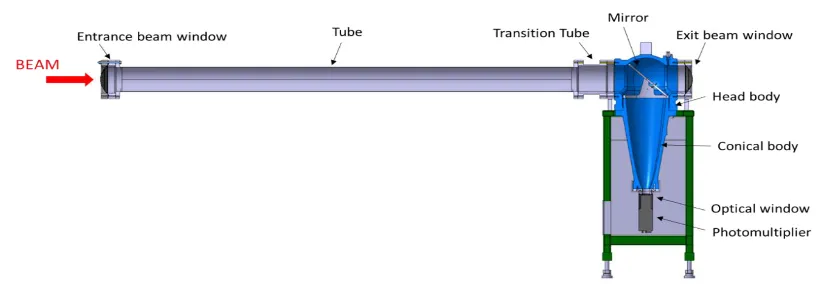
The threshold Cherenkov Detectors (XCET) are used in the experimental areas at CERN since more than 40 years to count the number of selected particles in the beam. It is based on the detection of Cherenkov radiation emitted by a relativistic charged particle traversing a medium with a speed higher than the speed of light in that medium.
The XCET currently in use in our East and North Area beamlines, were designed and fabricated in the 70’ and they urge of consolidation since the number of spare parts is critical and many subsystems do not comply with current safety regulations at CERN. In particular, the XCET central body it is an old aluminium casting which through testing, together with EN-MME, revealed multiple defects (pores, cavities) probably linked to the original manufacturing process. For this reason, the HSE unit decided to forbid the personnel access to the area where the XCET are at high pressure, and the low pressure XCET are protected by a chassis in the areas where the users are entering without limitations.
2021 was an important year for the validation of the Mylar and polyethylene XCET beam window design. This design (250μm Mylar window superimposed to 150μm black Polyethylene window) has been used in the XCET for the past 40 years but was never validated. A series of FE simulations and experimental pressure tests validated the use of these windows up to 3.5 bar (g).
Pressure tests validated the use of these windows up to 3.5 bar (g).