
New Design XCET Detector

16 DECEMBER, 2022 | By Jan Buesa and Giulia Romagnoli
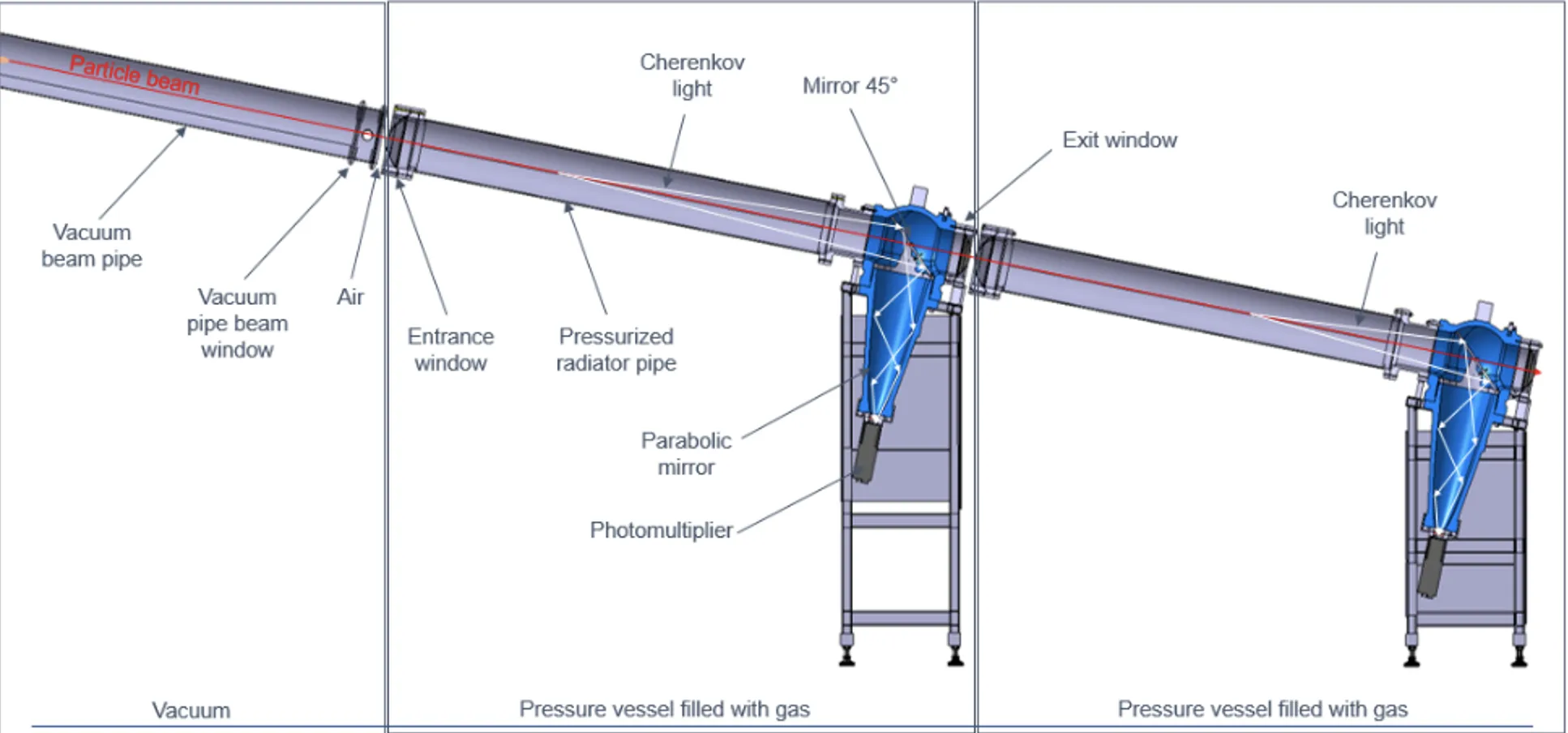
The Threshold Cherenkov Detectors (XCET) are used in the experimental areas at CERN since more than 50 years ago to identify and count the number of selected particles in the beam. It is based on the detection of Cherenkov radiation emitted by a relativistic charged particle traversing a medium with a speed higher than the speed of light in that medium.
The XCET currently in use in our East and North Area beamlines, were designed and manufactured in the 70’s and they urge of consolidation since the number of spare parts is critical and many subsystems do not comply with current safety regulations at CERN, in addition they suffer from the degradation in efficiency in many optical components.
On the one hand, the main goal of the new design is to ensure the mechanical safety operation of the detector while operating at high pressure (up to 16 bar). On the other hand, the strategy is to upgrade the detector to the current technological capabilities, and not to copy an obsolete design.
We identified different components that were not optimized such as the parabolic mirror, the diameter of the body’s head or the optical window dimensions. Moreover, there were materials that degraded over the years, reducing their efficiency, like the coating of the 45-degree mirror, the parabolic mirror, or the optical window.
One of the key components is the 45-degree mirror. This mirror is vital to reflect the photons from the radiator tube towards the photomultiplier. As it’s set in the center of the beam axis, so it needs to be as thin as possible and made of a material with low density to avoid a loss in beam quality or multiple scattering. This is the reason why the mirror is manufactured from a 25um Mylar foil which is subsequently coated with a material with excellent reflectivity properties in the UV and far UV range. From the GEANT4 simulations, we have read that around 80% of the photons are produced in the UV range.
To produce a coating with high reflectivity in the far UV is not straight forward and even less if we use a 25um Mylar foil as a substrate. However, our first prototype produced by a collaboration with the EP-DT group, showed better performance than the old mirrors. The mirror was produced by an electron-beam physical vapor deposition of 100 nm of Aluminum + 20 nm of SiO2 .
We are currently exploring new coating solutions within CERN and external companies to enhance the far UV reflectivity, new results coming after Xmas…
Also, a study assessing the efficiency of the parabolic mirror in focusing photons on the photomultiplier was carried out, where new mirrors were designed and simulated to maximize the efficiency and minimize the size. The new design will improve the physics and integration of the detector while reducing the manufacturing costs.
Simulations have showed an increase of the collection of photons compared with the actual design up to 79% for muons, 72% for kaons, and 54% for protons while reducing the height around 10%. We also see that even if the height is reduced by 54%, we still get a significant improvement in collection of 67% for muons, 59% for kaons, and 43% for protons.
With a pressure scan, we can observe that the current design (design v0) reaches its efficiency limit around 6 bar for muons in a 2GeV beam with r218 as radiator gas. This is translated to an approximate maximum acceptance angle of 5.4 degrees, whereas the new designs have a maximum acceptance angle up to 20 degrees as well as showing better performance at low angles.
Lastly, there will be an upgrade of the optical window material, from regular Quartz to Magnesium Fluoride or enhance UV fused silica to maximize the transmission of photons in the far UV photon spectrum as well as a diameter increment from 2’’ (50.8 mm) to 3’’ (76.2 mm).
Merry Xmas and happy New Year!