
Consolidating the Micro-collimator

22 DECEMBER, 2022 | By Antonio Alonso
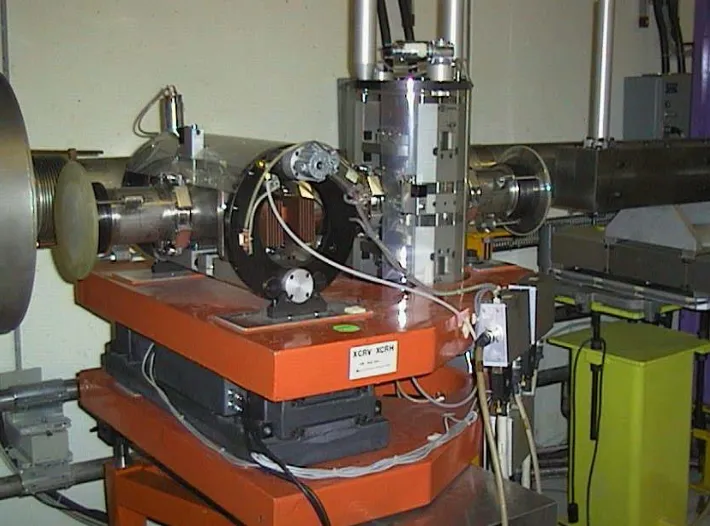
The XCRHV micro-collimator was built around 40 years ago and it is currently installed in H8 beamline. Used in the "micro beam" mode, it allows for either small beam divergences or very small beam spot sizes, depending on the location of the collimator in the optics (see EDMS 2718575).
It is made of two sets of 2-jaws collimators, one acting on the horizontal plane of the beam and one acting on the vertical plane, with a minimal aperture of 1 mm in each plane.
This equipment is unique at CERN, and there are only two units: one installed in the H8 beamline inside TT82 tunnel, and a spare. In the framework of the NACONS project, the consolidation of the spare started in 2022: the micro-collimator was found in bad shape, covered by years of dust and oblivion, used as an “organ donor” for the micro-collimator installed on the beamline.
It was our mission to make the spare great again!
At the beginning, little data on the collimator was known: when was it manufactured? by whom? if the spare was working, what was the failure that occurred years ago? no technical specification, no drawings, no manuals, no history, ….
“To defeat your enemy you first must understand him”, so we started to gather all the available information about the collimator from all the possible sources. More than 20 people were contacted, I even spoke with HR and the Pension Fund to try to contact the original members of the project in the 80’s, but unfortunately, I had no luck.
It was necessary to do some “Archeological Engineering” in order to find out more about the micro-collimator!
A famous archaeologist once said: “Seventy percent of all archaeology is done in the library”, therefore I started to dig deep into EDMS, DFS and CDD and I was able to find some lost photos and documents that gave us clues about the functioning and history of the collimator. The greatest achievement was to find around 50 drawings that someone heroically digitalized long time ago.
But at CERN there are also physical databases, memories of ancient times, where you can find very interesting information J
Looking for answers, I visited the CERN main archive, located in the R1 basement, where all CERN physical documents are stored. Unfortunately for us, all the physical folders of the micro-collimator were lost and I could not find either the original drawings nor microfilms.
In parallel to the archaeological research, with the skilled hands of Mohammed, we started to clean, identify and make the autopsy of the spare Micro-collimator, in order to discover the cause of failure and understand how it works exactly through reverse engineering.
The EA design office started to convert the hand-drawn blueprints and to turn them into a 3D CATIA model. This task proved to be very challenging, as plenty of drawings were missing, other contained errors or were referencing to other equipment.
We started the consolidation ordering the new pieces and cleaning, testing and assembly back the collimator. Due to the current market situation, the consolidation of the micro-collimator had a big delay since some deliveries took around 7 months to arrive!!
New documentation is also being created, to follow the standards of quality and configuration management like the as-built engineering specification, assembly/disassembly procedures and the user requirements.
Thanks to all our efforts, we will make the Micro-collimator stronger than ever and ready for a new and bright future in the North Area!!