
An East & North Areas teaser

5 DECEMBER, 2023 | By Markus Brugger
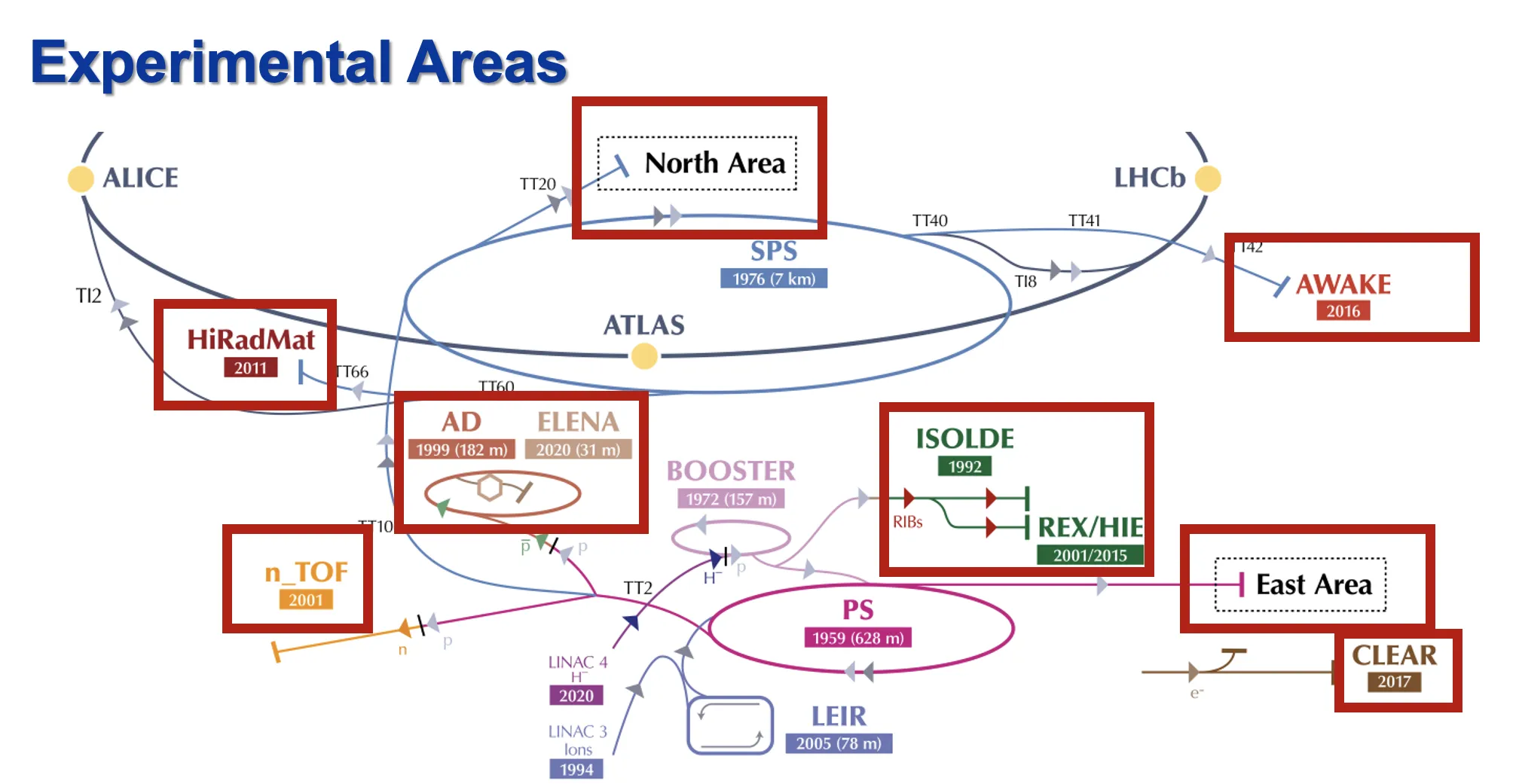
Our accelerator complex is a succession of machines that accelerate particles to increasingly higher energies, each stage boosting the energy of a beam of particles before injecting it into the next machine in the sequence. For protons it starts with the Linac4. It accelerates negative hydrogen ions (H–, consisting of a hydrogen atom with an additional electron) to 160 MeV to prepare them to enter the Proton Synchrotron Booster (PSB). In the injection process, the ions are then stripped of their two electrons, leaving only protons. These are accelerated up to 2 GeV for injection into the Proton Synchrotron (PS), which pushes the beam up to 26 GeV. They are then sent to the Super Proton Synchrotron (SPS), where they are accelerated up to 450 GeV. Similarly, ions start from a source of e.g. vapourised lead and enter Linac3 before being collected and accelerated in the Low Energy Ion Ring (LEIR), before then following the same route to maximum energy as the protons. For an instructive illustration, you might want to watch the following video.
Regarding fixed-target physics, our injector chain serves several experimental areas and through them a respective rich and diverse experimental programme. Starting with the Booster, the PSB delivers beams to the Online Isotope Mass Separator (ISOLDE) facility including HIE-ISOLDE, as well as the MEDICIS facility. The PS serves the Antiproton Decelerator (see our December 1st Advent article), the neutron time-of-flight (n_TOF) facility and our first general purpose experimental hall known as the East Area, housing the CLOUD experiment as well as IRRAD and CHARM, as well as annually the Beam-Line-For-School (BL4S) event. The SPS then serves the North Area experiments AMBER (previously COMPASS), NA61/SHINE, NA62, NA63, NA64, NA65, MUonE, and UA9, as well as the CERN Neutrino Platform, AWAKE and HiRadMat.
Focusing in this first teaser article on the East and North Area, those experiments tackle known and probe unknown physics which can be generally split in three groups – measurements linked to QCD, electroweak and QED (see video), as well as dark matter (see video) searches – individually located at different secondary and tertiary beamlines across the complex.
Starting with the East Area, thanks to many of you, this experimental hall stemming from the 60s underwent a complete refurbishment during LS2 leading to a reduction of the energy consumption from 11 GWh to 0.6 GWh, and literally shining in its new light. Its main permanent physics experiment is CLOUD, which simulates the impact of people, cosmic rays and complex processes on earth on cloud formation. Recently the collaboration added a new device, FLOTUS, a new detector component, which extends the atmospheric simulation covering important preceding ageing processes. The collaboration continuously extends their scientific program, looking into complex nucleation processes, touching even on the complex effects emerging from present and past conditions here on earth, such as monsoon regions.
Moving to the SPS and starting with EHN1, NA61/SHINE, is specializing in hadron physics, and underwent a major overhaul during Long Shutdown 2 (LS2) including the reuse of the time projection chamber from the ALICE experiment. Building on its predecessor NA49, the 17 m-long NA61/SHINE facility at the H2 beamline focuses on three main areas: strong interactions, cosmic rays and cross-section measurements for neutrino physics. The collaboration continues the study of the energy dependence of hadron production in heavy-ion collisions, in which NA49 found irregularities. It also aims to observe the critical point at which the phase transition from a quark-gluon plasma to a hadron gas takes place, the threshold energy for which is only reachable at the SPS, rather than at the higher energy LHC or RHIC experiments. By measuring hadron production from pion-carbon interactions, meanwhile, the team studies properties of high-energy cosmic-rays from cascades of charged particles. Finally, using kaons and pions produced from a target replicating e.g. that of the T2K experiment in Japan, NA61/SHINE will help to determine the neutrino flux composition at the future DUNE and Hyper-Kamiokande experiments for precise measurements of neutrino mixing angles and CP-violating phase. Profiting from their detector setup, they also seek ‘pushing’ H2 beams to lower energies leading to a dedicated VLE (very low energy) beam design study some of you were strongly involved in the proposal phase.
Situated at the same H2 beamline, the new NA65 “DsTau” experiment studied properties of the tau neutrino relevant for neutrino-oscillation studies and which could give hints to new physics. After a successful pilot run in 2018, a measurement campaign began starting in 2021 determined the ντ production flux from the decay of Ds mesons.
Moving to H4, NA63 received electrons and used a high-energy electron beam to study the behavior of scattered electrons in a strong electromagnetic field. In particular, the experiment tested QED at higher orders, which have a gravitational analogue in extreme astroparticle physics phenomena such as black-hole inspirals.
At the same beamline, searching for new physics is the main focus of NA64, which studies the interaction of an electron beam with an active target to look for a hypothetical dark-photon mediator particle connecting the SM with a possible dark sector. As from 2019, NA64 measurements touched upon the relevant parameter space corresponding to the “scalar relic abundance” for the first time. With increasingly higher intensities (thanks to the immense effort of many of you) they have an ambitious measurement programme ongoing in the current LS2-LS3 operation period, investigating whether such a dark mediator, should it exist, is either an elastic scalar or a Majorana particle. Adding further impetus to this program is the tension between the measured and predicted values of the anomalous magnetic moment of the muon (gμ-2), for which possible explanations include a model in which electrons and muons couple differently to the dark sector. A further novelty during the latest NA64 run period is a search for a light dark-mediator as a resonance in e+e– pair production in the calorimeters.
Expanding their physics programme, the collaboration is investigating options for using a positron beam and – again thanks to the enormous efforts from many of you – has found an additional home in EHN2 where they adopted their setup to operate with muons coming from the M2 beamline. Here the collaboration aims to cover the dark-mediator parameter space relevant to gμ-2 and the so-called ATOMKI anomaly.
Here in EHN2, as the largest setup AMBER houses a complex detector/spectrometer facility at the M2 beamline, which is an evolution of COMPASS, which operated for 20 years (2002 – 2022) with a focus on studying the gluon contribution to the nucleon spin structure. By measuring the proton charge radius via muon-proton elastic scattering, AMBER aims e.g. to clarify the long-standing proton-radius puzzle, offering a complementary approach to previous electron-proton scattering and spectroscopy measurements. In addition, a new data acquisition system enables the collaboration to measure the antiproton production cross section to improve the sensitivity of dark-matter searches carried out by AMS-02, for example. A third AMBER program will concentrate in the future on Drell-Yan processes measurements using heavy targets to address why the kaon, pion and proton differ in mass despite having almost the same quark-flavor content, pushing through this our M2 beamline to its limits and triggering ideas for future beamline upgrades you started looking into, preparing the basis for a respective upgrade proposal to be brought forward very soon.
Finally, moving towards ECN3, at the K12 secondary beamline, NA62 continues its search for the ultra-rare charged kaon decay to a charged pion, a neutrino and an antineutrino, which is very sensitive to possible physics beyond the Standard Model (BSM). The collaboration aims to increase its sensitivity to a level (10 – 20%) approaching or covering present theoretical uncertainties, also thanks to further data, experimental and beamline improvements to the over 200 m-long facility. One is the installation of a muon veto hodoscope during LS2 that helps to determine whether a muon is coming from a kaon decay or from other interactions, but relying as well as numerous beamline improvements carried out over the past years, and recently we contributed a lot to modify their CEDAR detector, now successfully operating with Hydrogen. Since 2021, NA62 also operates as a beam-dump experiment, where its primary focus is to search for feebly-interacting particles. Here, the ability to determine whether muons come from the target absorber is even more important since they make up most of the background.
Both East- and North-Areas are crucial for present and future detector developments, serving an ever increasing user community through test beam areas and irradiation facilities. Stable and highly customizable beams facilitate important detector R&D and evaluation of future experimental setups. These include e.g., the recently approved Water-Cherenkov Test Experiment in the East Area, which will help to develop detector techniques for neutrino experiments, and new detector components for the LHC experiments and for proposed future colliders. For the North Area, the CERN Neutrino Platform is dedicated to the development of detector technologies for neutrino experiments across the world, with upcoming activities including DUNE and ENUBET/NUTAG, which aims to study the neutrino flux of the electron neutrino in the Kaon decay to a positron, a neutrino and an antineutrino, and the possibility to study neutrino oscillations by tagging the corresponding lepton. Furthermore, in the EA, the mixed-field irradiation (CHARM) and proton-irradiation (IRRAD) facilities provide key input to detector R&D and electronics tests as they are capable of generating various radiation environments, while in the NA GIF irradiation facility and HiRadMat at the SPS are established world-wide unique test facilities.
Fixed-target experiments in the NA and EA, along with experiments at AD, ISOLDE and n_TOF, are an essential part of CERN’s scientific and in particular diversity program. They form an important cornerstone in the laboratories quest to understand the fundamental laws of the universe. Many of you have contributed forming those ideas, preparing proposals and contributing to the later implementations in the East- and North-Area and there are many more on the horizon. With those numerous physics opportunities and the consolidation of our facilities, we are clearly looking into a bright and interesting future and your countless efforts in serving our experiments users with the highest beam quality, reliable infrastructure and services make their existence and performance possible.