
Hostlab and related projects

9 DECEMBER,2020 | By Markus Brugger
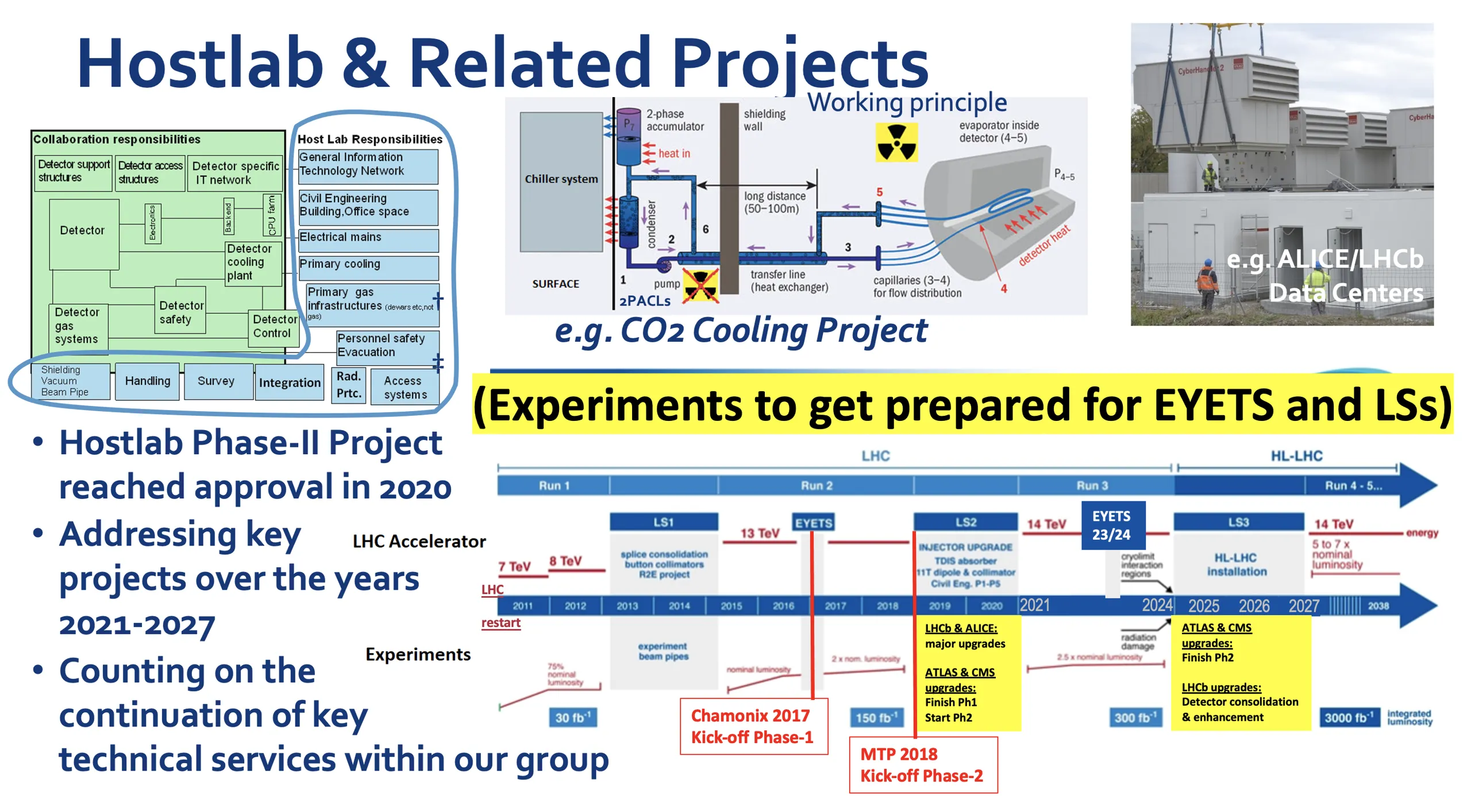
Our Hostlab initiative was triggered about five years ago when it became clear that all four LHC experiments would require significant additional support to reach their LS2 and LS3 upgrades, thus eventually allowing for their Run3/Run4+ physics targets. The overall context is that while collaborations are in charge (operationally, financially, etc.) for their detector, readout/analysis and related installations, the corresponding ‘primary’ infrastructure and related support/service activities are often under CERN responsibility. For this purpose, we have established a dedicated responsibility document, forming the basis of both project proposals Hostlab Phase-I and Phase II. Saying this, the important detector upgrades focus during LS2 mainly on ALICE and LHCb, but already include significant work for ATLAS and CMS to prepare for their Phase 2 upgrade to be finalized in LS3. Hostlab Phase-I is thus currently in its final implementation phase and our group was successfully involved in several corresponding projects (ALICE/LHCb data centres, ATLAS/CMS building extension and related technical support activities such as integration, scaffolding, and cabling). All these activities are followed not only technically, but also financially and provided a sound basis for the extensive Phase-II request we brought forward to management in this financial Medium-Term exercise and where we succeeded with a full approval for all related sub-projects and service/support activities. Phase-II is structured along (i) Projects, (ii) Upgrades & Consolidation, (iii) Technical Services and (iv) Logistics and Safety. Let me thus comment briefly on each of those: (i) the CO2 cooling project as an essential ingredient for ATLAS/CMS phase-II upgrade posing unprecedented challenges for detector cooling and aiming for operation at lowest possible temperatures, thus pushing the CO2 technology close to its technical and physical limits (CO2 triple point at -56.6oC), all required to cope with higher radiation loads at the HL-LHC as from Run-4 and implying a cooling system of close to 1MW; (ii) a partly related, but wide-reaching upgrade of the electrical and cooling infrastructure; (iii) essential resources for survey, transport, integration, cabling and scaffolding required to implement the detector upgrade, our group directly responsible for the last three and where this support enables us to technically further develop our key services; and (iv) in particular safety coordination, green-house gas recuperation and radioactive waste characterization, where for the latter recent legal limits where lowered and require additional measurement capabilities to maximize safety and minimize the amount of radioactive waste – something certainly also very interesting for future consolidation projects relevant for our group. Our group is responsible for the overall project coordination, and addresses several related technical, service and engineering activities, thus continuing being at the heart of our group for the years to come. I thus profit from the occasion congratulating many of you for the demonstrated technical and project management excellence, paving the way for this essential second phase of an essential CERN-wide project strongly linked to our group until 2027.