
The longest running experiment at the SPS

4 DECEMBER, 2022 | By Lau Gatignon and Dipanwita Banerjee
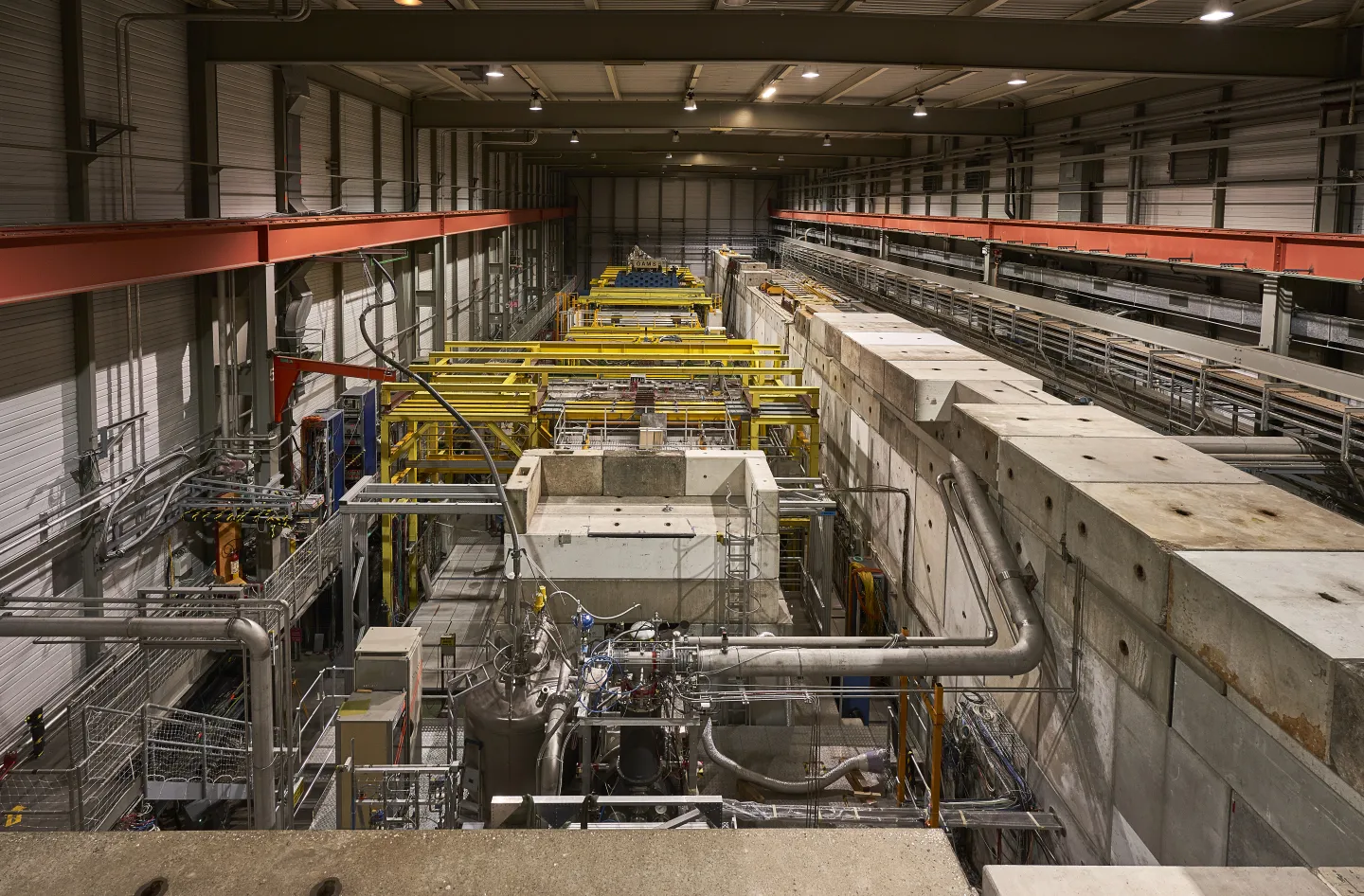
The M2 beam was the first beam to start operation in the North Area in 1978. As a dedicated high-intensity high-energy muon beam it served a very important and successful muon physics program, including the EMC, NMC and SMC experiments. In the mid 1990’s the collaboration started to work on a new physics program with a new detector and about a factor 4 times higher muon beam intensity. First studies and tests for this were done in 1995 and the HMC Letter of Intent was submitted to the SPSC committee later in 1995. At the same time the CERN management decided to stop the physics experiments (in particular the experiments at the OMEGA spectrometer) in the West Area. The OMEGA community submitted then a Letter of Intent to the same SPSC meeting, proposing an experiment with hadron beams: CHEOPS. The two groups proposed very similar detectors and the SPSC, in its wisdom, recommended to install one such a detector in EHN2 and swap between hadron and muon beam operation. The two collaborations ‘married’ and submitted together in 1996 the COMPASS (Common Muon and Proton Apparatus for Structure and Spectroscopy) proposal.
The proposal was approved in February 1997 and preparations and construction started. Also, the beam line was mostly redesigned and rebuilt to allow the switch between muons, hadrons and even electrons.
The detector was completely rebuilt, and a second large spectrometer magnet was added. The existing 400-ton SM2 magnet was moved downstream over 35 meters and space for two CEDAR detectors was created. All was ready at the beginning of 2002, 20 years ago, and COMPASS started its very successful physics program. The new facility was designed as a general-purpose one and it allowed the collaboration to cover a vast range of physics topics, covering muon spin physics, hadron spectroscopy, Drell-Yan, and many others.
Beam | Target | Year | Physics programme |
μ+ | Polarized deuteron (6LiD) | 2002, 2003, 2004 | 80% Longitudinal│ 20% Transverse SIDIS |
2006 | Longitudinal SIDIS | ||
Polarized proton (NH3) | 2007 | 50% Longitudinal│ 50% Transverse SIDIS | |
π│K│p | LH2, Ni, Pb, W | 2008, 2009 | Spectroscopy |
μ+ | Polarized proton (NH3) | 2010 | Transverse SIDIS |
2011 | Longitudinal SIDIS | ||
π│K│p | Ni | 2012 | Primakoff |
μ± | LH2 | 2012 | Pilot DVCS & HEMP & unpolarized SIDIS |
π− | Polarized proton (NH3) | 2014 | Pilot Drell-Yan |
2015, 2018 | Transverse Drell-Yan | ||
μ± | LH2 | 2016, 2017 | DVCS & HEMP & unpolarized SIDIS |
μ+ | Polarized deuteron (6LiD) | 2021, 2022 | Transverse SIDIS |
Now that COMPASS has officially ended, the experimental equipment will be handed over officially to the AMBER collaboration, which has large overlaps with the COMPASS collaboration, and which will further exploit the world-wide unique possibilities of the M2 beam for many other physics topics.
Congratulations to COMPASS, the longest running experiment at the SPS!