
Future AMBER Plans at BE-EA

13 DECEMBER, 2023 | By Dipanwita Banerjee, Philippe Boisseaux-Bourgeois, Sylvain Girod, Yacine Kadi, and Giulia Romagnoli
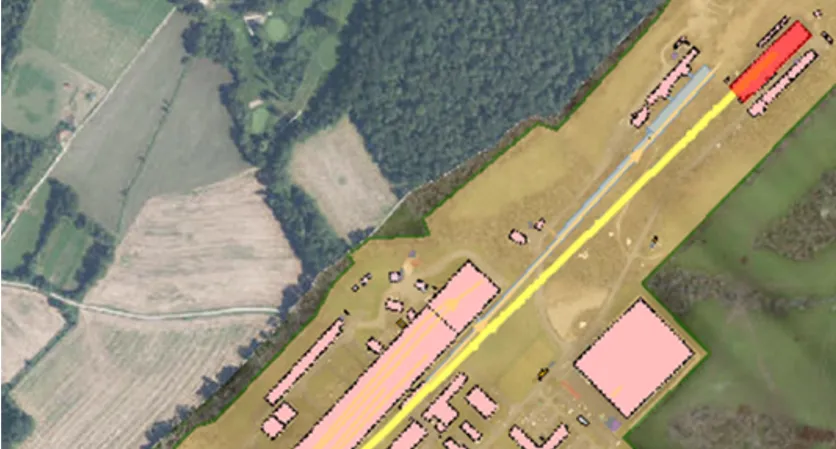
At the far end of the Prevessin site at CERN, served by the longest secondary beamline, M2, (more than 1 km), lies the building 888 (EHN2) which housed the COMPASS experiment for the last 25 years. Maybe some of you remember from last year’s Advent calendar where we visited a bit the history of COMPASS, which had its last year of data taking in 2022.
In 2023, we had the first data taking of COMPASS' succesor AMBER (Apparatus for Meson and Baryon Experimental Research). One could ask, so, what does this new experiment in EHN2, AMBER, plan to measure in the future? A LOT!!!
The proton, discovered 100 years ago, is an essential block of visible matter. However, many fundamental properties of the proton still pose confusions. One such property is the proton’s charge radius. Currently, there is a 4% discrepancy between the measurements of the proton’s charge radius. The nucleus of a hydrogen atom consists of a single proton, making this atom a suitable platform for determining the proton’s intrinsic properties. AMBER aims to use the muon beam in M2 and shoot it onto a hydrogen target to determine with high precision the radius of the proton’s charge.
In addition to tackling the challenge of measuring fundamental properties of visible matter AMBER also plans to help constrain dark matter properties. Cosmic-ray antiprotons represent an important channel for dark matter indirect detection studies. The primary flux of anti-protons in the galaxy is produced by dark matter in pair annihilation or decay events. AMBER plans to use the mixed hadron beam from M2, tag the protons (p) precisely with the CEDARs and shoot it on a liquid Helium (He) target to measure the anti-proton production cross-section for p-He. This will help to accurately predict the expected anti-proton flux in cosmic ray and possibly search for signals of new physics in case of any deviation.
Finally, AMBER will focus on the question “Where does mass come from?” Hadrons are composite particles made of several quarks. We all remember the excitement in 2012 when the Higgs boson was discovered at CERN which gives the mass of elementary particles. However, the Higgs mechanism explains only a few percent of the mass of hadrons, and it is still unknown how hadrons acquire its mass. For example, the proton mass is 938 MeV/c2, whereas the bare mass of light quark (up/down quark) is only a few MeV/c2. As part of this measurement AMBER will use high intensity hadron beam, tag the kaons in the beam with CEDARs to study the internal structure of kaons.
As you can imagine, in order to realize these diverse measurements various support from our group is needed. To be able to tag the protons and kaons AMBER requires the CEDAR detectors which are currently being refurbished under the NACONS project. This is a crucial part of the measurement, and the optimal performance of the CEDARs is critical for the success of AMBER.
Additionally, for the proton-radius measurement, AMBER plans to use a 20-bar hydrogen filled TPC. This requires connection of the hydrogen gas supply to PPE221. This is already ongoing and will be ready for operation in 2024.
After LS3, AMBER will enter a new era with the high intensity hadron beam. In the hadron beam we have only 2.4% kaons and as AMBER aims to measure the internal structure of kaons, maximizing the rate is the key to a successful measurement. In order to be able to increase the intensity two aspect will be upgraded for the beamline:
- Shielding improvement to remain within the radiation protection limits,
- Integrating vacuum in the beamline to minimize multiple scattering and improve divergence at the CEDARs.
These modifications are currently being finalized and are aimed for a LS3 installation. Over the 1200 long beamline, almost 100 m are currently without vacuum. It will be a hard challenge for our group to implement vacuum where was never done before! Half of it will be “easy”, and we will put them under vacuum with standard vacuum chambers or we will install, in collaboration with SY-BI, new equipment already integrated with a vacuum vessel. The remaining 50 m will be quite a challenge being meters of air inside the magnetic collimators called scrapers as well as through a magnet with beam intercepting absorbers! The challenge will be to find the best compromise between the physics needed, according to the technical feasibilities, the operation handling to give the best flexibility and the costs.
These scrapers and the absorber are needed all along the M2 beamline to clean the beam of unwanted particles according to operation. The challenge will be to equip them with vacuum leaving, in some cases the options of moving the scraper jaws or the absorber blocks. Different ideas and studies are ongoing to find solutions for EHN2 users, like fixed aperture shaped vacuum chamber production, rails systems and elongated vacuum vessels… Stay tuned during 2024 to discover more about the new designs!