
10th Anniversary for Beamline For Schools (BL4S)

17 DECEMBER, 2023 | By Dipanwita Banerjee, Johannes Bernhard, Markus Brugger, Aboubakr Ebn Rahmoun and Maarten van Dijk
Beamline for Schools (BL4S) is an extraordinary physics competition opportunity for high school students from all around the world initiated and organised here at CERN, the European Laboratory for Particle Physics, in Geneva, Switzerland, and DESY, the German Electron Synchrotron, in Hamburg, Germany. It is funded by the CERN & Society Foundation and supported by individual donors, foundations and companies (e.g. for this 10th edition, notably by ROLEX through its Perpetual Planet Initiative and the Wilhelm and Else Heraeus Foundation).
BL4S started in 2014 on the occasion of the 60th anniversary of CERN. Following the success of the first edition, the competition continued, reaching this year its 10th anniversary edition. Since 2014, 22 teams have been awarded as winners in BL4S, while more than 16 000 pupils from all over the world have taken part in the competition. The participation rate has been rising consistently for the past few years, and this year, almost 380 teams from 63 countries submitted an experiment proposal.
Every year we are astonished by how many young people submit very creative, interesting proposals. To further extend the possibilities for the students, a fruitful collaboration between CERN and DESY started in 2019 during the shutdown period of the CERN accelerators, where this year, the German laboratory hosted its fifth team of winners.
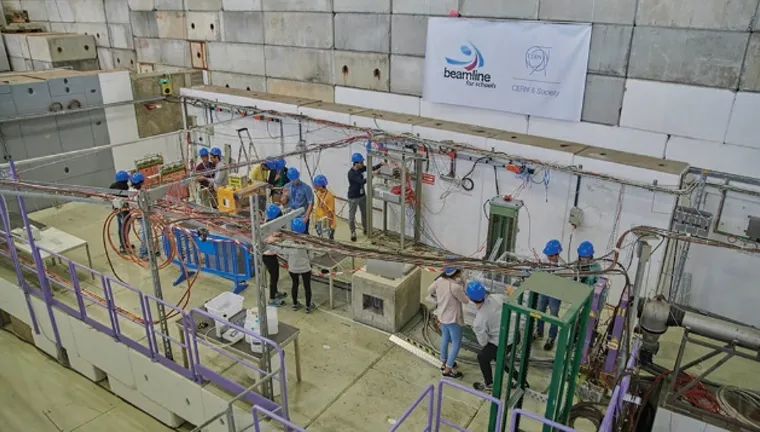
As you can imagine, preparing a proposal for such a particle physics experiment is a very challenging task for secondary school pupils but, when provided with the right support, the participants design very creative experiments. Teams of high school students can propose an experiment that they want to perform at a beamline. Out of the teams that submit proposals (this year from the 379 submissions 27 were short-listed, i.e. then carefully analysed in terms of feasibility and setup requirements), the three best proposals win a trip to CERN or DESY to perform their experiments at a fully equipped beamline, in our case at the T9 or T10 beamline in the East-Area.
This year the “Myriad Magnets” team from the United States and the “Particular Perspective” team from Pakistan came to the CERN T10 beamline, while the “Wire Wizards” team from the Netherlands were invited to go to DESY.
The “Myriad Magnets” team from the United States built and tested a permanent magnet with the Halbach geometry that can be configured to produce a dipole or a quadrupole magnetic field.
The Pakistan team “Particular Perspective” measured in detail the beam composition of the T10 beamline. The experiment set-up they designed aimed to differentiate between different particle species and measure their intensity.
The secondary T10 beam relies on the beam extracted from the PS and produced on either an aluminium or beryllium target. The available secondary beams can provide an energy range between around 0.5 up to 11 GeV consisting of electrons, positrons, protons, anti-protons, muons, pions, kaons, the latter two decaying along their path to the test beam area, then configured according to the beam requirements by using magnets, collimators and possibly convertors. The T10 user area has a size of about 5 m × 10 m, where the setup of the BL4S team is installed according to their needs.
As for this years’ results, the Myriad Magnets team managed to not only measure the action of their magnet array on the beam, but they also matched it to their simulation, which is quite an extraordinary feat for students at this level.
The Particular Perspective team managed to quantify the beam contents for both the positive and negative beam over the full momentum range with unprecedented precision, and we will surely use this in the future. We have been told by the BL4S team that they will potentially present this data at the BTTB conference the coming year to be held in Edinburgh between April 15-19th.
All required infrastructure (from the beamline, additional magnets, instrumentation and readout/DAQ) is made available by CERN (and can be complemented by the teams), carefully discussed between the CERN BL4S support team, the proponents and intensively involving our group support. Devices that are commonly used in those setups are various detectors, magnets, and all related infrastructure ranging from cabling, supports, racks, etc. Here CERN provides a range of technologies: scintillators, Cherenkov counters, delay wire chambers, multigap resistive plate chambers, micro-mesh gaseous structure detectors, lead-glass calorimeters and Timepix detectors.
In addition, students are allowed to build their own detectors and bring them to CERN. For the triggering, NIM modules are used, while the data-acquisition is based on a former system of the ATLAS experiment. As you can imagine, the student teams are provided with a detailed document that describes all of these components.
For this year, you can find the final presentations the teams gave here on Indico, also including the Wire Wizards (the team that tested a wire chamber that they built themselves, at DESY!). Helping the teams to prepare, this year, Laurie gave the introduction lecture on the beamline, and Maarten gave a specialist lecture on Cherenkov light (since this was one of the main tools for the PID team).
The announcement of each edition of BL4S is usually made during the summer the year before, with a deadline for submitting a proposal of up to 1000 words and a short video by early spring. After about two months of evaluation, involving more than 50 volunteer physicists, the two winning teams and up to 30 shortlisted teams are announced in June.
Of course, the final implementation of the proposal, the installation and preparation for data taking are guided by professional scientists. These scientists, typically young PhD students in physics, make the largest contribution to the success of BL4S. They are not only responsible for the fine-tuning and implementation of the experiments of the winning teams but have, in collaboration with the CERN detector workshops, also developed bespoke devices for use in the BL4S experiments. Even though these support scientists were often only involved with the project for less than a year, it offered them the opportunity to carry out a complete physics experiment from the beginning to the end; the skills that they acquired helped several of them to find interesting postdoc positions.
In this context, from the beginning, BL4S attracted a lot of CERN staff members as well as users and even retired staff to make voluntary contributions to the organisation of the event. This involves answering questions from the student teams, evaluating proposals, developing detectors and software, helping the winners with the analysis of the data, and many other things. These volunteers have become a crucial part of the competition.