
Our East Area Shining with IRRAD/CHARM & Users back and a closer look into 2021 Operation

10 DECEMBER,2021 | By Dipanwita Banerjee and the LE Operations Team
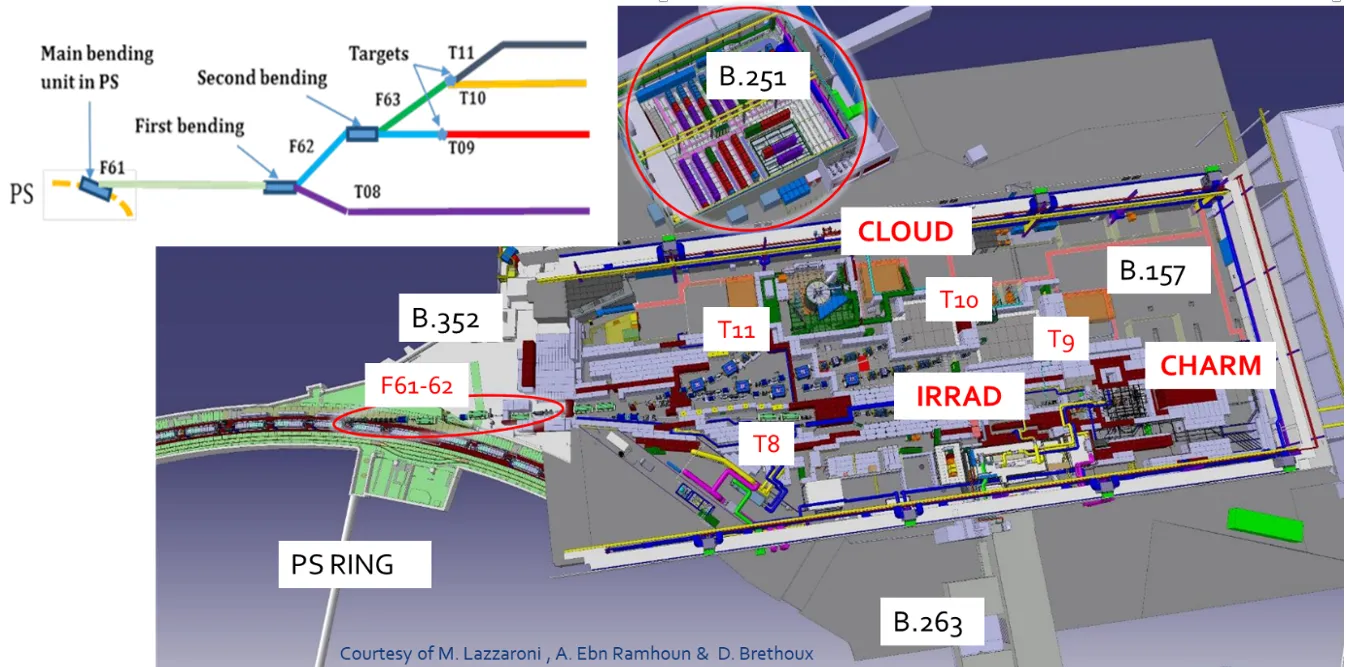
On October 18th, 2021, the East Area opened its doors to the first users following the extensive renovation works during the Long Shutdown 2. The experimental area facility underwent a major upgrade with optimised beamline layout, new beam instrumentations and laminated magnets with a new pulsed powering scheme including modern power converters.
The East Area comprises the primary beamlines F61 and T8, the secondary beamlines T9, T10 and T11. T8 receives the 24 GeV/c protons from PS and serves the irradiation facilities IRRAD/CHARM. Two new production targets serve the versatile secondary beamlines of T9, T10 and T11. The multi-target configuration helps providing either electron enriched or mixed hadron beam to the beamlines. On September 17th the first secondary beams were observed just after switching on the magnets at the design values which points to the excellent work of all teams involved including the East Area Renovation team,
Equipment/Service groups and the operation team.
The secondary beamlines were successfully commissioned delivering hadron, electron, and muon beams from 0.1 GeV/c to 15 GeV/c. The hadron beams are mixed beams produced from the primary target with an option to absorb the electrons with an absorber. A pure electron beam is selected from the conversion of the gammas in a converter, a thin Pb target and the muon beam is produced from the pion decay absorbing the pions in the closed collimators.
Dedicated measurements of the beam composition were done for different energies using a high-pressure Threshold Cherenkov detector which can have a maximum pressure of 15 bars. The pure electron beam was checked in the new T9 beamline which is an upgrade from the old configuration. A purity of more than 90% was observed for momenta < 3GeV/c for the electron beam which makes T9 an extremely desirable beamline for experiments and test beams requiring pure electrons at these energy ranges.
Many experiments including LDMX, TOTEM, HERD and ALICE had their test beam runs and a successful data-taking period in T9 and T10 until November 15th. The data taking for the CLOUD experiment which is housed at the T11 beamline was postponed to 2022. However, T11 was also successfully commissioned at the design momentum of 3.5 GeV/c. The lowest momentum ever tested of 0.07 GeV/c could also be achieved at this beamline. This was possible due to the newer, more precise power converters in the newly renovated East Area.
The commissioning of the IRRAD and CHARM facilities have also been successfully done including extensive tests of the new beam instrumentation in collaboration with SY-BI. IRRAD and CHARM hosted 16 experiments and 7 system level tests respectively and were serving the first users already in 2021. The experiments included EP-ESE, HL-LHC, ATLAS, LHCb, CMS and R&D collaborations and the system level tests were performed by TE-VSC, SY-EPC, SY-BI, CMS BDT and BE-CEM. Various user requests have already been received for the East Area for 2022 and a two-week beam commissioning is scheduled to start mid-March following the start of physics in April.
All teams are currently finishing up the last remaining works during the YETS 2021/22 including upgrade of some parts of the Threshold Cherenkov detectors, motorisation of the converter in the T9 beamline, installation of the absorber in the T10 beamline, installation of phones in the control room etc., to prepare for a full 36 weeks run in 2022.