
What experiment to run in ECN3 after LS3?

4 DECEMBER, 2023 | By Johannes Bernhard and Lau Gatignon
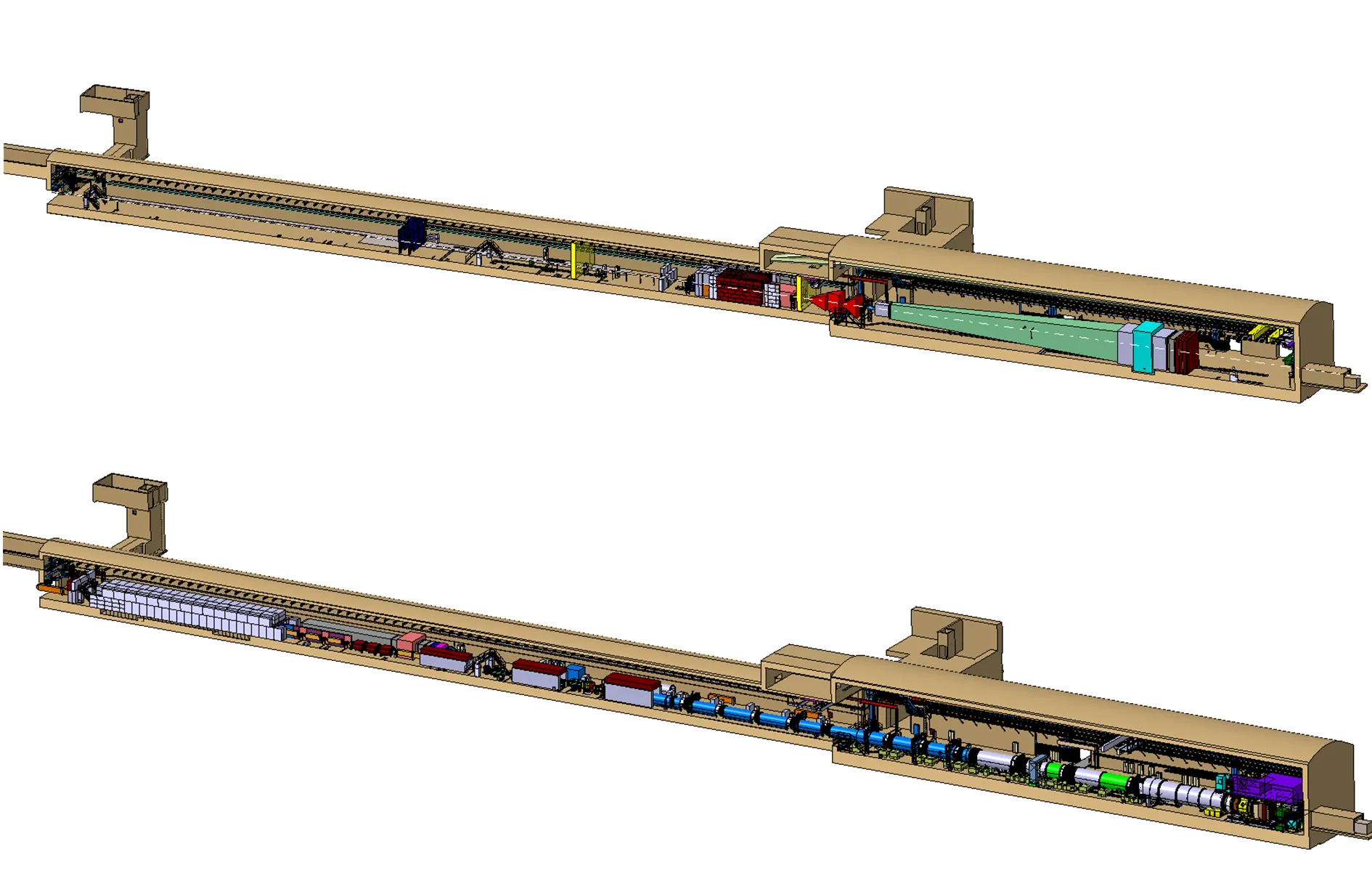
In the context of the Physics Beyond Colliders (PBC) study, new ideas were solicited for experiments complementary to the ones at high-energy colliders. ECN3 is the only underground cavern in the North Area, where the highest intensities are possible. A number of proposals were submitted to PBC to run in ECN3 with ever higher intensities. In the end, only three were followed up in detail and forwarded as full proposals to the SPSC committee: HIKE, SHADOWS and SHiP. The latter two are focused on the search for Feebly Interacting Particles (now called FIPs), whereas HIKE concentrates on precision measurements of rare kaon decays.
So far, all physics and particles that we observe at our accelerators are very precisely described by the so-called Standard Model (SM) of particle physis. However, the SM is incomplete. From cosmological observations we know that only 5% of the mass of the universe is in the form of the matter we observe in our laboratories. All the rest is composed of Dark Matter (DM, about 25%) and Dark Energy (about 70%). Dark matter is responsible for the way galaxies are organized on grand scales, whereas dark energy denotes the influence that drives the accelerated expansion of the universe that are measured in astronomical and cosmological observations. These 95% seem so far only to interact via gravity and we know almost nothing about them. Dark matter could well exist in the form of particles, whereas for dark energy this is less sure.
It is tempting to think that such putative dark matter particles are either very rare or interact very rarely with the SM matter that we know (baryonic matter, i.e. matter made of protons, neutrons and also electrons). Such new particles and other potential forces outside the Standard Model are often categorised as New Physics or physics Beyond the Standard Model (BSM).
It is obviously of extreme interest to look for the unknown 95% of matter. Many models predict how they can (very rarely) decay into known particles that we can observe in our experiments. There is a large variety of models that predict masses from below a micro-eV up to above electroweak scale (a TeV or more). There is no theoretical preference or guidance for any of these mass scales. One popular class of models is called Supersymmetry and was one of the motivations to build the LHC (in addition to the Higgs, of course), which however did not find it. Many models explain the non-observation of DM particles so far by assuming that the dark sector particles are too heavy to be produced in today’s colliders. This motivates the construction for even higher energy colliders such as the FCC. If those particles have very low masses, they could be detected in non-accelerator experiments, such as IAXO or MadMax (nothing was found in the CAST experiment at CERN).
Recently models were proposed that explain DM, as well as e.g. neutrino masses and matter dominance over antimatter by light particles, typically in the range between 10 MeV/c2 and a few GeV/c2, that interact very feebly with normal matter. Such particles are called FIPs. The simplest models propose that the mediators of these transitions to or from dark matter (so-called ‘portals’) can be neutrino like (HNL for Heavy Neutral Leptons), dark scalars (Higgs-like), axion-like particles (ALPS) or dark photons. The models predict specific decay channels for the different types of mediators. Those decays can be detected. As the processes are very rare, you need many proton interactions and an experiment with a very large detector. ECN3 is ideal for the detection of FIPs as it can accept large intensities and large detectors.
As the detectors can be long and the decay lengths are lower at SPS energies than at the LHC, fixed target experiments are better suited to search for FIPSsthan high-energy colliders.
Search for Hidden Particles (BDF/SHiP) is a dedicated experiment to search for FIPS. It is primarily optimized for HNLs but is also excellent for the other portals. It is probably as good a FIPS experiment as can be conceived in ECN3. The full proton beam from the SPS (4 1013 protons per spill) is extracted onto a massive target and beam dump that stops all protons and secondary particles, except muons and neutrinos and some very low-energy neutrons. A 40 metres long system of super-conducting and normal magnets will sweep most of the remaining muons away. The initial idea was to stop them in 11 tons of tungsten and 2500 tons of lead, but that was not enough! This dump and muon sweeping system is followed by a 50 m long decay volume, a magnetic spectrometer with 4 huge straw chambers, calorimeters, and muon detectors. The initial Letter Of Intent was submitted to the SPSC in 2013 for installation in a new underground cavern, ECN4, but this was considered too expensive. Studies and R&D work have continued without interruption and in October this year an updated proposal was submitted to the SPSC for installation in ECN3. If SHiP would discover dark matter, this would be by far the most important physics result that can be hoped for in ECN3: it would revolutionise the physics landscape. However, it is still a very expensive experiment with a high risk of finding nothing. Nevertheless, contributing to excluding this mass range as a possible place for new physics, thus also constraining respective theoretical models. To further mitigate this risk, the set-up was complemented with a neutrino detector that would collect thousands of tau neutrino interactions (so far only a few were seen) as well as to not yet observed tau anti-neutrino.
The High Intensity Kaon Experiment (HIKE) is also driven by the hope to find BSM physics or New Physics. The main idea here is to study very rare decays of the kaon into a decay mode that is very precisely known in the SM. If one measures the decay rate of such a decay channel very precisely and finds it sufficiently different from the SM (by 5 sigma), one may claim discovery of New Physics. Kaon experiments are sensitive to extremely high mass scales, not even accessible by the FCC. The ‘platinum channel’ is the decay KL →π0νν, which can be known theoretically to about 2% and has a theoretical branching fraction of about 3 10-11. This is however an extremely difficult measurement, considered by the KLEVER team, but not included in the HIKE proposal. HIKE does however propose two phases. The first phase is an upgraded version of NA62. HIKE hopes to measure the decay rate of the ‘golden’ channel K+ →π+νν to about 5% with a SM branching fraction of 8 10-11. NA62 is expected to achieve a 15 to 20% uncertainty. The 5% HIKE error should match the theoretical precision by the time the result becomes available. HIKE also measures a multitude of other important decay channels with unprecedented precision. All these measurements will put strong constraints on the SM. In the second phase, HIKE will use a neutral beam, composed of in particular KL particles. In this version they should measure the not yet discovered ‘gold-plated channels’ KL →π0e+e– and KL →π0μ+μ– to 12%, respectively 18%. Again, the latter measurements are very important and complement the NP reach of the first phase as well as of experiments in the B-sector (e.g., LHCb and Belle-II). They could maybe lead to the discovery of lepton flavour violation or lepton number violation. HIKE has also sensitivity to the dark sector and it excels for masses below the kaon mass (0.5 GeV/c2). Here it does for some channels even better than BDF/SHiP, but NA64-μ and also in the future the DUNE neutrino experiment will be potential competitors. HIKE can also run in beam dump mode (as was already done for NA62).
In the latter case, Search for Hidden and Dark Objects With the SPS (SHADOWS) can run in parallel with HIKE using a setup on the side of the K12 beam, just downstream of the TAX which serves as the beam dump. As the detector is laterally offset from the beam, most of the potential background particles go straight and do not enter the SHADOWS detector. The detector principle is similar to SHiP but everything is much more compact.
But as the detector is very close to the dump, the angular acceptance remains large. In beam dump mode, the combination of HIKE and SHADOWS is much less sensitive than SHiP (typically by a factor 10 to 100), but for many channels much better than present limits and competitive with other planned experiments outside ECN3. SHADOWS has also foreseen a small neutrino detector, which however will get much less statistics than SHiP.
All three experiments can provide very important physics results. Unfortunately, not all can fit into ECN3. SHADOWS can run in parallel with HIKE, but BDF/SHiP can only run alone. Very soon, the SPSC, Research Board and Council are supposed to decide which of these experiments will run in ECN3 after LS3. In each case, the 2023 Advent will launch an exciting physics programme in ECN3 for many years to come, according to the proposals at least until 2048.