
RF separated beams

19 DECEMBER, 2022 | By Fabian Metzger
The M2 beam served the COMPASS experiment since beginning of data taking in 2002. It can run in three different modes, namely it is able to deliver muon, hadron and electron beams to EHN2. Now, that COMPASS data taking has finished and AMBER is taking over most of the detector equipment and will further make use of the M2 beam. Different to COMPASS exploiting pions, AMBER is also planning to do physics with kaons. For this, it is necessary to have a high-intensity beam of kaons so that they can go and hunt for the needle in the haystack.
As the M2 beam can deliver hadron beams, we have also a kaon component sent to EHN2. Naturally, this fraction is low due to limiting production, but dominantly due to decays (we lose circa 85% along the 1.1km!!! long beam line). The beam is therefore dominated by pions and because of radiation protection limits applying to EHN2 being overground, the achievable maximum rate of kaons in EHN2 is relatively low. To overcome this problem, we need to filter out particles of minor interest to be able to get more kaons. This can be achieved with a setup that acts like a mass spectrometer; the so-called radio-frequency separation.
This technique has already a long history at CERN. It was first brought up by Panofsky and Wenzel, and Wolfgang Schnell had the idea to install such a system at the PS. But not only at CERN, also at SLAC in the US RF separators have been widely used. Because of the limiting performance of cavities back then, the beam was limited to small energies and low intensities.
Like in the current M2 setup, we get the proton beam from the SPS and sent them to the T6 target. Up to the TAX, the beam line is kept unchanged. After it, the whole setup would be modified to be able to place the filtering system and make efficient use of it.
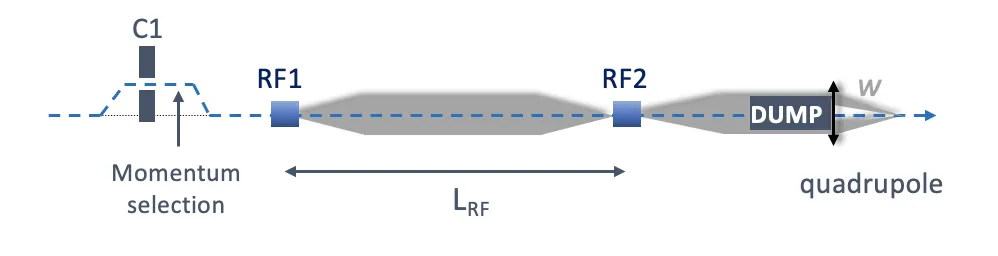
After the momentum selection we can then transport the beam, that still consisting of pions, kaons and (anti)protons to a first set of radio-frequency cavities. Those devices are widely known over the CERN campus, but we use them differently. While in the accelerator chain, they are used to increase the proton momentum in forward direction, we deflect the particles passing through them perpendicular to the beam axis increasing the transverse momentum. Then, we transport them to the second set of cavities. With some maths we can tune the second cavities such that we filter out all particles that we are less interested in, mainly pions in that case. That is possible because all the particles in the beam have different velocities. Challenging is, that those velocity differences are tiny as all the particles travel (nearly) as fast as light: Just as an example, the kaons fly with 99.9975% and the pions with 99.9998% of the speed of light.
Of course, this exists only on computers up to now, but one can already simulate the effect of separation as shown in the two pictures on the bottom. They show the so-called phase space of kaons and pions (it is an abstract space, where the