
The NA62 Experiment

22 DECEMBER, 2023 | By Lau Gatignon
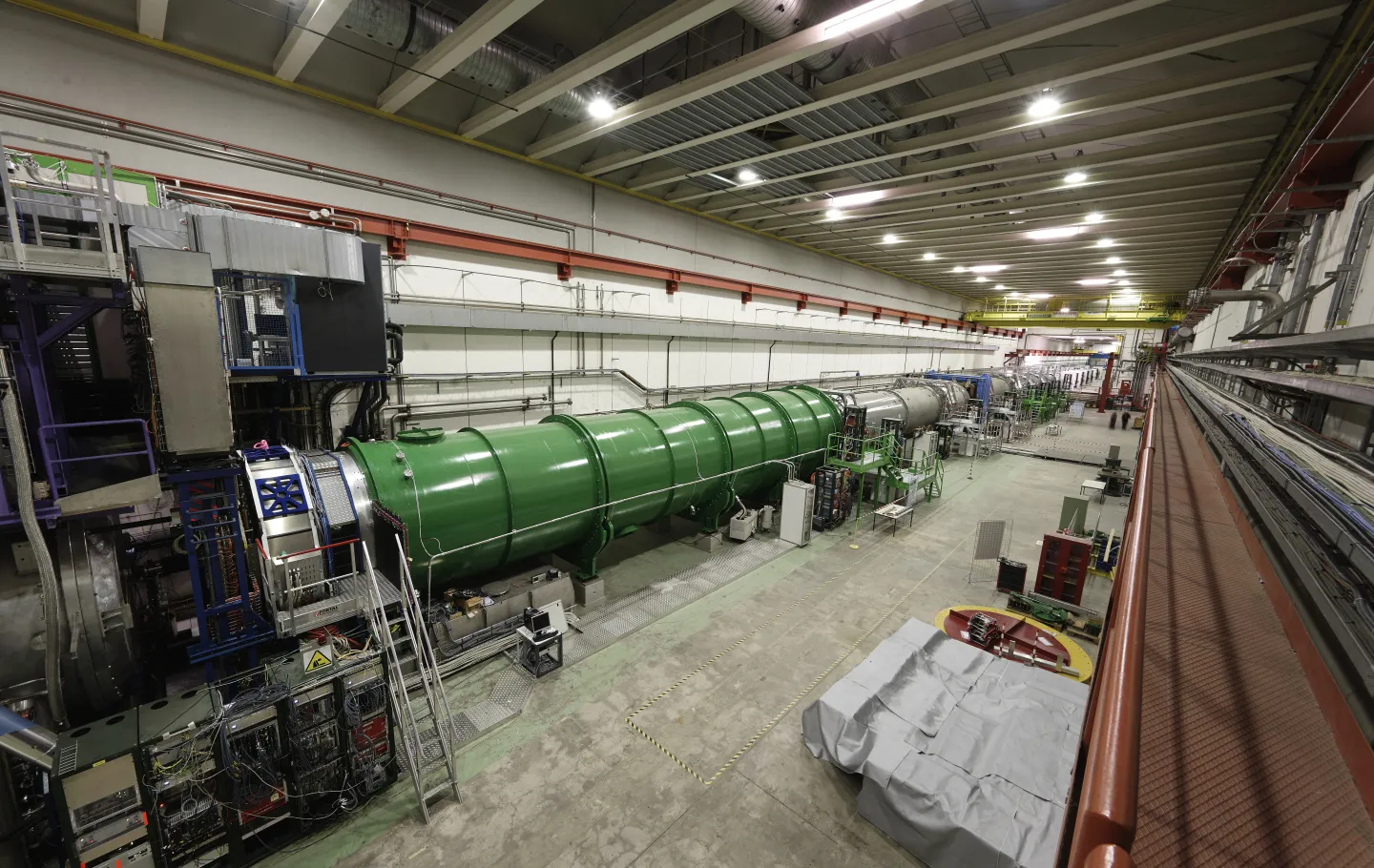
The NA62 experiment was proposed in 2005 and approved in December 2008 to search for the ultrarare kaon decay K+ → π+νν with a very tiny Standard Model branching fraction of 8×10-11, which means the decay happens only about once in 10 billion kaon decays. This is a very important decay channel, as the fundamental theory is precisely known and so a precise measurement can reveal potential tensions, whether due to uncertainties linked to parameters that must be measured still, or even new physics beyond what we think to know. NA62 measures a number of additional decay modes of the kaon and the pion that allow to better determine those parameters and hence improve the precision of the Standard Model predictions, in synergy with B-physics.
For the theory side of things, more can be found in previous Advent articles. Let us now go to how this kaon decay and its branching ratio are measured and where we in EA have contributed significantly.
Obviously, the first contribution, and not the least, is the design, installation, and operation of the K12 beam line. Between 2009 and 2012, the TCC8 and ECN3 caverns passed through a phase during which they were completely emptied downstream of the T10 target, at the time under the direction of Francois on the engineering side and Lau on the beam physics. The new K12 beam line was essentially complete in 2012 but the experiment installation only in 2014. First serious physics data-taking finally started in 2016.
The K+ → π+νν decay is a particularly difficult one to measure as there are backgrounds from 1010 times more frequent other decay modes, as well as from the so-called pile-up, which is particles from different events overlapping in time. Four conditions are essential to reduce those backgrounds: firstly, a good definition of the small (6%) fraction of K+ in the beam, combined with a good definition of a pion track in the experiment at the corresponding time, as these are the two particles that can be really seen by detectors in the K+ → π+νν (the neutrinos are basically invisible). Secondly, a good vacuum to reduce interaction of non-kaon beam particles that can produce pions. Thirdly, a good muon sweeping to reduce the pile-up and possible misidentification as pion and muon masses are very close together. And, last but not least, hermetic coverage of particles that might escape detection, which means a good coverage with veto and other detectors around the beam.
The kaon detection is performed with the KTAG, a Cerenkov light detector built around a CEDAR counter. The CEDAR is a very beautiful detector design from the beginning of the SPS in the 1970s, made by Claude Bovet from the BI team. It allows tagging a specific type of particle in the beam whilst being blind to all others, both with very good efficiency and clean identification of the particle. In case of a 6% kaon fraction in a high-intensity beam, this is an ideal concept. In the following pictures we show first a schematic view of the Cedar and then on the next page the corresponding KTAG addition.
The CEDAR is filled with a gas, typically Helium or Nitrogen. Each charged particle traversing the gas in the detector at a high speed produces photons at an angle precisely defined by the particle velocity, which we call the Cherenkov effect, hence the name of the detector.
As the momentum is well defined by the beamline, the angle depends only on the mass of the particle for constant environmental conditions, i.e., constant temperature, volume, and gas pressure. The optical system reflects the light onto a diaphragm plate that only passes the light from particles with the kaon mass. The light is then directed onto one of eight photomultipliers in most of our CEDAR detectors. The particle is considered a kaon if at least 6, but better 7 or 8 photomultipliers fire at the same time. The more fire, the more we are sure that is a kaon.
The nominal K12 beam intensity is 2.2×10⁹ particles per spill, so almost an order of magnitude higher than the other secondary beams we have so far, which corresponds to a rate of over 400 MHz. Even the kaon rate alone is then 24 MHz, hitting every photomultiplier. No detector can stand this high rate. Thus, each of the 8 photomultipliers was replaced by a spherical mirror that reflets the light outward and in addition increases the light spot. This allows sharing the photon flux over 50 small photomultipliers in each of the spots (the green plates in the sketch above). This scheme was initially proposed and even simulated by our team in 2004 and finally worked out and built in the UK.
We also realized that the gas and windows in the CEDAR would perturb the beam too much and looked for ways to reduce the impact of the material. The originally used CEDAR-W runs with Nitrogen at low pressure, but the Nitrogen represents many radiation lengths (Xo). The CEDAR-N uses Helium at about 11 bars, which requires thick windows. Therefore, we proposed already in 2004 to use Hydrogen instead. This can work with 4 bar pressure and offered by far the best compromise: Hydrogen has 6.4 permille of Xo only when comparing to 18.3 and 33 permille of Xo for Nitrogen and Helium. Our simulations showed that even an unmodified CEDAR-W could work with Hydrogen, although with slightly degraded but still acceptable performance. We even made initial studies in 2008 to see if an optimized optics for Hydrogen could be designed.
This seemed to be possible, but we did not have the means to build a new CEDAR at the time. A CEDAR-W was then installed in K12 and tested with Nitrogen. New thin windows (150 and 200 m) were built by our vacuum team. The modified device was a prototype and turned out to produce 20% less light than it should. Running with Hydrogen would even further reduce the light yield by another 20% and thus affect somewhat the efficiency and particle discrimination performance.
Fortunately, recently the CEDAR-H project was launched, and the UK teams finalised the optics design for Hydrogen. Thanks to the efforts of the EA teams who did all the engineering, assembly, and mechanics, the CEDAR-H is now installed in K12, and it has performed beautifully during the 2023 run.
Another major contribution from the EA teams is the blue vacuum tank and the vacuum system. The blue tube was built in industry for NA31, but the design was initiated and followed by EA. It initially served in the H4 beam in EHN1.
After the end of NA31, it was moved to ECN3 to serve NA48. Unfortunately, many of the modules had been permanently magnetised in H4. The upstream part by tests at full power of the MBN magnets that were installed inside on a target train (the XTGV) and the downstream part by the stray field of the neighbouring M2 magnet in H2 (already!). Whenever the tubes are moved, they are mechanically shaken and the field can change slightly. Therefore, each time the field must be remeasured. The fields are quite small (typically a few tens of mT or a fraction of a Gauss), but integrated over the length of the tank their impact is significant. Without correction for this, neither NA48 nor NA62 could work.
When one of us (then still member of NA31) claimed the presence of such a field inside a soft iron tube, he only got severe insults from everybody, until Niels took him inside the tube and the fields were really measured.
The vacuum inside the tube must be of the order of 10-6 mbar. Most of the sections of the tank are made of normal steel, which tends to outgas more than stainless steel. Therefore, for NA62 they were cleaned by sputtering CO2 pellets onto the entire surface. The vacuum studies started inside EA, but were finally handed over to the vacuum group. It is interesting to note that without the capabilities of both CEDAR and KTAG, the vacuum requirement would have been 17 times tighter (1 / 6%) and unrealistic in the presence of 2500 lead glass crystals inside the tank.
Those are addressed by a magnetic collimator inside the so-called second achromat, to which we will refer a bit later. Following detailed simulations, it was found that the remaining flux in NA62 could be reduced by another 30% if the last MCW magnet of the achromat was to be installed upside-down. This changes the orientation of the return fields that positively affects getting rid of the remaining muons.
The last topic we want to address here are the recent modifications of the ‘second achromat’ section, pictured below. The dominant remaining background in the experiment came from decays and interaction in this last section of the K12 beam line. They only contribute to background if at the same time another particle traverses the Gigatracker beam tracker stations, so the famous pileup. By reshuffling and slightly reoptimizing the different magnet positions, space could be created for an additional veto counter, that helps to keep these backgrounds under control. Indeed, the new layout and veto counter has made a significant improvement: the upstream background remained constant while the intensity was increased significantly. Note that pileup increases with the square of the intensity.
These are a few highlights out of the many contributions of the EA teams to the success of the NA62 experiment. And success there is! Based on the data taken in 2016-2018 (mostly in 2018, in fact), NA62 has published a first result with 2020.
K+ → π+νν events including 7 background events. This corresponds to a 3.4 σ observation of this decay mode. The paper has already been cited 173 times in 2 years (the much older beam and detector paper 349 times). The prospect for the final result is a precision of just over 15%. In addition, the experiment has published many papers on many rare decay modes and searches, all not possible without our help.