
SND@LHC and its upgrade studies (AdvSND)

6 DECEMBER, 2023 | By Lukasz Krzempek and Deepti Kandhol
The Scattering and Neutrino Detector at the LHC (SND@LHC) aims to make measurements with neutrinos of all three flavours at the LHC and to search for feebly interacting particles in a hitherto unexplored domain. The detector is a combination of a neutrino target, based on the nuclear emulsion technology interleaved with scintillating fibre tracker layers (SciFi), and a system with scintillating bars and iron absorbers that combines the task of timing measurement, hadron calorimetry and muon identification.
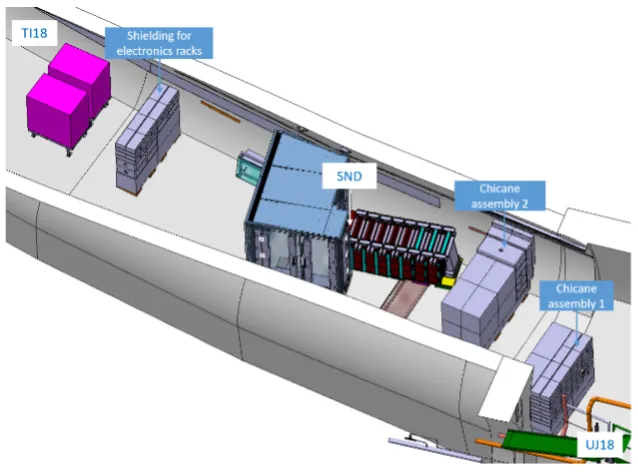
In the beginning of 2023, the installation of shielding blocks took place to reduce the influence of neutrons and hadrons in the detector and in electronic racks. The additional installation of new shields required some extra works in TI18 to resolve space constraints and to enable handling of blocks. The goal has been achieved by BE-EA group coordinating design, preparatory works and work site supervision involving different teams, CERN main mechanical workshop as well as SND collaborators.
Based on FLUKA simulations of the beam induced background, the results have shown improvement of the first neutrons interaction points with shielded detector. The plots below depict the experimental conditions for the SND experiment with and without shielding walls.
The 2023 run of the LHC has confirmed that the concrete shielding walls reduced the impact of neutrons and hadrons on the SND detector and electronic racks. Some studies focused on the upgrade of the current experimental setup during the run. The new configuration of the detector will efficiently distinguish all three neutrino flavours and measure their energy. AdvSND will open a unique opportunity to probe the physics of heavy flavor production at the LHC in a region inaccessible to other experiments.
The detector will be made of three elements. The upstream one is the target region for the vertex reconstruction and the electromagnetic energy measurement with a calorimetric approach. It will be followed downstream by a muon identification and hadronic calorimeter system. The third and most downstream element will be a magnet with two high-resolution tracking stations to enable muon charge and momentum measurement, thus allowing for neutrino/antineutrino separation for muon neutrinos and for tau neutrinos in the muonic decay channel of the lepton.
From the point of view of BE-EA integration team, the most challenging task is to leverage space constraints of TI18 and to ensure at the same time the feasibility of detector’s transport and assembly. Therefore, a local 8m-long enlargement has been proposed to the civil engineering team. The excavation will partially concern a side wall and the floor of TI18 which will also have an impact on the current tunnel’s services. Since the beginning of feasibility studies, immense importance was placed on the transportation of heavy components of AdvSND. After few iterations with SND collaborators, it was agreed to optimise the detector’s components to their maximum weight allowing the installation/upgrade of appropriate handling tools and cranes in UJ18 and TI18 caverns. Further, the transport team is also verifying the feasibility of handling strategy, keeping in mind civil engineering team will have to bring down the excavators for the construction of TI18 enlargement.
An advanced version of the SND@LHC detector is envisaged for the HL-LHC phase and has been presented at the open session of 156th LHCC meeting this year.