
T11 Beamline for CLOUD

21 DECEMBER, 2023 | By Johannes Bernhard, Aboubakr Ebn Rahmoun, Laurie Nevay and Giulia Romagnoli
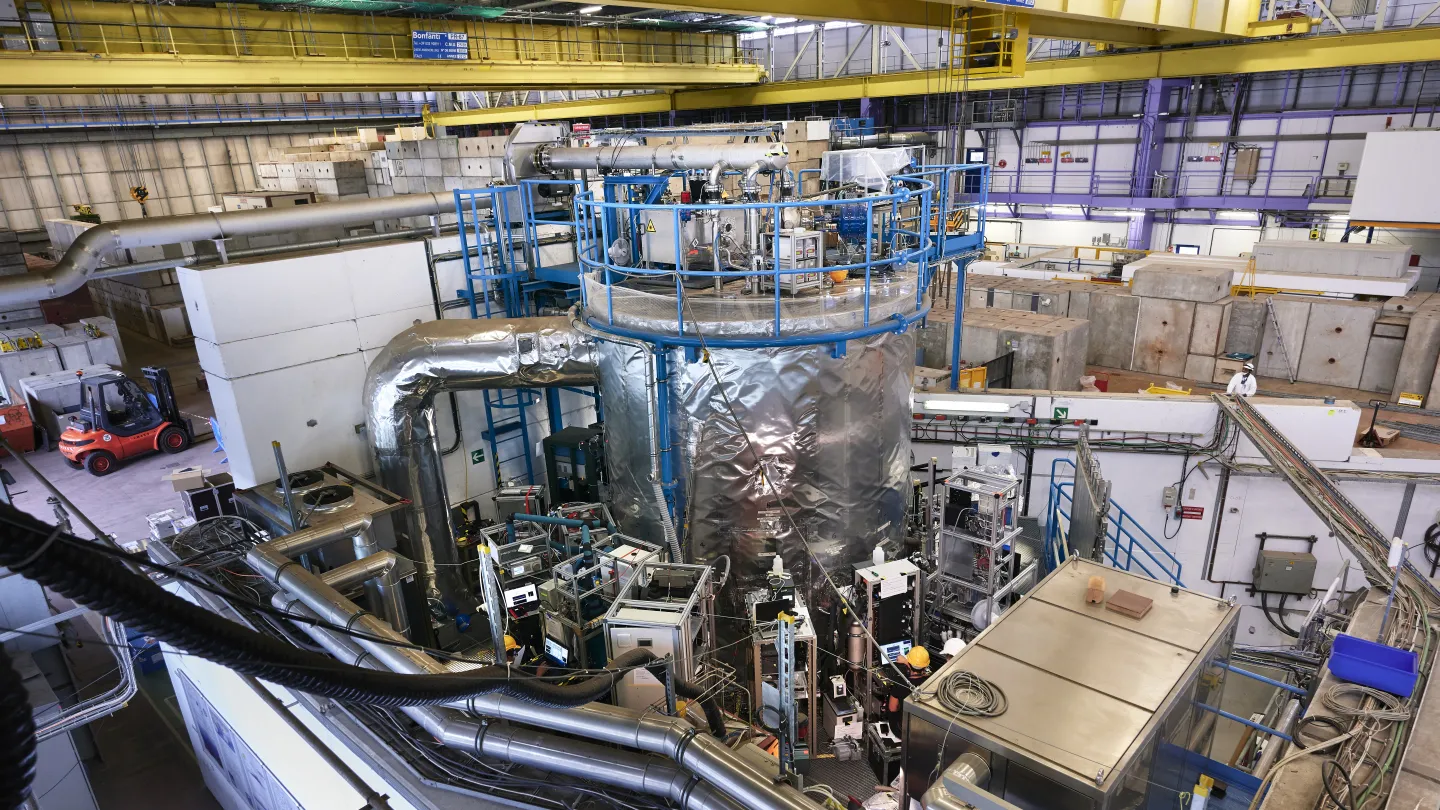
Did you know? The East Area T11 beamline in building 157 is bringing 3.5 GeV/c pions to the CLOUD experiment.
The CLOUD (Cosmics Leaving Outdoor Droplets) experiment was installed in the East Area in 2009 and it was the first time when an accelerator (the PS) was used to study atmospheric and climate science. The huge cloud chamber installed inside the East Area is used to precisely recreate the gas in the upper atmosphere and study the influence of galactic cosmic rays on aerosol particles in the atmosphere. It can use the mixed pion and proton beam coming from protons from the PS accelerator hitting a target at the start of the T11 beamline, but also it can run using UV light when the line is not delivering particles (during LS or YETS for example).
The pressure, temperature and humidity are controlled precisely to study the formation of aerosols. These play a huge role in the evolution of our climate but are not well understood. The temperature in the 26 m3 of synthetic air (mixed from pure gases) can be controlled to 0.10C and cooled down to -500C. In fact, there would be no clouds in the atmosphere if there were no very small aerosol particles to act as ‘seeds’ to start the formation of cloud droplets. The chamber can be illuminated by specific laser sources to start specific chemical reactions.
Clouds are created in the chamber by lowering the pressure slowly, which causes the relative humidity to increase over 100% and cloud droplets to form. Clouds can be maintained in the chamber for 5-10 minutes depending on the selected conditions.
Did you know? The T11 beamline was completely renewed and refurbished during the East Area Renovation Project in LS2.
The T11 beamline starts from the secondary target of the F63 beamline in the primary areas of building 157, passing inside the mixed area and reaching the T11 experimental area where the CLOUD chamber is installed and ends there in the T11 beam dump. The T11 beamline was completely re-built and is a simplified version of the T10 and T09 beam lines due to space constraints. It shares the same target as the T10 beam line and starts with a large horizontal angle with respect to the primary proton beam.
Did you know? With a total length of 40 m, T11 is the shortest beamline of the East Area but it is the most bended one on both the vertical and horizontal planes.
The beam is bent in the horizontal plane by two huge M200L magnets, which were completely re-designed by Roberto Lopez, starting from the MBPL magnets we use also in the North Area. Roberto was a dear colleague to us and passed away way too early. Since the whole beamline is under vacuum, two special bended vacuum chambers are inserted into these magnets. The T11 beamline is built at a starting angle both vertically and horizontally from the incoming beam to the target. This “production” angle means that any remaining protons from the PS cannot reach the experimental areas but stay flat and go into a dump. The T11 beamline only has bends in the horizontal and it continues uphill to get it to the height of the CLOUD chamber. The other magnets of T11 beamline are there to focus and adjust the beam shape to the one required by the experiment. The beam stopper at the beginning of the line it is classified as an EIS element to be inserted into the beam if access to the experimental area is needed.
The interesting thing about the T11 beam is that it is ‘over-focused’ before CLOUD. This means there is a focus of the beam before it reaches CLOUD so by the time it reaches CLOUD it is much bigger and over 1 x 1 m2. The goal is to illuminate the whole chamber as evenly as possible. This solution was one found by our very own Lau Gatignon after CLOUD had been proposed for years and nobody knew how to create a beam that big.
A mobile shutter was installed in the shielding surrounding the CLOUD experimental area to slightly reduce the radioactive dose inside while the T9 and T10 beams are working and while CLOUD has long access periods. The shutter is a steel block, 200 mm thick, moving up and down according to the needs. This shutter is not considered an EIS as it is not designed to absorb the beam, but just to add more shielding and protection to the people inside CLOUD areas while the East Area lines are working.
CLOUD has been profiting a lot from the East Area renovation, especially for their new infrastructure and much more space, which allowed them to upgrade their system this year. Unlike the name suggests, FLOTUS has nothing to do with Jill Biden, but stands rather for FLow TUbe System. It consists of a 3 m long quartz tube with 20 cm diameter, surrounded by high intensity UV lamps, which was installed during the last YETS close to the big CLOUD vessel. The new system is an attempt to deal with a general shortcoming of all such aerosol experiments: they literally hit a wall, or rather the chamber walls, and get absorbed or chemically modified there. This is similar to what happens to exhaust fumes in your car’s catalytic converter, where certain aerosols and gases are converted to less harmful products. When you want to study exactly this, such an effect limits the experiment typically to about one hour after which everything must be cleaned and started from scratch. In the real atmosphere, chemical processes take place over hours or even days, so you can imagine that the CLOUD experimentalists tried to find a solution to their dilemma. FLOTUS helps as it acts like a small time-machine: The trace gases, which will later help building up aerosols, are inserted first in the tube and then get artificially aged by the help of UV lights (like the sun in the sky), heat, and adding some ‘radical’ ingredients to the mix, such as ozone. The new system can age the gases up to 10 days in just a very short time. They are then injected in the CLOUD chamber, where all experiments and measurements can take place. FLOTUS has been successfully commissioned and first measurements were taken this year. The experimentalists look ahead to the new possibilities and have already plans for the next 10 years to come.