
Cleaning and dismantling

16 DECEMBER,2020 | By Markus Brugger
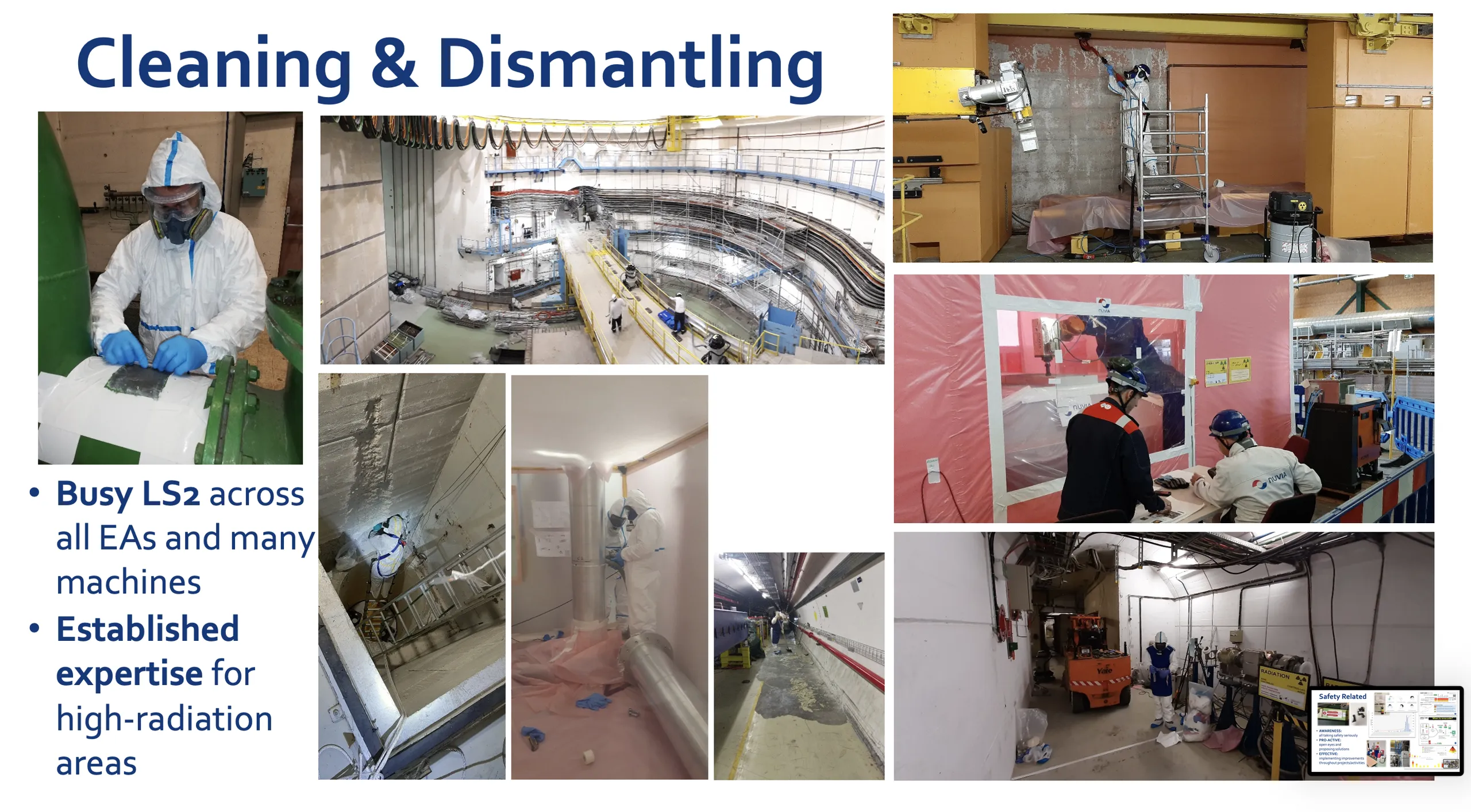
Based on LS1 experience and triggered by the various projects within our group, it was in 2018 during a group management retreat when we realized that many work packages and activities will require critical dismantling and cleaning tasks to be carried out in radioactive areas. Based on an initial list of requests, we thus initiated a new framework contract which has provided essential support across CERN, largely exceeding the initially envisaged scope, and this way becoming an essential support activity managed by our group. Target or dump areas, high-loss regions in the injectors and the LHC make dismantling activities a challenging exercise and require careful preparation, dose planning, and timely execution. To maintain the latter, schedules are often constraint, thus relying on a professional dismantling and cleaning team is essential for the success of many projects. Precise documentation in the preparation process is key for the success and carried out effectively together with the contractors. As you can see in the pictures below, their work spanned across most of CERNs machines and experimental areas, such as LSS1/LSS5 of the SPS, the AD and nToF target areas or the primary beam area in the context of the East-Area Renovation project. A particular challenge turned out to be the ATLAS forward shielding modifications required for our HL-LHC machine detector interface work package (WP8). For the latter, a significant amount of material must be removed in order to house the future LHC beam vacuum assembly elements (VAX) on the side of the experimental cavern. For this purpose, we purchased a robot together with the CERN robotics team, remaining at our service also for future activities. The reactivity of this contract has also proven to be essential when we discovered in the beginning of LS2 that several cooling installations contained lead in their painting, thus for activation reasons requiring dedicated cutting and cleaning procedures when related dismantling or upgrade work is required in radiation areas. This initially posed a significant risk of accumulating delays to the overall LS2 schedule but could be remedied also thanks to the fast availability and professional execution of the required tasks. Over the past two years, more than 40 activities where followed, some small but essential to be carried out quickly, others large and often forming a critical milestone to be reached by the concerned projects. I received numerous positive feedback from many of our clients, thus profit from this occasion congratulating all teams involved in this endeavour.