
The CO2 Cooling Project for ATLAS & CMS

11 DECEMBER, 2021 | By unknown
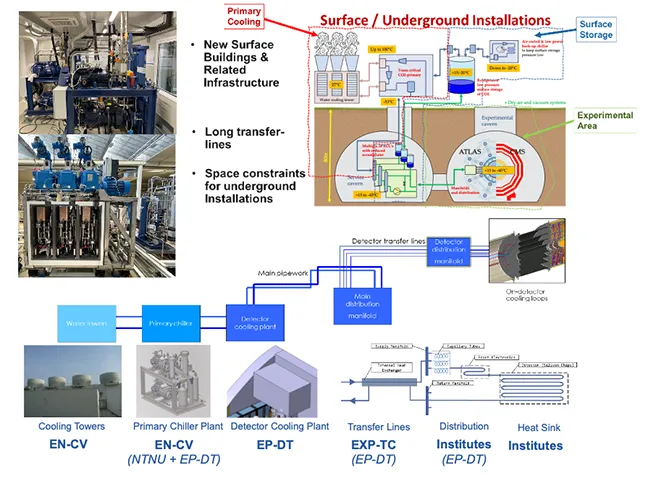
The phase-II upgrades of ATLAS and CMS pose unprecedented challenges on detector cooling. Operation at lower temperatures (down to -40oC) is required to cope with higher radiation levels at the inside of the detector during the upcoming HL-LHC area. In addition, the number of systems to be cooled and in particular the heat load rise tremendously, reaching the order of 1MW of total cooling power of the new ATLAS and CMS CO2 systems together.
Over the last decade, CO2 has established itself as a promising coolant. Operated in the so-called 2PACL mode, dual-phase CO2-based cooling systems bring the advantage of small diameter pipes, both on the detector evaporator and in the transfer lines between plants and detectors. Applied first in the AMS-02 detector, since 2008 in the LHCb VELO and more recently also in the ATLAS IBL and the (phase-I) upgraded pixel detector of CMS, 2PACL plants have proven to be reliable, efficient and stable cooling systems. Compared to conventional systems which often use fluorinated coolants, they have the additional advantage of being environment friendly. To achieve this performance, also the primary systems upstream the 2PACL plants face several challenges. The primary system needs to provide a very stable temperature regulation, be compatible with installation on surface (due to the limited space available in the underground premises) and to be compatible with CERN’s greenhouse gas objectives.
The final primary systems for ATLAS and CMS will be installed in two new buildings at point 1 and point 5. The liquid supply and gas return CO2 pipes will be installed between these buildings and the corresponding underground areas through long vertical service shafts (PX15 and PN54) and connect the primary circuit to the 2PACL systems installed in the service caverns. The overall schedule of the CO2 project is tight and has despite the Run-3 extension only very little margin. An amazing project spanning across sectors, departments and involving many groups, as well as teams around the world for the corresponding detector parts. An exciting gamechanger upcoming for LS3.