
SND@LHC

7 DECEMBER, 2023 | By Lukasz Krzempek
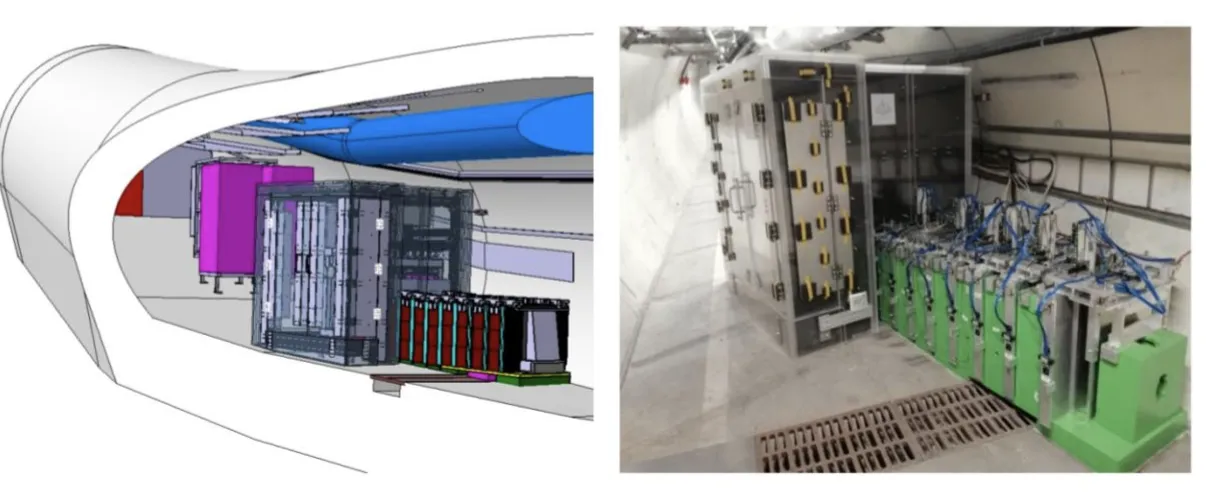
The Scattering and Neutrino Detector (SND) aims to measure the process pp→νX at the LHC and to search for feebly interacting particles in an up-to-date unexplored domain. The detector is a combination of the muon identification system and the neutrino target which is based on the nuclear emulsion technology with the scintillating fibre tracker (SciFi).
EA has been involved since the early phases, after a very intense approval and preparatory period, the installation of the SND took place in November 2021 and was accomplished in the beginning of 2022. The detector has been installed in the TI18 tunnel due to very low machine-induced background and the small angle with respect to the beam-beam axis at the ATLAS Interaction Point (IP1).
On 28th November 2022, the LHC machine has ceased its run for the yearly technical stop (YETS). It has delivered more than 40/fb of integrated luminosity, out of which 96% have been recorded with the SND electronics detectors. It is considered to be a very good result, especially, for the new detector which was installed and commissioned within few months. During its run in 2022, 3 emulsion films have been exposed in total.
The current YETS 2022/2023 is a good opportunity to implement some improvements around the detector and its infrastructure. One of the goals is the installation of some extra shields in the TI18 tunnel. The aim of an additional shielding is to protect the detector and its electronics racks from the neutrons and hadrons coming from mainly the adjacent LHC quadrupole Q12.