
Robotic Inspections

19 DECEMBER,2021 | By Ramon Folch, Antonio and Giulia Romagnoli
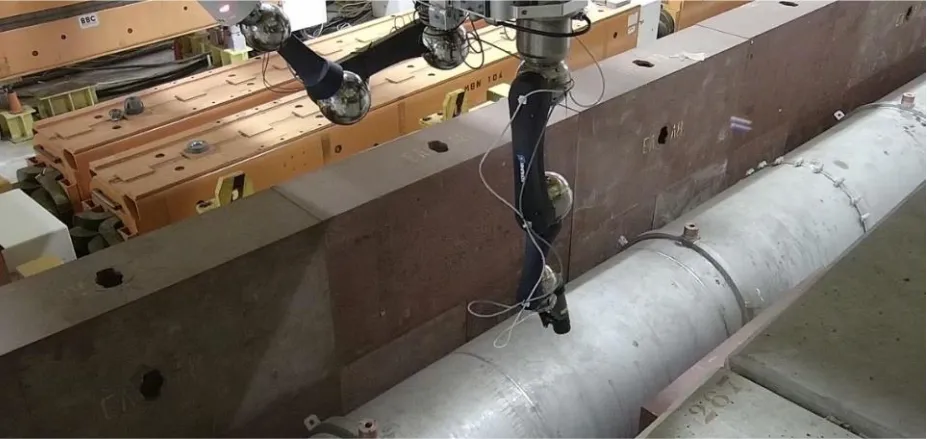
Two robotic interventions have been planned and coordinated with colleagues from EN/HE, BE/CEM and HSE/RP
for this year’s technical stop. They are both connected to vacuum leaks in highly radioactive zones in the North
Area.
he first one concerns a vacuum leak that has developed over the last year in VXSS vacuum chamber located in M2 beamline in the North Area in between the T6 target and the XTAX absorber. This leak has degraded the vacuum to unacceptable levels, particularly when running in electron mode to calibrate downstream detectors, as well as for the divergence of the CEDAR counters. There is good evidence that the culprit for the leak are three Helicoflex joints installed more than 20 years ago that have degraded over time due to the extremely high radiation levels in the area. Contact doses above 60 mSv/h call for a careful work and dose plan that will have to be eventually approved in an ALARA 3 Committee. Robots have been already used to inspect the environment in TCC2, understand the local constraints and develop the chamber handling and lifting strategy. Plans are to develop a robot-assisted joint replacement procedure involving the dismounting and reinstallation of the flanges that will be first exercised on one of the spare chambers.
The second intervention concerns a leak in a bellows interconnection between two horizontal bending magnets (MBNH) in TT83. The plan here is to disconnect the magnet, move it out of the beamline, cut the bellow from the chamber and reweld a spare one before re-installing everything back in the beamline. Measured contact dose rates of 1mSv/h combined with risk of dust contamination during the machining operations have called for the use of a robot that will assist with all destructive steps. As for the VXSS chamber the sequence will be first trained with the robot on a spare magnet.
The return from these experiences, more and more common these days, will provide a good basis to start understanding and incorporating in our design processes principles connected to telemanipulation and streamline the collaboration with other teams and groups involved in these type of campaigns.
It is important to note that the use of robots is not always fast or easy to deploy. But thanks to the expertise of our colleagues from BE/CE M these visual inspections and RP surveys allow collecting highly valuable information at the earliest stage of the YETS (before radiation decay) to prepare and optimize the Work Dose Plan for future interventions.