
Mechanical support and vacuum

14 DECEMBER,2020 | By Markus Brugger
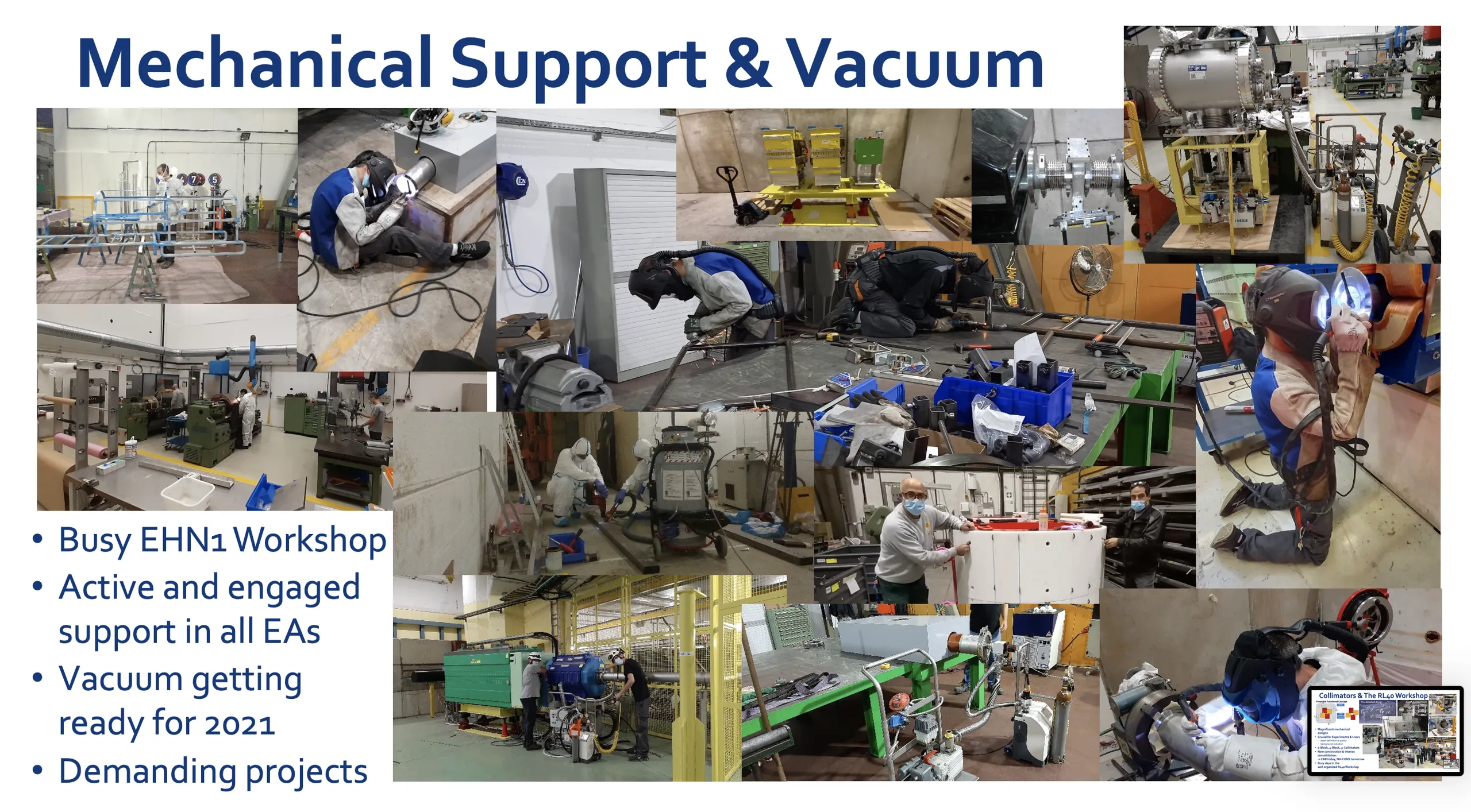
Yesterday we spoke about the collimators, focusing on the RL40 workshop. Today, let us have a closer look at the EHN1 workshop and the mechanical and vacuum support team, where everybody is very busy during LS2 and highly active in all our experimental areas working on mechanical supports and vacuum lines for the EAR project, refurbishing multiple beamline elements and providing support to numerous other activities. The latter address the EA/NA/AD consolidation, the ELENA and HL-LHC WP8 project, HiRadMat, as well as nToF and many related experiments and user areas. Yesterday we also briefly discussed how particles interact on purpose with collimator materials, but in general material on the beam line can be very detrimental to the beam rate and quality provided to our users. Air at atmospheric pressure has a radiation length of about 300 metres and a nuclear interaction length of about 750 metres. Therefore, a full North Area beam line, if left at atmospheric pressure, would then contain about one nuclear interaction length and several radiation lengths of air. Hence the need to evacuate the beam line as much as possible, strongly relying on our vacuum support team. However, as particles only pass once, primary vacuum at the level of 10-3 mbar is normally adequate, as this adds up to the equivalent of less than a single vacuum window. As an example, a typical 120 μm mylar window corresponds to about 0.5‰ of a radiation length and a 200 μm aluminium window to about 2‰. A 25 cm air gap with two 120 μm mylar windows corresponds to 1.6 ‰, equally shared by the air and the windows, thus whenever possible we optimize between air sections (allowing for flexibility of user installations) and dedicated vacuum lines. The vacuum is normally obtained by rotary pumps, connected via pumping ports, requiring careful testing of all elements before installation. In high-radiation areas, two may be installed in parallel, where one serves as in-situ spare. The vacuum pressure is measured by Pirani gauges and as the diameter of vacuum tubes is small (in particular inside magnets) and the beams are long, sector valves must be installed at regular intervals (typically every 50 to 100 metres). These valves are helpful in leak finding and to pump faster after an intervention that requires breaking the vacuum. For pragmatic reasons, individual sections of vacuum tubes are normally not longer than 6 to 10 metres and you will find many of these tubes stored nearby our EHN1 workshop. Magnets, collimators, and detectors connected to the vacuum have a bellow at least on one side to allow alignment adjustments. Often the flange at the end of a vacuum tube has a different diameter from the one on a magnet or other equipment, requiring special transition pieces and often welding. Given the large variety and long list of LS2 activities, we strongly rely on the pro-active collaboration and support across our sections and projects. We adjusted our SBA meetings and introduced a new way of scheduling the various tasks, including the methodology how jobs are managed, implying a new JIRA based tool now in successful production. Thanks to your strong commitment, so far, all milestones were reached, and we are looking forward with confidence to 2021 beam operation. Congratulations and many thanks!