
CELESTA – A Space Dream Coming True

14 DECEMBER, 2022 | By Markus Brugger
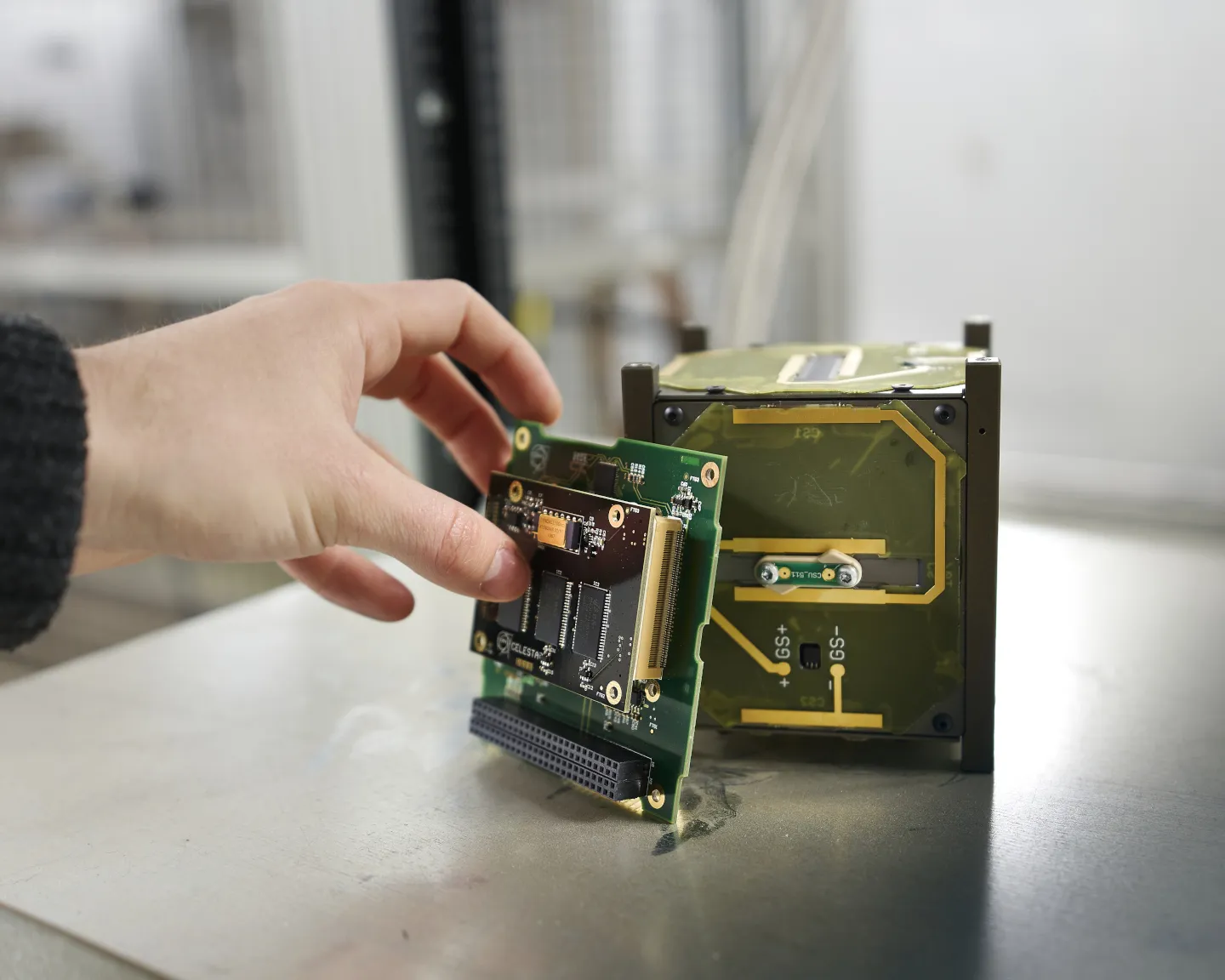
Contributing to a satellite with CERN technology started as an idea in 2015 during the RADECS conference, a discussion on the way to the conference dinner, some first ideas developed around the table and agreement found, giving birth to CELESTA as a student cubesat mission product of a collaboration between the "Centre Spatial Universitaire de Montpellier" (CSUM) and CERN. This cubesat activity was then launched in the framework of CERN’s Knowledge Transfer projects and linked to the "Radiation to Electronics" program at CERN, taking over the responsibility of a future cubesat payload, developed by CERN, consisting of radiation monitors and effects experiments, and including its ground-based calibration and testing against radiation, as preparation and benchmark basis for in-orbit results.
CELESTA, measuring just 10 cm3, is a technological demonstrator and educational project. It played a key role in validating potential space applications of an existing CERN technology called RadMon, which was initially developed to monitor radiation levels in the Large Hadron Collider (LHC) and is now used across the complex. By using RadMon sensors to measure radiation levels in low-Earth orbit, CELESTA will test if RadMon could be used in space missions that are sensitive to radiation, ranging from telecom satellites to navigation and Earth-observation systems.
Another important goal of CELESTA was to demonstrate that the CHARM facility located in the East Area is capable of reproducing the low-Earth orbit radiation environment, opening opportunities for CHARM to be used beyond its original use for high-energy physics, in this case for space applications. The radiation field at CHARM is generated through the interaction of a 24 GeV/c proton beam extracted from the Proton Synchrotron with a cylindrical copper or aluminium target. Different shielding configurations and testing positions allow for controlled tests to account for desired particle types, energies and fluences. It is the use of mixed fields that makes CHARM unique compared to other test facilities, which typically use mono-energetic particle beams or sources.
CELESTA, successfully entered orbit during the maiden flight of Europe’s Vega-C launch vehicle. Launched by the European Space Agency from the French Guiana Space Centre (CSG) on the 13 July at 13.13 UTC, the satellite deployed smoothly and transmitted its first signals in the afternoon. Our payload, the Space RadMon functioned perfectly, providing data immediately once the ground station had established communication with the satellite and having initiated the start-up procedure of the payload.
The launch and the initial days before establishing contact with CELESTA through the ground station, successfully executing the commissioning protocol, until receiving the first data, were moments of immense tension, excitement and joy. This Vega-C flight brought our satellite into a very challenging (mission and radiation-wise) orbit at a distance of more than 5800km around the earth, circling around Earth once every 3.7 hours and traversing the (in-)famous radiation belts. An amazing set of data was collected from both the radiation monitors and the latch-up experiment, confirming the mission targets and feeding into the final on-going detailed data analysis. The success of this satellite is the result of a fruitful partnership between CERN and the University of Montpellier, and most importantly the many students from both institutions.