
Preparing the Platform for Neutrino Detectors

7 DECEMBER, 2023 | By Nikolaos Chariontidis, Giulia Romagnoli and Filippo Resnati
Everybody who spent at least one summer at CERN, knows the “big building”, 887, in front of the BBQ place in Prevessin. If the person is there since few years, they will also remember when in 2016 construction works were going on and the “big building” was extended on the left side by about 70 m.
What most of the people don’t know is what there is inside the “big building” and why it was extended. On the contrary for our group saying “I’m going to EHN1” it is really typical and common, so that our cars will drive themselves there if needed!!
The “big building” or EHN1 (Experimental Hall North 1) is hosting the H2, H4, H6 and H8 beamlines of the North Area and all different test beams areas and experiments using these beamlines. Among them, the fixed-target experiments NA61 as well as the GIF++ facility. Also, not to forget, all the CEDAR tests that took place in the H6 beamline, or the MADMAX installations in H8.
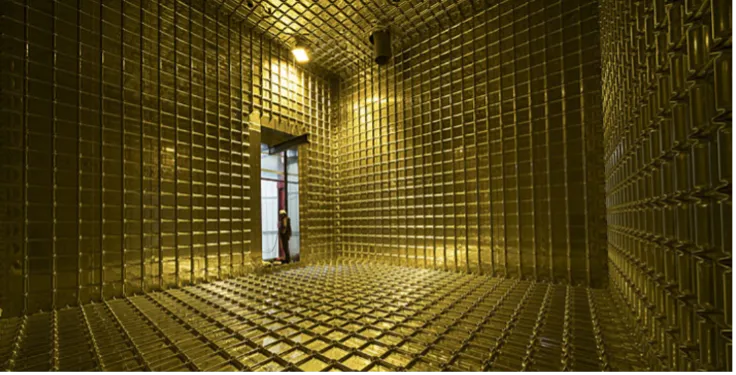
The Neutrino Platform (NP), installed in the 70 new meters of the EHN1 building, is the unique place in the World that is suited to develop and benchmark the technologies for future very large neutrino detectors. Particularly, it is the place where very low energy particles are used to understand the response of the two World’s largest liquid argon (LAr) Time Projection Chambers (TPC), that are the prototypes for the fare detector modules of the Deep Underground Neutrino Experiment (DUNE), which is in construction in South Dakota (US).
Neutrinos are fundamental particles that interact extremely feebly with matter, which is why the neutrinos generated in Fermilab (Chicago) can travel through the earth crust 1300 km without being affected. For the same reason, neutrino detectors must be massive. The Very Low Energy beams on H2 and H4 beamlines, extended into the Neutrino Platform, allow to study in details the detector’s response to the charged particles that a neutrino generates when interacting with liquid argon.
If a visitor went on the “passerelle” at the end of EHN1, they would notice that one of the strange characteristics of the extension H2 and H4 beamlines, is that they are tilted and curved. The reason for this is two-fold: (a) the detectors (for safety reasons) are placed inside a deep pit; (b) the necessary pions and kaons for their characterisation, are very unstable and decay in a very short time. Therefore, the beamlines should be very short in length (maximum of 40m), and using tilted magnetic elements to “faster” turn the beam towards the centre of the detector.
The single phase ProtoDUNE (NP04) was commissioned along with its associated beamline (H4-VLE) in 2018, just before LS2. The first detected particles were celebrated by the collaborations with spectacular tracks appearing in the TPCs. The first phase of test of NP04 was concluded in 2020 after two exciting years of data-taking. NP02, the other detector prototype, was in operation from 2019 and 2021. Both detectors are now in the second phase of development. The new and improved version of NP04 is completed, and NP02 is very close to be closed as well. What’s missing is basically the argon: 2023 was a challenging year with this respect, with prices skyrocketing to unaffordable levels. Things are changing and detector operation is expected in spring, ready to receive excellent beam in 2024.