
Beamline and physics studies

20 DECEMBER,2020 | By Markus Brugger
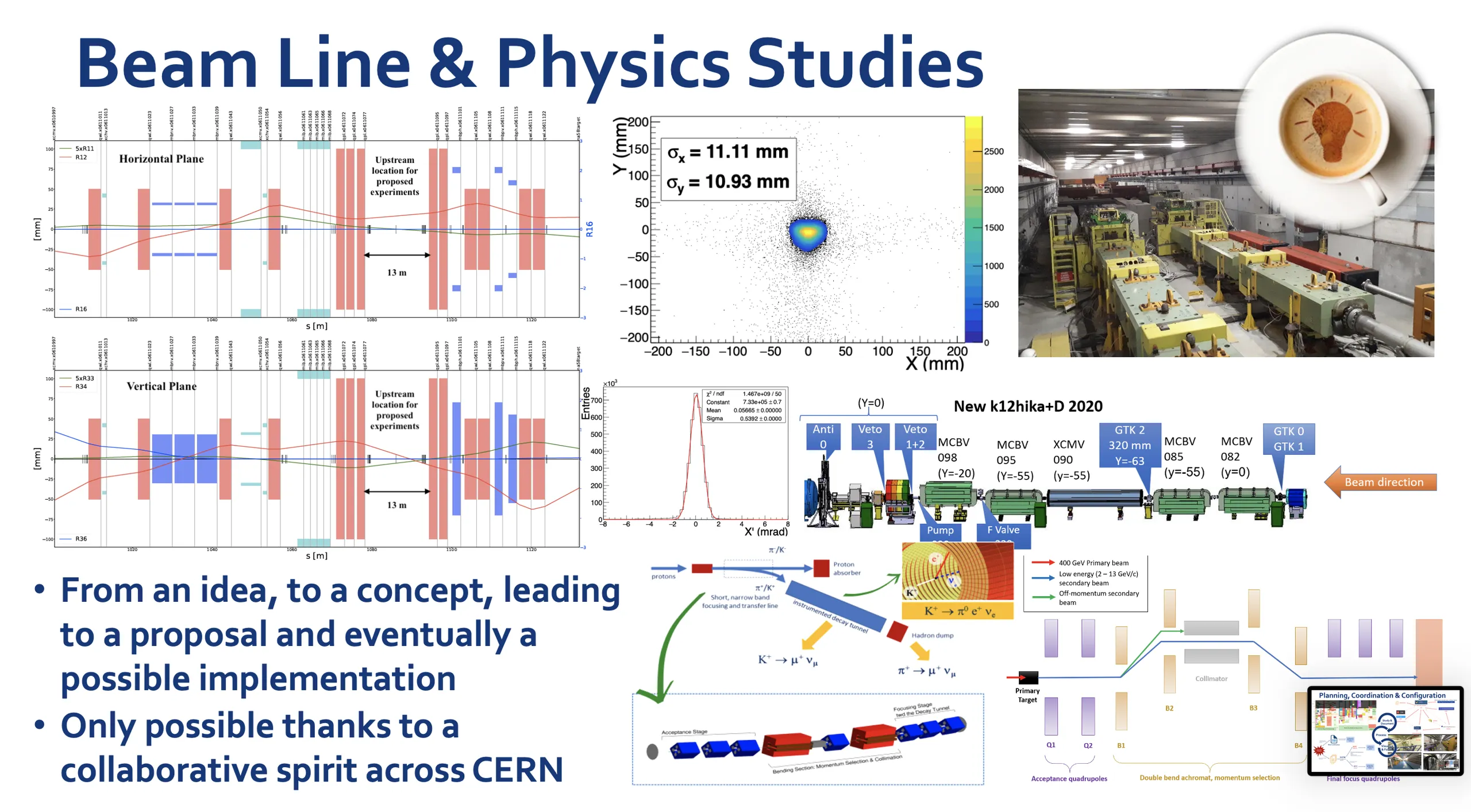
Many experiments have started with an idea, initially discussed between few people only, and following good CERN tradition, often sitting around a cup of coffee (at least before the current COVID situation). For fixed target experiments, very early on an important question is raised, namely if a measurement can be performed with existing beam conditions, whether the latter could be upgraded and if a possible implementation would be compatible with respect to background rates, or other detrimental aspects such as radiation protection constraints. Latest at that moment our group gets involved, thus I propose that we go through a few recent examples. Let us start with neutrino physics where the aim for the next decades is to detect effects due to CP violation, mass hierarchy, and search for effects beyond the Standard Model predictions (sterile neutrinos, NSI, dark matter candidates etc.). These future experiments need precise measurements of the neutrino interaction cross-sections at the ~GeV/c regime, currently limited by the exact knowledge of the initial neutrino flux on a ~10-20% uncertainty level. The previous implementation of the H2/4 beamlines for the Neutrino Platform project has triggered an idea of a possible low-Energy extension of the H2 line currently serving the NA61/SHINE experiment in our North Area to enable the study of particles in the 2-13 GeV/c momentum range to measure low energy hardon production cross section as these is necessary to better constrain the initial neutrino production uncertainties. The design of this beamline includes the study of optimal targets to maximise the yield of secondary hadrons produced and accepted by the beamline, the development of a high acceptance optics with high momentum resolution and considerations on the instrumentation which would enable required particle identification (PID). Similarly, we recently discussed it in a dedicated coffee meeting the ENUBET project which proposes a novel facility, capable of constraining the neutrino flux normalization through the precise monitoring of the Ke3 ( K+⟶ e+π0ν) decay products in an instrumented decay tunnel. Picking-up on the very Kaons, we performed studies for the K12 high-intensity Kaon beam developed in both FLUKA and BDSIM codes. Looking into a possible future high-intensity upgrade, ideas are proposed to run in the CERN K12 beamline from 2026 onward at higher intensity but facing several challenges such as upgrading the production target and changing the P42 beamline configuration in order to have a sufficiently small beam-size at the T10 target for both proposals KLEVER and NA62-HIGH-INTENSITY. These optics studies are developed in by our group in MADX and AppLE.py, the latter a tool developed by us and linked to the inclusive configuration management process I mentioned yesterday. After EHN1 and ECN3, let us close with our unique M2 beamline in the North Area and where I previously already mentioned the related SPSC sub-working group, addressing the various new experiments which have been proposed in the PBC context. The experiments include MUonE, NA64μ and the successor to the COMPASS experiment, tentatively named AMBER. The AMBER collaboration proposes to build a QCD facility requiring conventional muon and hadron beams for runs up to a timescale of 2030. MUonE aims to measure the hadronic contribution to the vacuum polarization in context of the (gμ−2) anomaly with a setup longer than 40 m and a 160 GeV/c high intensity, low divergence muon beam. NA64μ is a muon beam programme for dark-sector physics requiring a 100 – 160 GeV/c muon beam with a 15 m – 20 m long setup.
All three experiments requested similar beam times up to 2024 with compelling physics programs, which required launching extensive studies not only for integration, but in particular the beam optics and background estimations. Many other studies were conducted, starting from the East-Area finalizing our new beamlines and addressing recent requests for increased ion operation for T8, optimizing the beamline towards CLOUD, or finding ways of hosting NA61+ in EHN1 while providing maximum intensity, or even investigating smart ideas how to install a parasitic experiment before/next to NA62. Clearly a lot of subjects ready to be better explained during one of our coffee meetings, thus let me close by thanking you all for these studies and your contributions, where an idea leads to initial calculations performed by our LE section, raising implementation questions and related studies involving the DC and EC sections, as well as carefully aligning requests with present and future consolidation projects in the future brought together in our new PR section, and eventually asking the support from the many services of our AS section. Starting from the coffee, building on the team spirit within our group and thanks to the effective collaborations with the experiments and other equipment service groups, makes CERN such a special place you all contribute to.