
ECN3: Pushing Beam Intensities and ensuring a bright physics future

2 DECEMBER, 2023 | By Markus Brugger, Johannes Bernhard, Francisco SANCHEZ GALAN , and Yacine Kadi
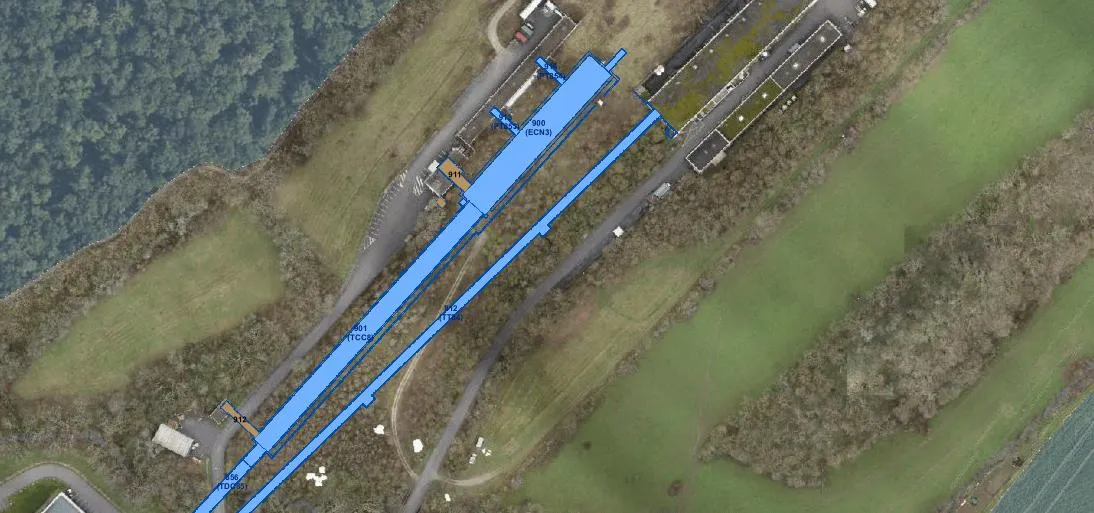
Last year CERN launched a taskforce with many of us involved to investigate a possible major intensity upgrade for the ECN3 cavern, currently housing the NA62 experiment, which searches for ultra-rare kaon decays as well as for feebly-interacting particles (FIPs).
Facing numerous challenges and possible limitations (beam losses, beam intercepting device limitations, instrumentation, radiation protection, etc.), the timing of this endeavor was equally critical to maintain compatibility with the already ongoing North Area consolidation project, as well as allowing for an implementation schedule compatible with LS3.
With the help of many of you, the successful taskforce outcome (see report), demonstrated the technical feasibility and compatibility with the proposed experiments (HIKE, SHIP and SHADOWS) and led to the important decision taken during the June session of the CERN Council to launch a technical design study for a new high-intensity physics programme at CERN’s North Area, at the same time also approving the full scope of the North Area Consolidation Project (NA-CONS), now with both Phase-I and Phase-II in CERNs’ Medium-Term-Plan.
This intensity upgrade implies for the extraction of a high-intensity proton beam from the SPS to deliver up to a factor of approximately 20 more protons per year to ECN3, and equally challenging upgrade requirements for the TCC8 target/TAX area and overall TCC8/ECN3 and adjacent infrastructure. A final recommendation and likely approval for experiment(s) that can best take advantage of the intense proton beam on offer is expected to be made very soon.
To put things in perspective, i.e. to employ such a high-intensity proton beam at a fixed-target experiment in the North Area and to exploit effectively the protons accelerated by the SPS, this is quite an endeavor, with the beam which must still be extracted slowly. In contrast to fast extraction within a single turn of the synchrotron, which utilises kicker magnets to change the path of a passing proton bunch, slow extraction gradually shaves the beam over several hundred thousand turns to produce a continuous flow of protons over a period of several seconds. One important related limitation to overcome concerns the particle losses during the extraction, foremost on the thin electrostatic extraction septum of the SPS but also along the transfer line leading to the North Area target stations. A previous R&D study has shown that it is possible to deflect the protons away from the blade of the electrostatic septum using thin bent crystals, upgrades are planned the transfer line beam-intercepting devices as part of NA-CONS and recent tests have demonstrated that a dedicated beam delivery scheme (avoiding losses at the splitters and ‘bumping’ the beam around the target) are giving us now full confidence that we will be able reaching the beam intensities required for all experiments.
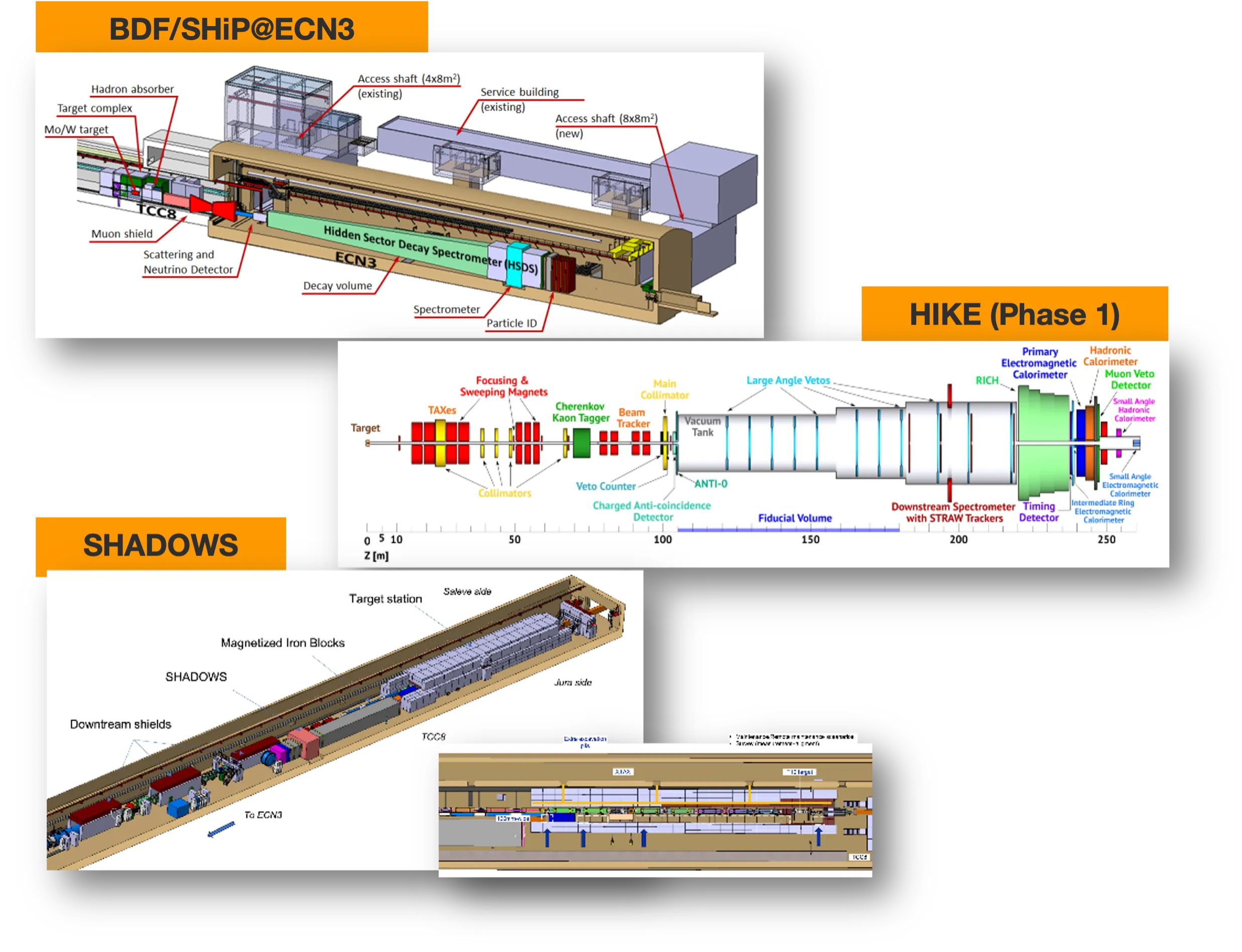
For those experiments, a total of three proposals that could exploit high-intensity beams in the ECN3 cavern have been submitted to the SPS committee, which recently finalized its evaluation process in preparation of this weeks’ Research Board. They include the High-intensity Kaon Experiment (HIKE), which requires an increase of the current beam intensity by a factor of between four and seven and aims to increase the precision on ultra-rare kaon decays to further constrain the Cabibbo-Kobayashi-Maskawa (CKM) unitarity triangle and to search for decays of FIPs which may appear on the same axis as the dumped proton beam. Looking for off-axis FIPs decays, the SHADOWS (Search for Hidden And Dark Objects With the SPS) programme could run alongside HIKE when operated in beam-dump mode.
Alternatively, the SHiP (Search for Hidden Particles) experiment would investigate hidden sectors such as heavy neutral leptons in the GeV mass range and also enable access to muon- and tau-neutrino physics in a dedicated beam dump facility installed in ECN3.
The ambitious programme to provide and prepare the high-intensity ECN3 facility for the 2030s onwards is driven in synergy with NA-CONS, where works for the high-intensity ECN3 project are planned to be carried out even after LS3 without impact on the other beamlines and experiments in the North Area, aiming at a first beam commissioning of the new facility expected from 2030. This implies that once the experimental decision has been made, things will move quickly and involve teams across all sectors of CERN and many of us.
It will be the first experimental programme, already with a timeline in mind even beyond the High-Luminosity LHC, probing nature for new physics, with many of us being closely involved – amazing, isn’t it?
Not only the above-mentioned experiments, but basically all newly proposed experiments want to push the limits of precision aiming at either excluding new physics at a certain scale or even making a discovery of new physics. This implies the needed mentioned higher intensities, none the less to serve the demand of having more high intensity users at the same time. This happened already with NA64, NA62 and COMPASS wanting to run simultaneously. Touching acceptable radiation protection limits, it nevertheless showed the required capabilities for future high-intensity operation.
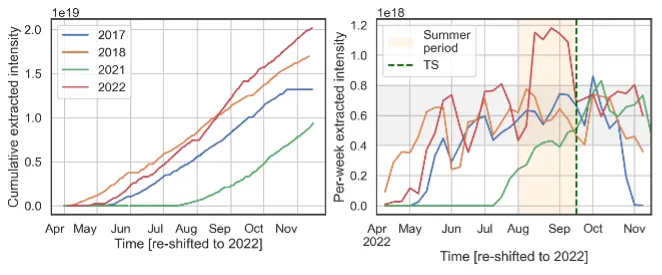
Progress on this slow extraction of high proton intensities providing a high quality beam is one of the major features that makes our fixed-target facilities at CERN unique, and where we aim at constantly improving the reachable operation targets (see many related contributions progress followed by the SLAWG team). High intensities come also at the cost of higher backgrounds, thus advanced muon shielding designs and simulation of muon backgrounds at more than 11 orders of magnitude must be dealt with.