
AMS – A Fixed Target Experiment which you will not find in the Layout Database

22 DECEMBER, 2023 | By Dipanwita Banerjee, Johannes Bernhard and Roman Folch
The variety and the extent of means deployed for the research at CERN are fascinating. One of the most exciting endeavors of the last decades is AMS.
The Alpha Magnetic Spectrometer (AMS-02) is a particle physics detector that was built in 16 countries (from Europe, Asia, and North America) and assembled at CERN. Most importantly, AMS was extensively calibrated at the CERN SPS, specifically with beam in EHN1 (H8). Headed for the International Space Station, the agency's youngest shuttle made its final flight delivering the Alpha Magnetic Spectrometer-2 (AMS) and critical supplies, including two communications antennas, a high-pressure gas tank and additional parts for the Dextre robot. This was the 25th and final flight for Endeavour, which spent 299 days in space, orbited Earth 4,671 times and traveled 122,883,151 miles, wrapping up an illustrious spaceflight career.
Orbiting the Earth every 90 minutes, AMS is searching for an understanding of dark matter, antimatter and the origin of cosmic rays. The experiment is run by a collaboration of 56 institutions. The detector, which measures 64 cubic meters and weighs 8.5 tons, was assembled at CERN. Over the past four years, AMS has collected more than 60 billion cosmic ray events. Because of its precision, the results of AMS are shedding new light on our understanding of cosmic rays.
“An interesting fact is AMS results are very nicely complemented by two other experiments in the North Area," explains Dipanwita. "During the last decade, AMS has measured the cosmic ray flux of antiprotons with an unprecedented accuracy in the range of 1 GeV to a few TeV. Antiprotons in the cosmic rays are produced from the interaction of protons with interstellar matter. That’s why the interpretation of the AMS results requires the correct description of the anti-proton production cross-section from proton interaction on matter as any deviation of the measured flux from the expected will point to new physics. NA61 in H2 has already published results of an anti-proton production cross-section for p-p at 20, 31, 40, 80 and 158 GeV/c. AMBER in EHN2 also aims to measure this cross-section for proton on liquid Helium (run completed in 2023) and proton on liquid hydrogen target (planned for 2024) between 50 and 280 GeV/c.”
Of course, even more than for our terrestrial experiments at CERN, the reliability of the equipment can be sometimes challenging. And worrisome for S. Ting, the Nobel Prize and father of AMS Experiment! This is one of the stories (reported in the CERN Courrier – March 2020) which will probably echo to the maintenance teams in the Group: “On 25th January, European Space Agency astronaut Luca Parmitano stepped outside a half-million-kilogram structure traveling at tens of thousands of kilometers per hour, hundreds of kilometers above Earth, and, tethered by a thin cord, ventured into the vacuum of space to check for a leak. […] Though not huge, the leak was serious enough not to guarantee that the system would work, jeopardizing four years of preparation involving hundreds of astronauts, engineers, and scientists.
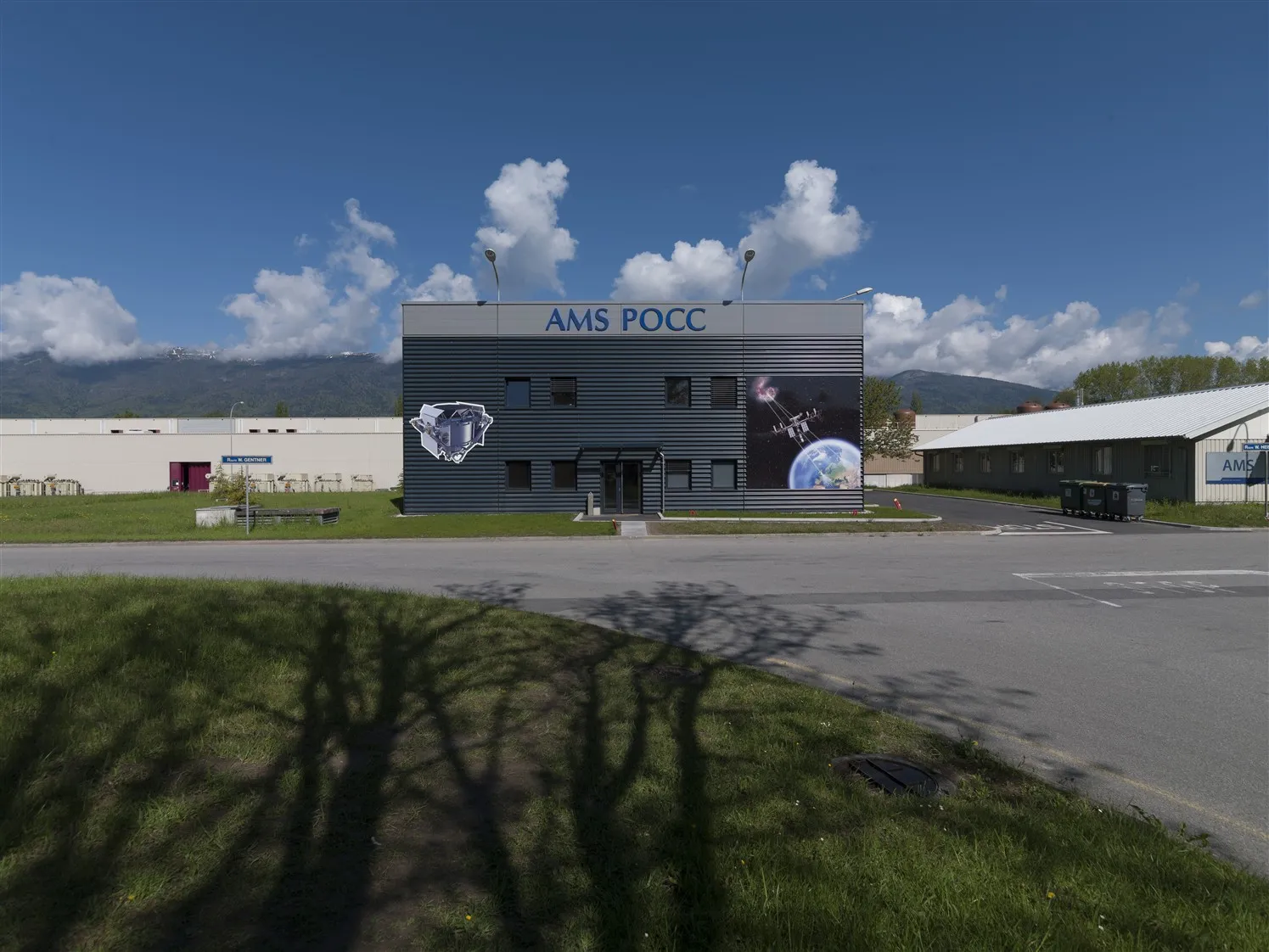
Data are received by NASA, and then relayed to the AMS Payload Operations Control Centre (POCC) at CERN for analysis.Following procedures put in place to deal with such a situation, Parmitano tightened the connection and waited for about an hour before checking the tube again. A leak was still present. Then, after re-tightening the troublesome connection again, while the team was preparing a risky “jumper” maneuver to bypass the leak and make a new connection, he checked a third time: “No red!” Happy faces lit up the POCC.