
The T4 Wobbling station
06 DECEMBER, 2024 | By Fabian Metzger

In CERN’s North Area, wobbling stations play a fascinating role in guiding particle beams to multiple experiments. Think of them as the traffic controllers of high-energy physics, ensuring that the products of a single proton beam are steered into different beamlines with precision. This clever setup enables several experiments to run simultaneously, including current fixed-target experiments and exciting future endeavors like the SHiP experiment, which will explore the mysteries of hidden particles and physics beyond the Standard Model.
I am working on the wobbling station at T4, which I find particularly impressive. Here, three distinct particle beamlines emerge: H6, H8, and P42. The process starts when protons from the SPS, CERN’s Super Proton Synchrotron, strike the T4 target. This collision produces a cascade of secondary particles—hadrons like pions, protons, and kaons, along with electrons and positrons—at energies ranging from nearly zero to the original proton energy of 400 GeV. Dipole magnets downstream the target act like a prism for particles, separating them based on their momentum. This clever design allows one beamline, for example, to carry 120 GeV/c particles, another to carry 180 GeV/c particles, and the third to transport protons that did not interact within T4, still traveling at 400 GeV/c. Changing the currents in the magnets, the wobbling is extremely flexible and can provide many other configurations, even negatively charged, high momentum beams with electrons that will be crucial for the detector R&D of the FCC-ee, the largest collider ever imagined.
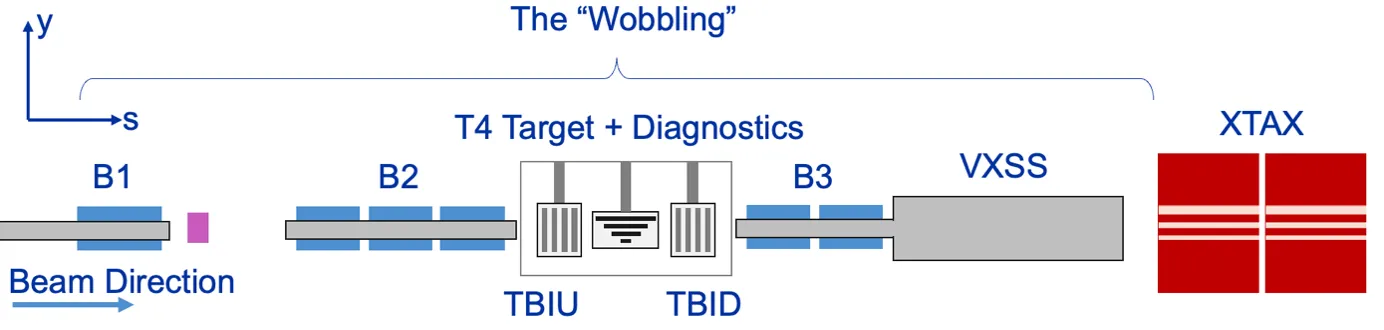
To handle all these particles, the wobbling station relies on a system of six powerful magnets, a target, and a large vacuum chamber, called VXSS. Together, these components not only split the beam but also ensure that each secondary beam reaches the right destination. The large VXSS vacuum chamber, for instance, contains all the separated beams and prevents particles from interacting prematurely with the surrounding air.
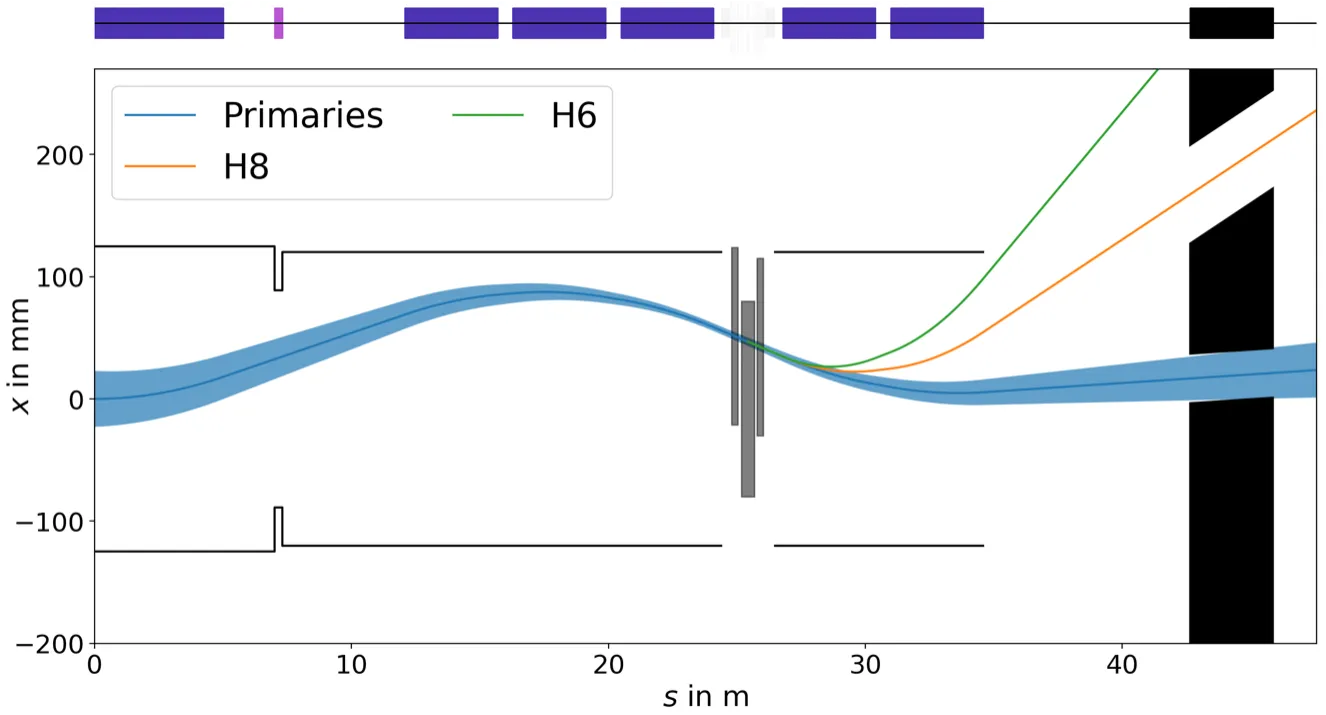
The wobbling station isn’t just about splitting beams; it’s also paving the way for future experiments like SHiP. Right now, protons that don’t interact with the target head to T10 and produce Kaon beams for NA62, one of CERN’s fixed-target experiments. But when SHiP begins, the system will need to manage even higher-intensity beams with minimal losses. Luke has studied these losses extensively and identified the vacuum interruption around the P4 XTAX absorber as a significant contributor. To address this, the start of the P4 beamline (located in TCC2) will need to be moved horizontally closer to M2. Our engineers are designing these upgrades and we are placing a new horizontal kicker magnet that will guide the protons more efficiently depending on which experiments are getting the SPS beam. This will ensure that high-intensity beams destined for SHiP are handled safely while still supplying experiments at H6 and H8 in the so-called shared cycle.
The North Area’s wobbling stations might not be as famous as CERN’s massive colliders, but they’re a brilliant example of creative design and precision engineering that keeps the science moving. And with future experiments on the horizon, their role is only set to grow more exciting.