
A journey into the quark-gluon plasma
13 DECEMBER, 2024 | By Elisabetta Parozzi

Imagine rewinding the clock to the very beginning of the universe, when temperatures were so blisteringly high that quarks and gluons – normally locked inside protons and neutrons – roamed freely in a primordial soup called the quark-gluon plasma (QGP). Buliding on the legacy of the NA60 experiment, the proposed NA60+ experiment at CERN’s Super Proton Synchrotron (SPS) wants to recreate and study this exotic state of matter.
By studying subtle signals like dimuons (pairs of muons) and the thermal radiation emitted by hot, dense matter, NA60+ aims to map the QCD phase diagram – a kind of treasure map showing how matter behaves at extreme temperatures and densities. Could it uncover the mythical critical point, a place where matter undergoes a dramatic transformation? Only time – and a lot of beamline magic – will tell.
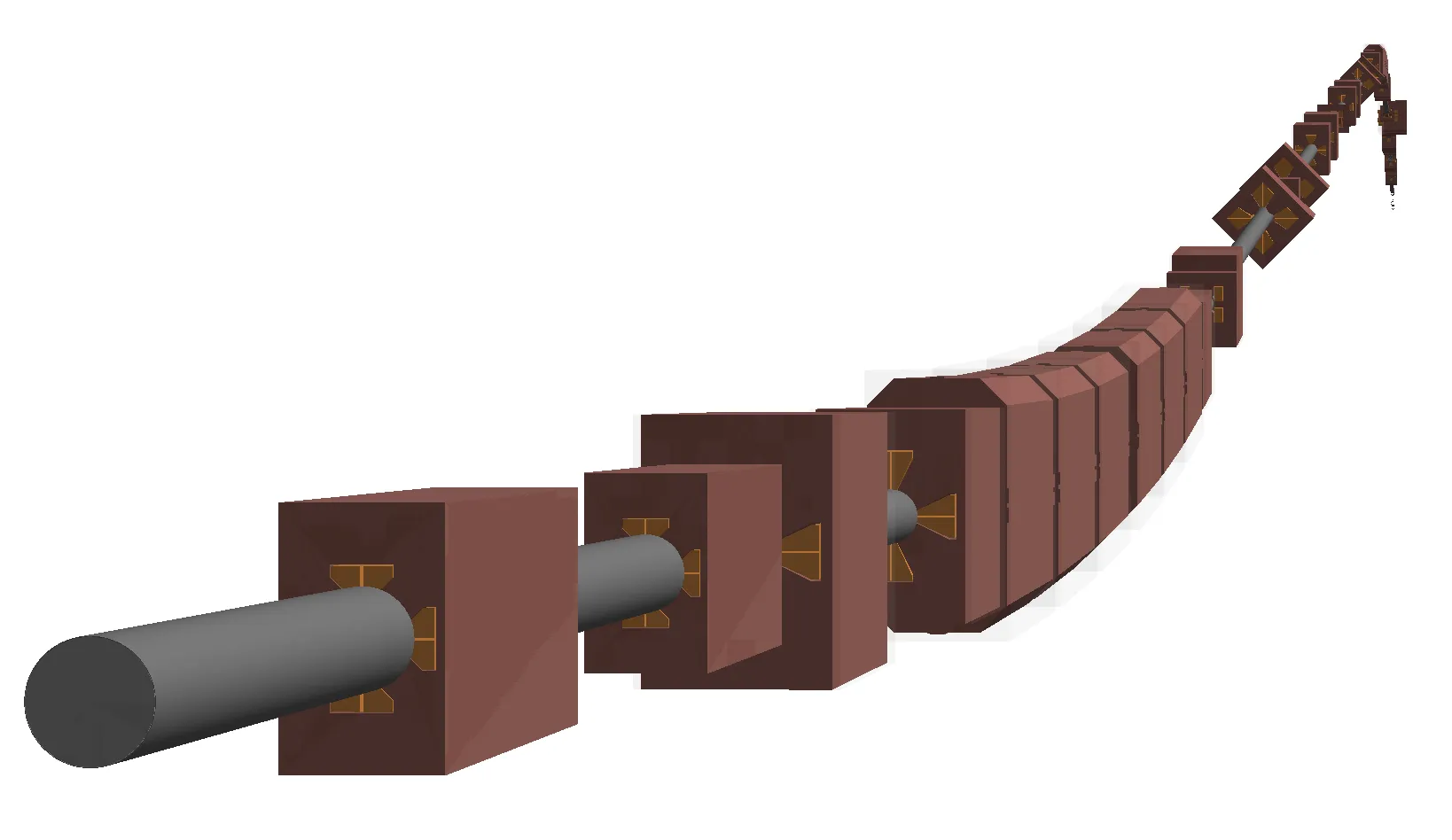
This is where BDSIM, a Geant4-based simulation tool, takes center stage. Think of it as a crystal ball for particle beams, allowing scientists to predict how secondary particles produced by 400 GeV/c protons smashing into a beryllium target will navigate the H8 beamline on their way to NA60+. The simulations have already uncovered some fascinating insights. For example, measurements at a wire chamber 474 meters from the T4 target match closely with what the BDSIM models predict—proof that the team’s hard work is paying off. However, the beamline isn’t without its challenges. It turns out that achieving the desired beam intensity with secondary particles alone isn’t feasible due to the H8 acceptance and the natural limitations of particle production.
Now, the details of the tunnel environment are being implemented, which will help ensuring the muon flux staying within safe limits. We do this in close collaboration with CERN’s Radiation Protection team. Every obstacle is an opportunity to refine the setup and bring NA60+ closer to success. These intense studies aren’t just about overcoming hurdles; they’re about fine-tuning the beamline to meet the ambitious goals of NA60+.