
A Holly Jolly Heat Check: Thermal Simulations of the P42 XCHV Collimators
16 DECEMBER, 2024 | By Naini Mandal

It’s the season of snowflakes and holiday cheer, and while the Jura gets its winter blanket including the wonderlands 530 and 599, we’ve been keeping warm with some holly jolly thermomechanical simulations of the XCHV 4-block collimators! These vital components of the Experimental Areas’ beamlines control the beam flux and act as momentum slits to fine-tune the momentum band.
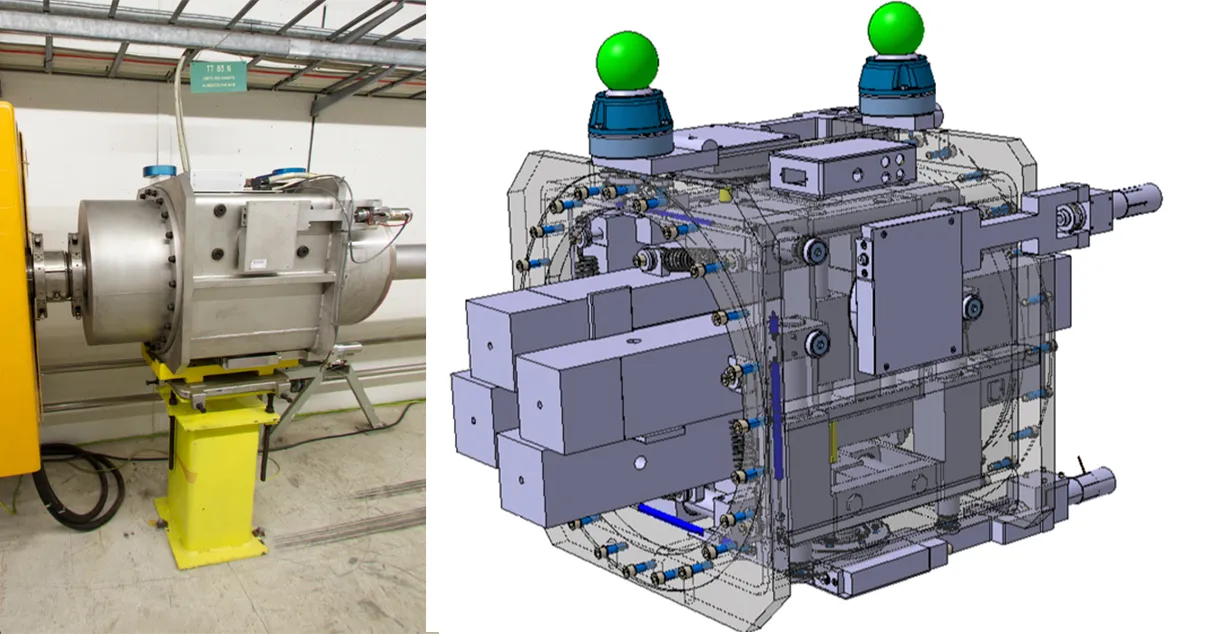
During the commissioning period in March-April, we turned our attention to the XCHVs in the P42 beamline. These four “wise jaws” scanned a beam of 5 × 10¹¹ protons at 400 GeV – powerful enough to pass straight through a jaw! Each jaw, crafted from steel with a tungsten plate facing the aperture, is built to withstand intense conditions. However, the ball bearings, with their service temperature limit of 120°C, remind us why it’s snow-important to calculate how hot these collimators can get during extreme use.
In the FE software Ansys – while it may not hang tinsel or decorate Christmas trees (though with its precision, it probably could) – the geometry was simplified, merry materials assigned, and bright boundary conditions applied. Collaborating with the LE physicists, we modelled a total heat deposition of 4.4 kW for the “hot case,” where a beam travels inside the jaws, positioned 40 mm from the tungsten plate’s outer surface. This jolly input, delivered via a festive FLUKA file, powered a Transient Thermal analysis with a spill cycle of 4.8 seconds ON and 9.6 seconds OFF, run for a toasty 10-minute duration.
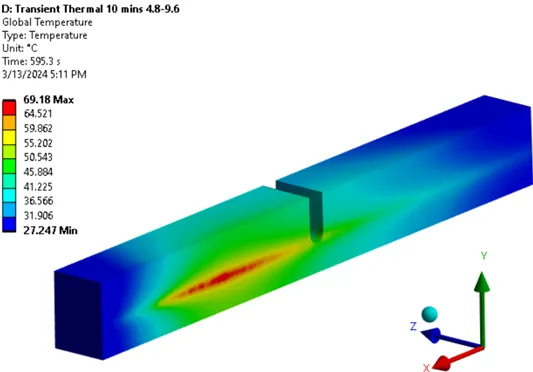
The result was a cheerful 69.2°C – well within the safety limit of the ball bearings. There's snow place like the Experimental Areas!