
CERN Cabling team

10 DECEMBER,2023 | By the CERN Cabling Team
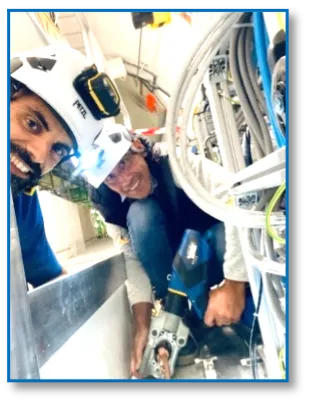
In June 2023, the BE-EA Cabling Team, which undeniably supports Experiments in various fields, particularly cables and connectors, was asked to study and install the cables required for the future FORMOSA demonstrator detector.
This request, made by the physicists Matthew Citron, Jamie Boyd, and Brian Petersen, had initially been planned for installation during the YETS 2023-2024 period. Having already played a key role in the installation of the FASER detector, the cabling team brilliantly installed the paths and cables required for this experiment.
Thanks to its know-how and proven expertise, the Cabling Team led by Gianluca Canale drew up an installation schedule for August 2023, taking advantage of an unscheduled shutdown of the LHC. Our very good relationship and perfect knowledge of the conditions of access and installation in the LHC enabled us to prepare the site quickly and carry it out in strict compliance with quality and safety standards.
The specific requirements for the experiment to run smoothly called for the installation of 520 meters of cables of various types linking the existing racks to the future detector.
The main complexity lay in the restricted space above the FASER detector, requiring the installation of cable trays and cables without disturbing the detector itself.
Celim and Gianluca therefore assembled a made-to-measure platform in just a few minutes, made up of compact elements that made it easy to move and transport the parts, avoiding the need for a transport service at such short notice. This provided the installation team with comfortable working conditions while preserving the existing facilities. Working together with the Comsa's team our supervision, we successfully completed this project.
The connectors at each end of the cables were assembled on site, once the cables had been routed through the new cable trays that we had carefully installed. Each cable and connector were rigorously checked against our quality standards. In addition, we have identified and resolved a non-conformity concerning the earthing of the FASER detector, following the approval of the team in charge of this experiment, although this irregularity is not our direct responsibility.
The project proved to be a resounding success.
The total cost of the project was well below 10kCHF, demonstrating our customary efficiency in carrying out the tasks entrusted to us quickly and accurately.
FORMSA
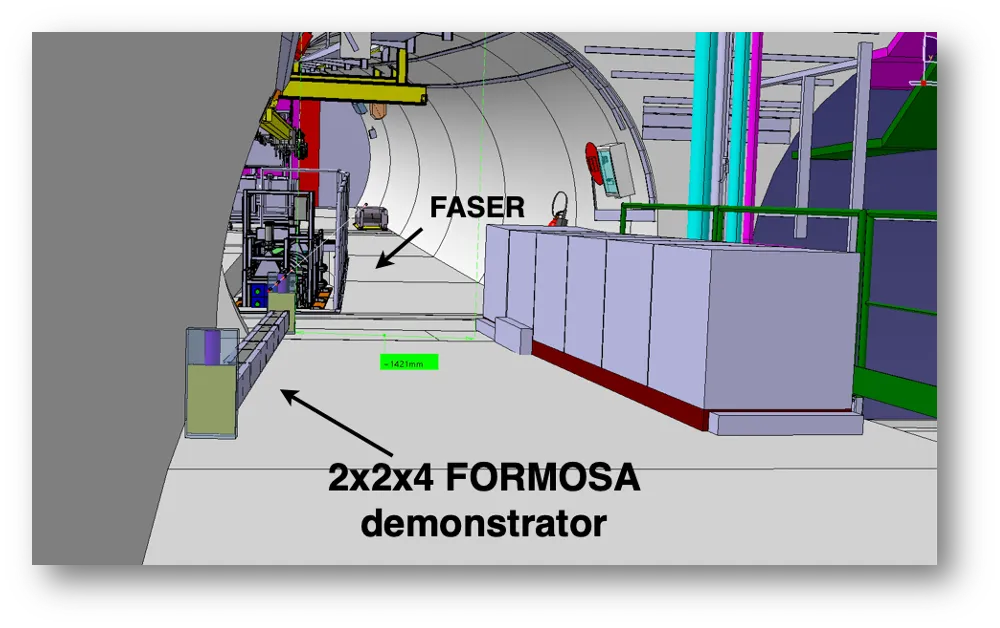
FASER (Forward Search Experiment), is designed to search for light and extremely weakly interacting particles. The existence of such new particles is predicted by many models beyond the Standard Model that attempt to solve some of the biggest puzzles in physics, such as the nature of dark matter, the origin of neutrino masses, and the imbalance between matter and antimatter in the present-day universe.
The four main LHC detectors, ALICE, ATLAS, CMS and LHCb, are not suited to detect signals from light and weakly interacting particles produced parallel to the proton beamline, because they have holes along the beamline to let the proton beams through. Located along the beam trajectory, 480 meters downstream of the ATLAS detector, FASER is ideally positioned to detect the particles into which such light and weakly interacting particles will decay.
FASER also comprise a subdetector called FASERν, which is specifically designed to detect neutrinos. Until recently, no neutrino produced at a particle collider has ever been detected, despite colliders producing them in huge numbers and at high energies. As a result, neutrino interactions at these high energies have not yet been studied in detail. The FASERν detector is a 25cm × 25cm × 1.35m emulsion detector, consisting of 1000 layers of emulsion films interleaved with 1-mm-thick tungsten plates, with a total tungsten target mass of 1.2 tons.
In this context, the FORMOSA team has identified the potentially most sensitive location in the world for the search for millicharged particles in the mass range 10 MeV to 100 GeV: the front region of the LHC. They propose building a scintillator-based experiment, FORward MicrOcharge SeArch (FORMOSA), at this location, and estimate the corresponding sensitivity projection. They show that FORMOSA can discover milli-charged particles in a vast and unexplored parameter space, and study strongly interacting dark matter that cannot be detected by direct detection experiments on the ground. The recently proposed LHC Advanced Physics Facility (FPF) is an ideal structure to host.