
The BDF/SHiP Proposal

18 DECEMBER, 2023 | By Lau Gatignon
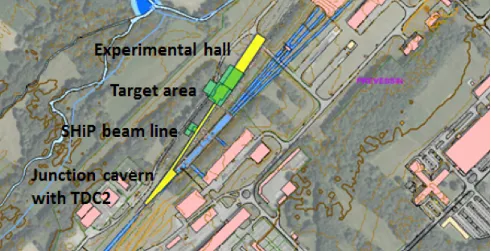
Ten years ago(!) the SHiP collaboration submitted an Expression of Interest to the SPSC committee, in October 2013. Their idea was quite original at the time, namely to look for Feebly Interacting Particles or FIPS at the SPS. The idea was based on a new model for ‘dark matter’, proposed by Mikhail Shaposhnikov, a theory professor at EPFL in Lausanne.
As you know by now from previous articles in this Advent series /e.g. December 4th), normal ‘baryonic’ matter, made of protons and neutrons, explains only about 5% of the total mass in the universe: This is based on cosmological observations of the expansion of the universe and the organisation of mass in galaxies. The so successful Standard Model of particle physics describes the 5% of normal matter extremely well, but cannot explain several features of our universe. Among those the dominance of matter over anti-matter, the (small) neutrino masses (confirmed by the observation of neutrino oscillations, e.g., by OPERA at the CNGS facility) and of course the presence of dark matter and dark energy.
Shaposhnikov shows how all these shortcomings of the Standard Model can be accounted for by the existence of three ‘Heavy Neutral Leptons’, also known as ‘sterile neutrinos’. In this ‘Neutrino Minimal Standard Model’, νMSM, one of the three, N1, is very light and has only a very weak mixing with other leptons (i.e. electrons, muons, taus and ‘normal’ neutrinos) and is sufficiently stable to be a dark matter candidate. The other two, N2 and N3, are heavier and are very close in mass. They could have masses in the 1 or few GeV range. These heavier particles could, very rarely, decay into standard model particles, e.g. into a pion and a muon. Those decays could be detected in a dedicated experiment.
N2 and N3 are the mediators of a possible very weak force between normal matter and dark matter. Theorists call this particular type of mediators the neutrino ‘portal’, as it offers a passage between the ‘normal’ and the dark universe and is based on neutrino-like particles. There are several other portals under consideration. One is the dark photon, a (‘vector-like’ for the specialists) particle that can decay into an e+e– pair, the Higgs portal and the ALPS portal, which is looked for by non-accelerator experiments like CAST, IAXO and MADMAX. SHiP has sensitivity to several portals.
The SPS energy rage is thought to be of particular interest, as the N2 and N3 particles are thought to be associated with beaty and charm quarks, which are copiously produced at the SPS. As they are only very weakly coupled to normal matter, they are expected to have relatively long lifetimes. They could also be produced at the LHC, but as most of them are produced at much higher energy and travel far before they decay, and as the LHC detectors are smaller in dimension, they would mostly decay outside the LHC detectors.
Therefore, a fixed target experiment at the SPS is a unique opportunity for detecting FIPS. SHiP was proposed as the ultimate detector at the SPS. However, the experiment requests 2 1020 protons on target within 5 years, which implies an under-ground area. At that time our only underground area, ECN3, was just being equipped with the new NA62 experiment. Therefore, SHiP required the construction of a new underground cavern ECN4 or BDF (Beam Dump Facility) and related infrastructure.
In the initial proposal, the extracted beam to the North Area would be branched off to the new cavern via the first splitter. Normally it splits off the fraction of the beam for T6 and EHN2 to the right, but for SHiP it would send the whole beam to the left. The new splitter magnets would have to be wider and laminated.
This was a major request. Normally the SPSC does not follow up in detail EOI’s, but in view of the high potential interest of this experiment and the large size and cost of the set-up, the management set up a task force in the accelerator sector to study the project. This task force started already in January 2014 and worked in close collaboration with SHiP towards a proposal. The taskforce, which already involved our group, submitted its report in June 2014 with an estimated facility cost of about 120 MCHF plus 90 FTEs. The SHiP proposal was submitted to the SPSC in April 2015, alongside a long physics paper signed by almost a hundred theorists.
The experiment itself starts with a very massive and dense target, made of the heaviest materials that can stand the heat load from the beam. The target is followed immediately by a hadron absorber. This whole system is optimised to stop all known particles. In particular pions and kaons must be stopped as quickly as possible before they have time decay into muons and neutrinos. However, many neutrinos and muons will always come out as they can traverse material much more easily than other particles. Therefore, the original idea was to range out the muons in a passive muon filter consisting of 110 tons of tungsten surrounded by 2500 tons of lead!
Fortunately, the SPSC referees recommended to consider magnetic sweeping instead, and this had already become the baseline in the 2015 proposal. The muon sweeping system was then followed by a long decay volume, a magnetic spectrometer, calorimetry and muon veto detectors. All somewhat reminiscent of the NA62 layout. NA62 is also optimised for detecting decays of invisible’ (neutral) particles in flight. Indeed, NA62 can do similar experiments as SHiP, but with a much smaller proton flux and a much smaller acceptance for Heavy-Neutral Leptons (HNLs). The required SHiP detectors were indeed huge (6×12 m2).
Clearly the discovery of dark matter would be a revolutionary result, affecting the overall physics landscape very significantly. However, the physics outcome could reduce to almost nothing in case of a non-discovery. Therefore, the SPSC asked to find an addition that provides at least some ‘guaranteed’ physics results. At that stage a neutrino detector was added just downstream of the muon sweeper and before the start of the decay volume.
The SPSC was impressed by the overall physics case, but in view of the very high cost it recommended the collaboration to prepare a more detailed report with a more precise and hopefully reduced cost estimate. This comprehensive design study report (CDR) was submitted in December 2019, just in time for the European Strategy deadline, but once having considered all details at CDR-level, with an even increased total cost. In its conclusion, the European Strategy report stated that the quest for dark matter (and the exploration of flavour and fundamental symmetries) are crucial components of the search for new physics. However, the report also stated clearly that SHiP could not be funded in the ongoing European Strategy period.
Therefore, SHiP launched a study to significantly reduce the cost by using existing locations. Several locations were considered, including the locations of HiRadMat (TNC), the ex-CNGS area and ECN3. ECN3 turned out to be the most cost-effective option. In addition, the Research Board has approved NA62 only until the beginning of LS3 ‘for their last run’, so ECN3 could possibly become available for post-LS3 operation.
In 2022 BDF/SHiP then submitted a new Letter of Intent and a new Proposal in 2023. For their preparations they were strongly supported by the Physics Beyond Colliders study and the ATS sector in particular. This proposal is now under consideration by the SPSC and the management, but it is in in competition with HIKE and SHADOWS.
These updates profited from the detailed 10-year long studies already done for ECN4 and from the strong support by the accelerator teams and the high-intensity delivery taskforce for ECN3. It was demonstrated that the required high intensity can be delivered to ECN3, see the Advent article of December 2nd.
The detector dimensions had to be reduced to fit inside the hall, but thanks to optimisations of the neutrino detector layout and the muon sweeping system, the detectors could be moved quite a bit closer to the target. As a result, the overall sensitivity of the experiment, as well as the signal to background ratio remained essentially the same as in the initial ECN4 proposal.
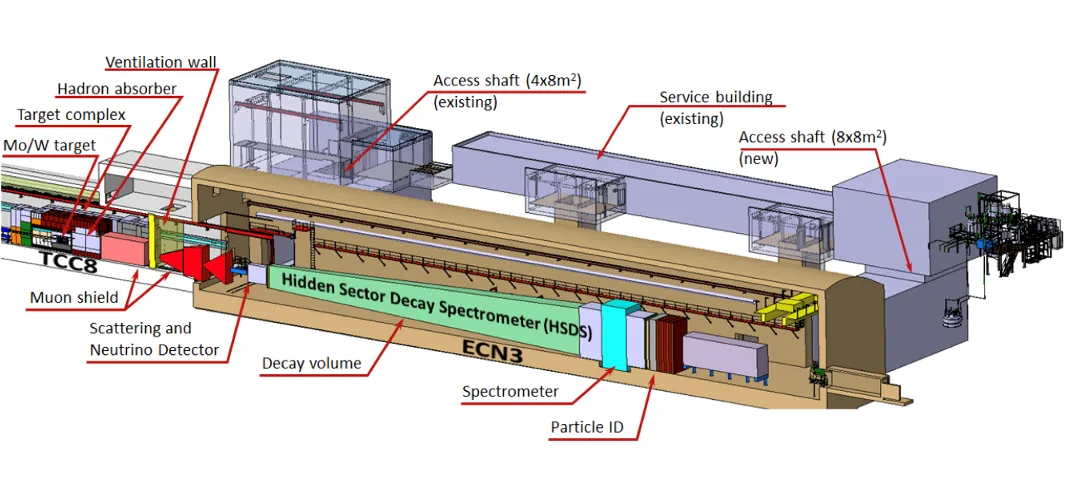
Our group has been responsible for the integration studies in the TCC8 and ECN3 caverns. The final layout in TCC8 and ECN3 looks like:
As an example of the excellent physics sensitivity of SHiP we show on the right the comparison of SHiP (blue line) with existing limits. Up to a factor of 10,000 improvement over other experiments in the mass region from 05 to 5 GeV/c. And a significantly extended mass reach for the dark photon. Impressive!
In addition, the neutrino detector will accumulate a large number (around 100,000) of tau neutrino interactions. This includes a fair fraction out of anti-tau neutrinos which so far have not yet been observed.
It is now up to the management to decide which experiment will occupy ECN3 from 2030 up to possibly even 2048.