
The antimatter transport challenge

15 DECEMBER, 2022 | By François Butin and Clara Klink
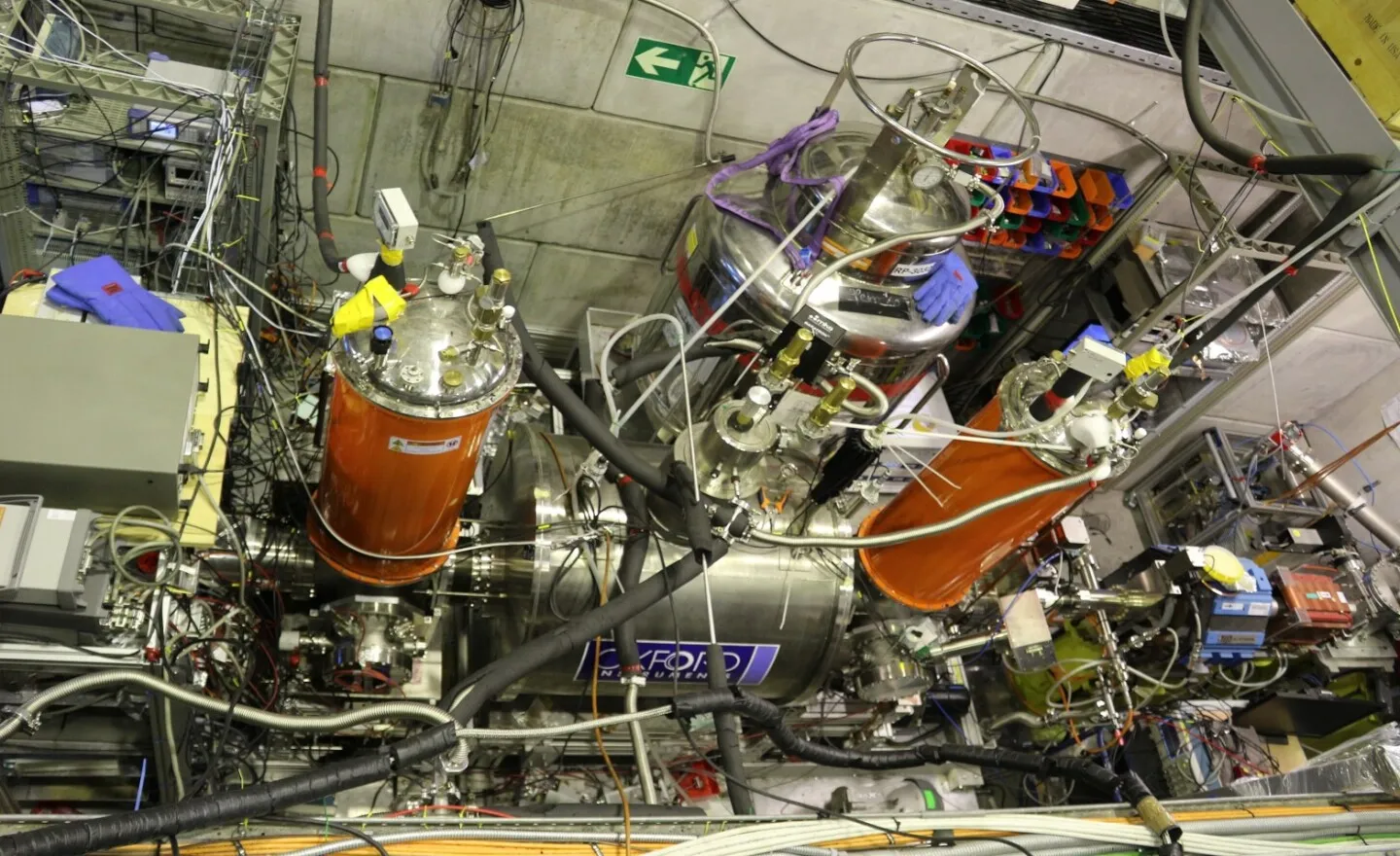
This is surely the most expensive substance in the world, and potentially the most dangerous: the production cost of 1 gram of antimatter is impossible to estimate as with our current production means, it would take… 45 billion years! And this single gram would be enough to power the largest NASA rocket to-date -Artemis- for a few travels to the moon! But is also the most delicate substance, as the least contact with ordinary matter is enough to cause its annihilation, in a burst of pure energy. Teams at CERN will try for the first time the incredible challenge to transport this fascinating substance on ordinary trucks!
Two new experiments PUMA and BASE-STEP have been approved to store antiparticles, then to transport the precious load with lorries over a significant distance. These antiparticles will be antiprotons produced at the Antimatter Factory, the AD complex. The destination will be ISOLDE for the PUMA experiment. The destination for the BASE-STEP trap will be another lab not yet identified (inside CERN or even possibly in Germany).
The objective of the BASE (Baryon Antibaryon Symmetry Experiment) collaboration is to track the most subtle differences that may exist between protons and antiprotons. According to the standard model, there should be none, apart from the electric charges that are opposite. But the theories describing the birth of universe also tell us that the Big Bang should have produced strictly identical quantities of matter and antimatter. They should therefore have completely annihilated each other, and should have left a universe containing only energy. This is obviously not the case as we are here, on our planet Earth, in the neighbourhood of our Sun, somewhere in the suburb of our galaxy the Milky Way. The BASE scientists are verifying if some asymmetry can be observed between protons and antiprotons that could explain the apparent excess of matter, appearing during the cool-down of the universe. In January 2022, the BASE team published their latest results: the measured of the electric charge-to-mass ratios of the proton and the antiproton with record precision.
PUMA is a transportable experiment with the specific requirement to remain under operation during the transport phase since the storage of antiprotons requires the full operation of the Penning trap. The transfer of PUMA will take place between the ELENA experimental area (building 193) and the ISOLDE experimental hall (building 170) at CERN. Once PUMA is loaded on a trailer and during transport, the experiment will be powered by an external diesel generator. So far, a solution that allows to compensate the road inclination along the itinerary is taken in consideration. The frame will be equipped with sensors to record the acceleration and vibration history of PUMA during the transport. Transport of fragile large-size objects, such as accelerating cavities, have often been performed at CERN (i.e. HIE ISOLDE RF cavities). Note that the demonstration of transporting trapped charged particles was made more than twenty years ago: an electron cloud in a Penning trap was transported by truck over 5000 km from the west coast to the east coast of the USA !