
Magnetic Collimators

20 DECEMBER, 2022 | By Dipanwita Banerjee and Naini Mandal
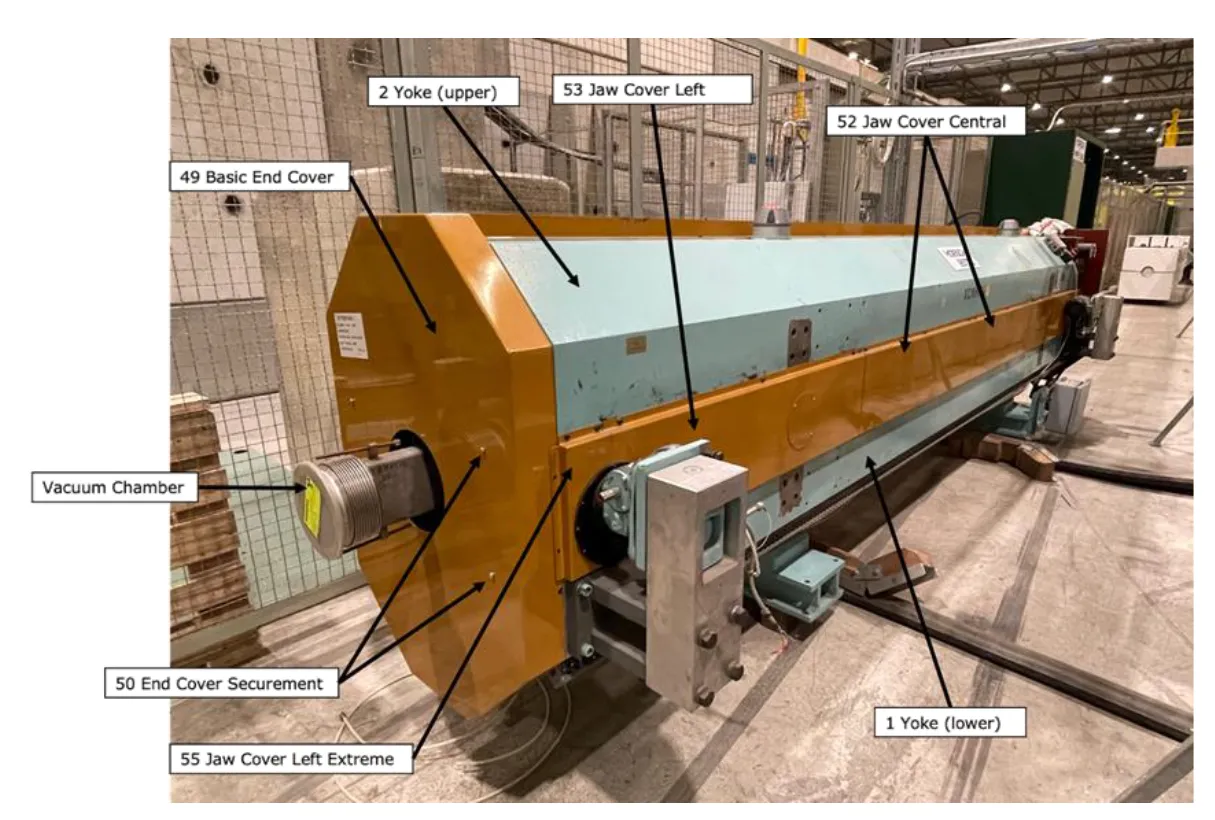
Is it a magnet, is it a collimator… well, it’s sort of both. Serving the M2 and K12 lines, there are 10 magnetic collimators installed in the North Area beamlines, and we didn’t really know them in detail… so we tried to figure them out!
Reverse engineering
Designed and installed in 1975-1980, the magnetic collimators (XCM) have been ‘cleaning’ their respective beamlines for a long time. With such reliable machines, our know-how of their operation and functioning started fading in time.
As soon as I joined CERN, I was tasked with reverse engineering the XCM and writing up an engineering specification from scratch (EDMS 2781455), and only in retrospect – quite a challenge! Over the last couple months, this involved:
• Looking at the original hand-drawn engineering drawings, yellowed from age.
• Scan, classify and name the old drawing organizing them in EDMS and dfs.
• Visiting the M2 line at TT84 and looking at various XCM.
• Visiting EHN1 to see the spare XCM in storage that used to be part of the K12 line.
• Translating from old, typewriter-written specifications in French.
• Gathering information from forgotten websites and documents – SBA, AB/BI/EA site,
old EDMS documents etc.
• Talking with physicists and engineers in BE-EA and other groups who work with/are
familiar with the XCM.
When the collimator was first described to me, I certainly wasn’t expecting a 5 metre long, 1 metre-squared cross-sectional area, weighing 30 tonnes!
So, how do they work…?
Magnetic collimators are used for collimation of muon beams. As opposed to hadrons and electrons, muons at higher energies cannot be stopped in standard collimator blocks. The energy loss dE/dx of muons in iron is typically around 1.2 GeV/m and in concrete only around 0.5 GeV/m. Therefore, in order to collimate a muon beam at the North Area beamlines with energies of hundreds of GeV, one would need more than 100 m collimator length to stop the muons in the jaws!!!
Inside the XCM there is a toroidal magnet at low currents that helps to collimate the muon beam with a field-free region in the aperture and a strong magnetic field in the yokes. With this set-up, muons passing the XCM yokes are rather swept out than stopped keeping the core of the beam unaffected. The XCM jaws are always controlled independently and this allows a tapered aperture that can be adjusted as per the evolution of the beam size over the length of the magnetic collimators.
Each jaw is moved by two gear motor-powered jackscrews, one at each end. A linear potentiometer measures the exact distance of each end of the jaw, and with a closed loop control system, the jaw position is effectively controlled. The XCM collimators were designed very cleverly, as they are able to be both horizontal and vertical i.e. changing orientation of the whole collimator by 90° and adjusting the position of a few components. We call the XCM by their expert name as “Scrapers” since they have a variable aperture. The scrapers work together on the North Area beamlines with their cousins the MIBs (Magnetised Iron Blocks) that are also toroidal magnets with a larger, fixed aperture.
The two systems are normally used together with a Scraper in the first stage, allowing for the halo muon suppression, defining the muon beam’s transverse acceptance, momentum band and central momentum (e.g. Scraper 4 and 5 in M2). In a second, downstream stage, the MIBs help to further deflect the muons out of the beam-line acceptance.
More details can be found in EDMS 2798464