
Physics Beyond Colliders

17 DECEMBER,2020 | By Markus Brugger
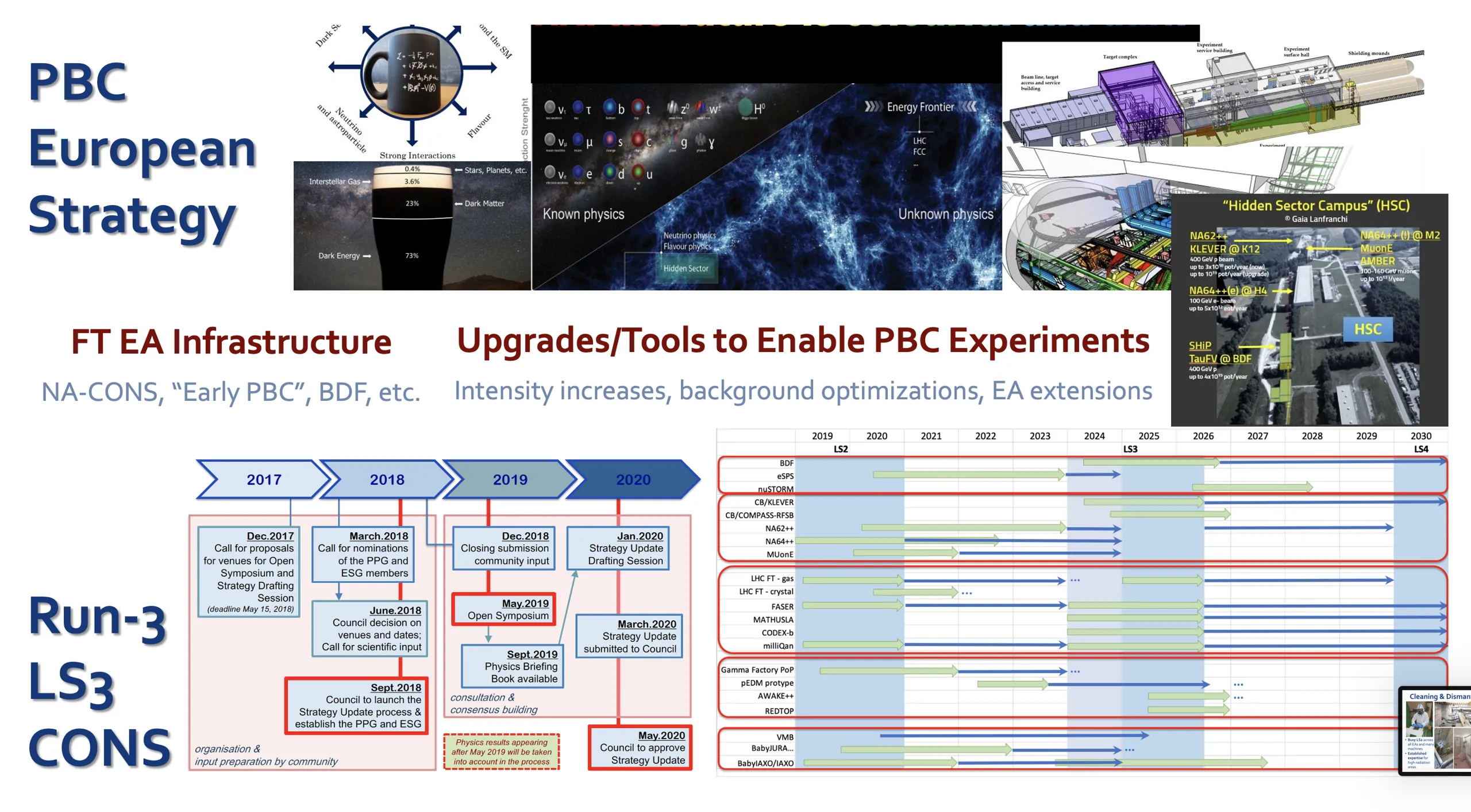
2020 was a special year for particle physics where after a preparation phase of almost four years the community refreshed the roadmap for the field in Europe, considering the worldwide context, in the so-called European Strategy for Particle Physics update, which happens every seven years. The main questions addressed are: What are the scientific priorities and future objectives of particle physics?; Which instruments offer the best potential to achieve these objectives?; and Which technologies need to be developed to build such instruments? This led to the main conclusions addressing first the full exploitation of the LHC physics potential and successful completion of high-luminosity upgrades in the timeframe of LS3 and LHC operation afterwards. Second, an electron, positron-based Higgs factory as the highest-priority next collider project to be prepared, as well as the investigation of the technical and financial feasibility of a future ≥ 100 TeV hadron collider at CERN, with the previously mentioned e+e- Higgs and electroweak factory as a possible first stage. The strategy furthermore promotes an increased R&D on accelerator technologies, such as high-field superconducting magnets, high-gradient accelerating structures, plasma wakefield, muon colliders or energy recovery Linacs and the continued support to long-baseline neutrino projects in US and Japan, and in particular the successful implementation of DUNE at LBNF. Very important for our group is the highlighted importance of continued support to high-impact scientific diversity programme complementary to high-energy colliders. This implies the Physics Beyond Collider Study to continue with the first experiments already in line for starting operation during Run-3. These decisions are well reflected in the updated CERN financial medium-term plan which has been approved by Council at the end of September and foresees an important budget increase for PBC related studies over the next 5 years. To quote our DG "PBC has a unique role in promoting and channelling new research initiatives at CERN and European national labs”. We are thus well set to push some existing options and back some of the incoming new ideas which will be discussed in the PBC workshop early next year. For the North Area, already the initial list of diversity related experiments considered is long (NA61++, high-intensity NA62, KLEVER, NA60++, feebly-interacting particle related proposals, AMBER, MUONS, NA64-μ and RF-separated beams), thus letting us look forward to a promising future of a CERN fixed target physics programme.
I mentioned previously in one of my preceding Advent entries the M2 beam line, now addressing four measurement programmes in competition for beam time and real estate, and where many of you contributed to a dedicated EHN2 sub-working group of the SPSC which has this year proposed an effective strategy in view of related technical and compatibility constraints preparing the Run-3 schedule. Finally, the BDF implementation study will be aiming for TDR readiness, possibly one day completing our North Area ‘Hidden Sector Campus’. Let us all be looking forward to a bright future for Particle Physics.