
Cabling, Connectors and Qualification

18 DECEMBER,2020 | By Markus Brugger
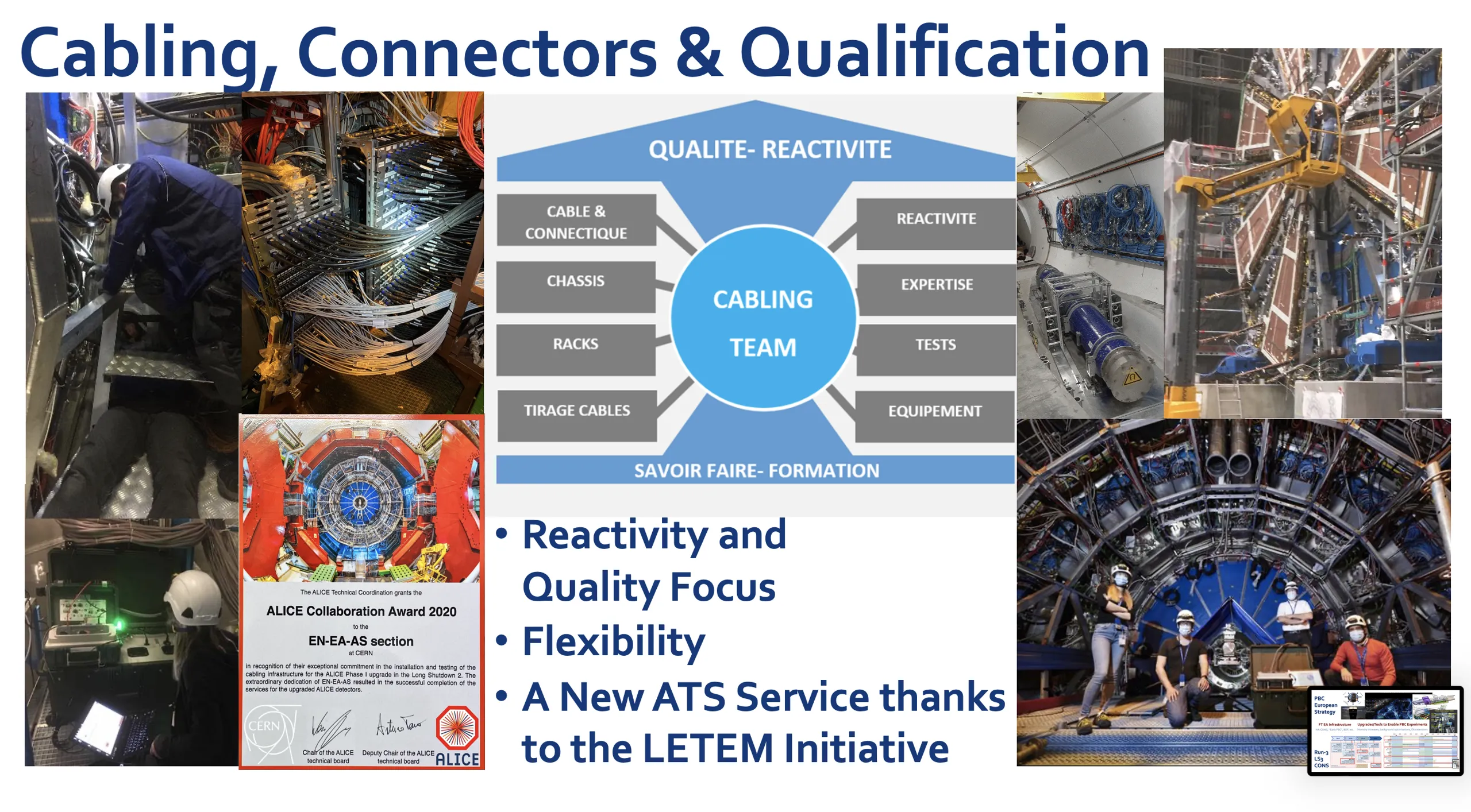
Preparing for today’s Advent entry, I first made a fast scan through my email box and this years’ entries related to our cabling support activities, initially looking for the most representative examples to share with you. Given the large variety of work and diversity of clients, let me first quickly begin with a respective list of activities: starting with the ALICE re-cabling activity where more than 10000 hours of work for cabling and connectors together with the required and developed qualification steps ranged from the ALICE ITS (Inner Tracking System), TPC (Time Projection Chamber), MFT (Muon Foward Tracker) and many other sub-detectors. Staying with ALICE, observed non-conformities of the Wiener Power Supplies required not only a reactive analysis, but also an effective mitigation proposal, currently implemented in our workshop. A relatively late, but high-priority request concerns your important work for the ATLAS NSW, then also complemented by the delicate ATLAS forward detector cabling routing and later installation. Furthermore, let me quickly also list the LHCb SHV cables, the support provided for SPS BA3, the Burndy cables for the LHC600A-10V power converters, your help for the LIU wire-scanner at LHC P4, or the EN/CV control and powering cubicles, as well as the ASACUSA support and the important work done for the FASER experiment mentioned in an earlier Advent entry. Demonstrated by this enormous diversity and most important the expertise developed over the past years, your strong commitment provides an incredible service to the experiments or equipment/service groups. Discussing with you, it is also this variety of tasks and close collaboration with our clients, allowing not only for finding the most effective solutions, but also taking pleasure and pride during the execution phase. Cables are omnipresent in all experiments, their various sub-detector parts and basically all CERN installations. During this second Long Shutdown, your achievements helped keeping the LS2 moving forward, and the excellent results demonstrated the efficiency of our cabling team in charge of both the installation and the testing of the cables and connectors. Furthermore, the team’s efficiency has been boosted by the of an automated cable testing system (HiPotCT) developed in collaboration with EN-SMM-MTA. Testing the cables in the experiments is crucial as the smallest error can take on unexpected proportions. Cables are normally replaced only as a last resort, after the breakdown of an installations as the replacement process is painstaking. Consequently, there is no room for error in the tests that are carried out before their installation. Done manually until recently, by measuring the leakage current between the many filaments of an individual cable subjected to a voltage of up to 5kV, a single cable test thus involved a hazardous two-hours long handwork for two people. This is around 80% more than the time it takes for a “HiPotCT” automated test. In the case of the ATLAS and ALICE cabling campaigns, this automation has significantly reduced the testing time, crucial for reaching 100% success in quality and representing also an important cost saving for our clients. Your commitment is the key to these multiple success stories, and what can measure it better than the feedback received by your many clients, most recently crowned by the ALICE Collaboration Award and the gained confidence of both LHC and Fixed-Target experiments considering the cabling team as referent when it comes to sensitive detector installations, challenging cabling environments, delicate rack assemblies and high-quality connector requirements. Congratulations and many thanks to everybody involved in this endeavour.